AI Transformation Strategy for Business Leaders
In October 2025, 4,000 technology executives gathered at Nationwide Insurance’s headquarters in Columbus, Ohio to confront a hard truth about AI transformation. The AI revolution has already arrived. Organizations that hesitate will struggle to compete in a market reshaped by machine intelligence, automation, and generative tools that improve every seven months.
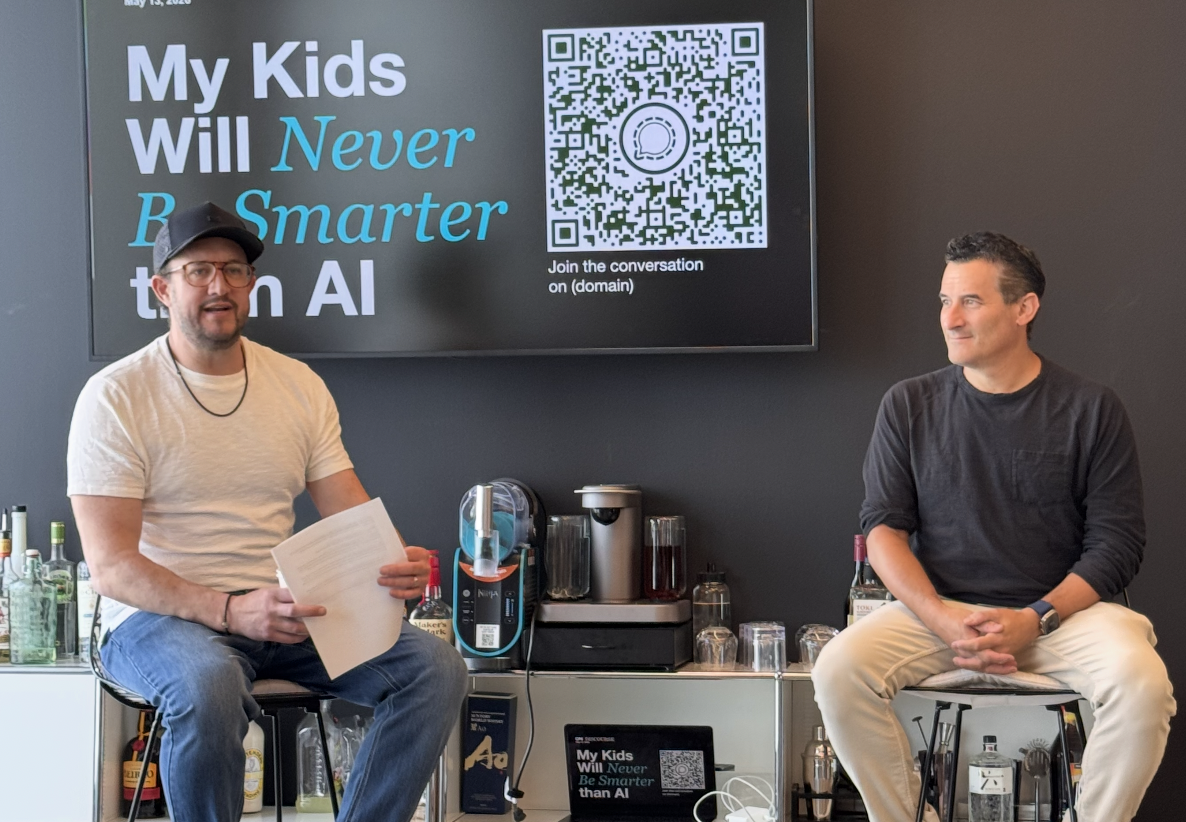
Matt Britton delivered that message with unusual credibility. As CEO of Suzy, a consumer intelligence platform with more than 300 employees, and author of Generation AI, Britton speaks at over 500 keynotes globally on consumer trends and innovation. He does not theorize about artificial intelligence from a distance. He builds with it.
The night before his speech, at 32,000 feet, he created a fully produced music video about Nationwide. Lyrics, soundtrack, animation, and a flying eagle pulled from the company’s logo — all assembled on a plane with consumer AI tools.
“I made that video on the plane last night. Think about what that means.”
It means the barriers to creation have collapsed. It means technical gatekeeping is dissolving. It means the advantage now goes to leaders who experiment first and institutionalize learning fast.
AI transformation is no longer a technology initiative owned by IT. It is a leadership mandate tied directly to growth, efficiency, and talent strategy.
Britton’s thesis is straightforward. Generational change, economic power shifts, and exponential compute growth are converging. Companies that build AI fluency at the executive level will define the next decade.
The conversation has moved beyond whether AI matters. The question is who will operationalize it first.
AI Transformation Strategy Starts With Gen Alpha
Gen Alpha will be the first AI-native generation, and their expectations will reshape markets. Born between 2010 and 2025, this cohort is growing up in homes filled with voice assistants, generative chatbots, and algorithmically curated media. They will never experience a world where technology cannot respond conversationally.
Britton has built his career decoding generational shifts. He began in 2000 studying Millennials, the first generation raised with household internet access. He then turned to Gen Z, shaped by smartphones and social media feeds in their pockets.
Now he focuses on Gen Alpha, children ages 0 to 14 who will mature alongside artificial intelligence.
For Gen Alpha, interacting with AI will feel natural. Conversational agents will function as tutors, companions, research assistants, and entertainment partners. The psychological barrier older generations feel toward machine relationships will not exist.
The economic implications are enormous. Over $30 trillion is expected to transfer from Baby Boomers to Gen Z and Gen Alpha in what economists call the Great Wealth Transfer. This capital shift will accelerate spending patterns that favor access, personalization, and immediacy.
Britton describes the transition from a scarcity mindset to a YOLO approach to capital allocation. Experiences over assets. Speed over patience.
Brands that design around AI-native expectations will capture disproportionate share. Think hyper-personalized insurance policies generated in seconds. Financial planning tools that speak like trusted advisors. Retail platforms that anticipate needs before search begins.
AI transformation strategy must begin with an understanding of who the next power consumers will be. Gen Alpha will not adapt to legacy systems. Systems will adapt to them.
How to Implement AI in Business: A Four-Step Framework
AI adoption succeeds when leaders start with a specific problem and build incrementally. Britton did not begin by unleashing AI across Suzy’s 300-person organization. He started with a personal challenge: longevity.
At age 50, with four children, he aggregated two decades of medical data — X-rays, MRIs, blood panels, and doctor notes stored across hard drives and file cabinets. He uploaded that information into a custom AI model and trained it with a singular mandate: act like a leading Johns Hopkins physician and optimize for survival.
His first prompt was direct: If I am likely to die within five years, what is the most probable cause?
Unlike a generic web search, the model analyzed his specific biomarkers across time. It identified patterns in bloodwork from 12 to 15 years earlier and flagged trends that warranted intervention. It offered targeted recommendations grounded in his personal data set.
The process reshaped his habits. Nutrition changed. Exercise intensified. Specialist visits became more strategic because the AI generated comprehensive dossiers before each appointment. His allergist now receives a structured summary annually.
From that experiment, Britton distilled a repeatable framework for AI transformation strategy:
- Identify a meaningful problem. Choose something that matters — health, customer churn, pricing optimization. Focus sharpens experimentation.
- Understand the data required. Inventory the inputs that drive better outcomes. Clean, structured data multiplies AI effectiveness.
- Build step by step. Use tools like ChatGPT or Claude to guide execution in stages. Complete step one before advancing. Iteration compounds skill.
- Practice in low-risk environments. Personal projects build confidence. Corporate rollouts require governance, but fluency starts at home.
Most organizations stall because they attempt enterprise-scale deployment before leadership develops hands-on familiarity. Competence grows through use. Confidence follows.
Why AI Transformation Is Different From Past Tech Cycles
AI adoption is accelerating because usability and compute power are compounding simultaneously. Previous technological revolutions required specialized training — coding, network engineering, hardware configuration. Artificial intelligence requires language.
If someone can compose a text message, they can prompt an AI model.
Britton created a home management bot for his 75-year-old mother. It stores appliance manuals, tracks streaming passwords, and answers household questions conversationally. No technical background required.
The rate of improvement adds urgency. AI capability roughly doubles every seven months according to industry estimates. A tool that feels adequate today can feel extraordinary within a year.
Streaming video in 2001 buffered endlessly. In 2025, 4K content loads instantly.
Underneath the interface sits an expanding infrastructure layer. Nvidia’s GPUs power massive data centers. Demand for compute is projected to increase 30 times by 2035.
In Northern Virginia, data centers already consume approximately 40 percent of regional electricity. A single ChatGPT query can require dozens of times more energy than a traditional search. That intensity is driving parallel investment in nuclear, geothermal, and advanced cooling systems.
On top of infrastructure sit large language models such as OpenAI’s GPT, Google’s Gemini, and Anthropic’s Claude. Above them are applications tailored for marketing, finance, healthcare, and education. At the highest layer are end users who translate capability into productivity.
Leaders must understand each layer at a conceptual level. Strategy depends on knowing where value accrues and where differentiation is possible.
AI and the Future of Work: From Knowledge to Creativity
The future of work will reward problem framing, creativity, and adaptability over memorized expertise. The knowledge economy prized retention and procedural mastery. Accountants memorized tax code. Lawyers internalized contract structures. Radiologists trained their eyes to read scans.
AI systems now draft contracts, prepare tax filings, and analyze medical images with increasing precision. The comparative advantage of humans shifts toward defining the right problem, applying judgment, and exercising ethical oversight.
The World Economic Forum’s Future of Jobs research consistently ranks analytical thinking, resilience, creativity, leadership, and lifelong learning among the most critical skills for the coming decade. These attributes align with an AI-augmented workforce where machines handle repetition and humans orchestrate direction.
Britton often uses photography to illustrate the transition. A decade ago, professional photographers mastered darkroom chemistry and complex DSLR settings. Today, the majority of images are captured on smartphones with computational photography embedded.
The differentiator is perspective. Where to point the camera. What story to tell.
History offers precedent. When Henry Ford scaled the Model T, approximately 38,000 horse-and-carriage businesses disappeared. Within ten years, 64 percent of new jobs created were tied to the automotive ecosystem.
AI transformation will produce similar churn. Roles will evolve. New categories will emerge around model governance, prompt architecture, AI ethics, and synthetic media production.
Companies that invest in reskilling unlock upside. Those that cling to static job descriptions risk attrition and obsolescence.
Britton emphasizes that leadership credibility now depends on visible experimentation. Executives who use AI personally signal permission culturally. Curiosity scales from the top.
The Global AI Race and Trust Gap
National competitiveness increasingly hinges on AI literacy and public trust. While many of the leading AI firms are American, trust levels vary dramatically across regions. Surveys have shown citizen trust in AI significantly higher in China than in the United States, where skepticism remains pronounced.
China has introduced mandatory AI education for children as young as six in parts of Beijing. Curriculum includes foundational coding, algorithmic thinking, and practical application. Early exposure normalizes usage and builds fluency.
The United States risks repeating a familiar pattern. In the early 2000s, some schools attempted to block internet access rather than integrate it thoughtfully. Students learned anyway, often without guidance.
Trust grows through transparency and education. Parents who experiment with AI tools alongside their children demystify the technology. Companies that communicate clearly about data governance reduce fear.
For business leaders, the implication is strategic. Talent pipelines will favor regions that embrace AI literacy. Consumer expectations will rise in markets where AI usage is normalized early.
An AI transformation strategy must account for geopolitical dynamics, not just internal efficiency. Britton frames it simply: future-proofing requires participation. Opting out carries competitive cost.
Key Takeaways for Business Leaders
- Start with a high-stakes problem. Select a challenge tied to revenue, health, or operational efficiency. Focused experimentation produces tangible ROI and accelerates organizational buy-in.
- Invest in data readiness. Audit, clean, and structure your most valuable datasets. AI performance scales with data quality, and governance builds trust internally and externally.
- Model AI usage at the executive level. Use generative tools personally and share lessons with your team. Cultural adoption follows visible leadership behavior.
- Reskill for creativity and analysis. Prioritize training in critical thinking, prompt design, and cross-functional problem solving. Encourage curiosity as a performance metric.
- Engage with the ecosystem. Monitor infrastructure trends, regulatory shifts, and global education policies. AI transformation strategy operates within a broader economic and geopolitical context.
Frequently Asked Questions
What is an effective AI transformation strategy for large organizations?
An effective AI transformation strategy begins with executive alignment around a specific business problem, followed by phased experimentation using clean internal data. Leaders should pilot in contained environments, measure ROI, and scale successful use cases across departments while implementing strong governance and security controls.
How will AI affect the future of work over the next decade?
AI will automate repetitive, knowledge-based tasks and elevate the importance of creativity, analytical thinking, and leadership. Roles will evolve rather than disappear entirely, with new positions emerging in AI oversight, data strategy, and human-machine collaboration.
Why does generational change matter in AI adoption?
Gen Alpha and Gen Z are growing up with conversational AI as a default interface. Their comfort with machine intelligence will influence purchasing behavior, workplace expectations, and brand loyalty, making AI integration essential for companies targeting long-term growth.
How can executives build AI skills without technical backgrounds?
Executives can build AI fluency by using consumer tools such as ChatGPT or Gemini for personal projects, structured learning, and daily productivity tasks. Hands-on experimentation develops intuition faster than theoretical study and prepares leaders to guide enterprise adoption.
The Imperative to Act
AI transformation strategy defines competitive advantage in the coming decade. The tools are accessible. The compute is scaling. The next generation expects intelligent systems by default.
Matt Britton continues to explore these shifts through his keynotes, his bestselling book Generation AI, and conversations on The Speed of Culture podcast. As CEO of Suzy, he works directly with brands translating consumer insight into action.
Organizations seeking a roadmap can explore Speaker HQ or contact his team to design tailored engagements.
The window for passive observation is closing. Leaders who build fluency now will shape markets. Those who hesitate will inherit decisions made by faster competitors.
Related Posts
The Great Brokerage Consolidation: Real Estate's Multi-Model Platform War

Netflix's Tentpole Playbook: Why Owning Sports Moments Beats Owning Full Seasons

When AI Becomes the Default Teacher: A Reckoning for Parents and Business Leaders