When the Adobe Experience Cloud team launched LLM Optimizer in mid-2025, it signaled something larger than another product release. It marked the moment a category-defining software company conceded that the discovery layer for brands had moved from Google to ChatGPT, Claude, Perplexity, and Gemini. For Fortune 500 CMOs, that admission carried weight. According to Bain & Company, 80% of consumers now rely on AI-written summaries for at least 40% of their searches. The front door to brand discovery has shifted, and the marketing operating model is being rebuilt around it.
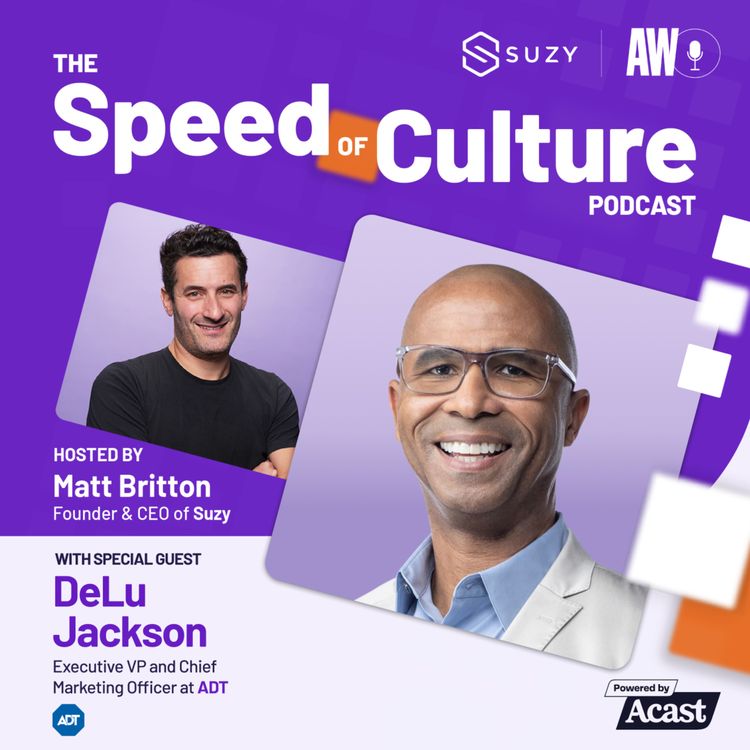
This was the backdrop for the conversation Matt Britton, founder and CEO of Suzy and bestselling author of Generation AI, recorded with Rachel Thornton, CMO of Adobe Enterprise, on the Speed of Culture podcast live from CES. Thornton runs marketing for the business that sells AI infrastructure to most of the Fortune 500, which gives her a vantage point on how enterprise marketers are actually deploying agents, what they are spending on, and where the genuine ROI sits. The conversation surfaced three structural shifts every CMO should be planning against in 2026: the rebuild of the data stack as the precondition for AI, the rise of agentic workflows inside the marketing function, and the migration of search budgets toward generative engine optimization.
The stakes are not theoretical. Gartner now predicts that by 2028, 60% of brands will use agentic AI to deliver streamlined one-to-one customer interactions, ending channel-based marketing as currently practiced. The brands repositioning now will own the next decade. The brands waiting will not.
Why Personalization at Scale Finally Becomes Possible in 2026
Marketers have been promising personalization at scale for two decades. Thornton was direct about why it has remained mostly aspirational: the data layer was never ready. Building a unified customer profile, applying it to a journey, and generating the content to match required armies of people, weeks of production cycles, and budgets that limited execution to high-value segments. Most marketing teams reverted to one-to-many because one-to-one was operationally impossible.
What changes in 2026 is that the entire production stack collapses. AI handles audience inference, content generation, localization, and journey orchestration as a single workflow rather than as discrete handoffs between teams. The Adobe Experience Platform is the data layer that feeds the model. GenStudio handles the content. Brand Concierge runs the conversational interface on the website. The customer experience that used to take ten to twelve weeks to assemble can now ship in one or two.
The data confirms the operational shift. Salesforce's State of Marketing 2026 found that 87% of marketers use generative AI in at least one workflow, up from 51% in 2024. McKinsey's Global AI Survey identifies content drafting at 3.2x ROI and personalization engines at 2.7x ROI as the two highest-return marketing applications. Median payback on AI tooling investment has compressed to 4.2 months, down from 7.8 months in 2024.
For CMOs, this is the moment to retire the phrase "personalization at scale" as a slide-deck aspiration and treat it as an executable program. Matt Britton has spent the past two years arguing in his AI keynotes that the brands winning Gen Alpha and Gen Z will be the ones who treat one-to-one as the baseline expectation rather than a premium feature. The technology has caught up to the rhetoric. The execution gap is now organizational, not technical.
The Data Stack Is Still the Differentiator
Thornton was careful to make a point that often gets lost in the agent conversation: every brand has access to the same foundation models. The differentiator is the proprietary data that gets layered on top. "Deploying AI solutions or AI products, it's only as good as the data you have," she noted. Without a clean customer profile, the AI cannot personalize. Without provenance on the data, the output cannot be trusted. Without owned data, the brand is renting capability that any competitor can rent equally.
This is why Adobe's investment in the Experience Platform precedes the investment in GenStudio. Customer Data Platforms, identity resolution, and consent infrastructure are now the precondition for AI ROI rather than parallel tracks. Companies that built robust first-party data foundations during the cookie deprecation cycle of 2023 to 2025 are in dramatically better position to execute AI personalization in 2026 than competitors who outsourced data to third parties.
The implication for the C-suite is straightforward. AI budgets without corresponding data infrastructure budgets will underperform. The proof point lives in the personalization ROI variance: enterprises with mature CDPs are seeing 2.7x return on personalization engines, while teams running AI on top of fragmented data stacks are seeing closer to 1.1x to 1.6x. The technology is identical. The data foundation is not.
For consumer-facing enterprises, this also redefines the role of the consumer intelligence function. Real-time first-party signal, not annual brand tracking, is what trains the personalization model. The consumer intelligence platform Suzy, which Matt Britton founded in 2018, was built on precisely this thesis: the brands that capture and act on consumer signal at the speed of the market will define the category. Eight years later, the AI stack has made that thesis non-negotiable.
How Agentic Workflows Are Rewiring the Marketing Function
The most consequential part of the conversation was Thornton's description of how her own team uses agents day to day. The Audience Agent recommends new audience targets based on prior campaign performance, including segments the marketer would not have manually identified. The Insights Agent surfaces campaign learnings without the marketer filing a ticket to a separate analytics team. The output of one agent feeds into GenStudio, which generates the assets, which then deploy across channels with localization handled at machine speed.
This is the operational pattern enterprise marketers should be planning against. The Gartner Q1 2026 data shows that 80% of enterprise applications shipped or updated in the quarter embed at least one AI agent, up from 33% in 2024. 34% of enterprise marketing teams now run at least one autonomous agent in production, more than double the 14% reported in Q4 2024. The pilot phase is closed.
What changes for the org chart is harder than what changes for the tech stack. Junior copywriting headcount fell at 23% of agencies in 2025, with 31% planning further reductions in 2026 per Gartner CMO Spend Survey. Demand for senior strategists, AI orchestrators, and prompt engineers is climbing in parallel. The marketing team of 2027 will be smaller, more senior, and structured around agent supervision rather than task execution. The leaders who survive this transition will be the ones who reorganize before they have to, not after a quarterly miss forces it.
Britton's argument across his recent AI keynote presentations has been that the agentic shift creates two classes of marketing professionals. The first class designs systems, sets guardrails, and directs agents toward outcomes. The second class waits to be told what to produce. The first class compounds in value. The second class is on the wrong side of automation curves that are accelerating faster than any prior enterprise software adoption cycle, including cloud.
The SEO-to-GEO Migration Is a Budget Reallocation, Not a Pilot
The single most actionable disclosure in the conversation was the existence and scope of Adobe LLM Optimizer. Adobe has been candid about the magnitude of the shift it is built to address: the platform itself cites projected decreases in brands' organic search traffic of up to 50% by 2028 as consumers migrate to generative AI-powered search. The acquisition of Semrush by Adobe earlier this year was driven by the same thesis. The SEO category is being absorbed into the AEO category, and the budget is moving with it.
Generative Engine Optimization, also called Answer Engine Optimization, is the discipline of ensuring a brand is visible, accurately represented, and favorably cited inside AI-generated answers across ChatGPT, Claude, Perplexity, Gemini, and Copilot. Unlike SEO, which optimizes for ranked link placement, AEO optimizes for citation inside synthesized responses. The mechanics are different. FAQ structure, schema markup, third-party authority signals on Reddit and Wikipedia, and content freshness all weigh more heavily for AI engines than for traditional search.
This is the category Matt Britton has been calling AEO for the past 18 months across keynotes and his work building the AEO Tracker at FutureProof. The thesis is that every Fortune 500 brand will need an AEO budget, an AEO scorecard, and AEO ownership inside the marketing function by end of 2026, or it will lose top-of-funnel discovery to competitors who built the muscle first. The enterprise platforms have now caught up: Adobe LLM Optimizer reached general availability in October 2025, joining Scrunch, Profound, AthenaHQ, Bluefish, and Semrush AI Visibility Toolkit as production-grade tools.
The CMO question is no longer whether to fund AEO. It is which platform, what prompt volume to license, and which internal team owns the scorecard. Brand presence, citation frequency, sentiment, and position inside AI-generated answers are the new KPIs. The teams that operationalize AEO ownership in Q2 2026 will have a two-year head start on competitors who delay another planning cycle.
What Adobe's Work With Sports Leagues Reveals About Co-Creation
Thornton spent a meaningful part of the conversation on Adobe's partnerships with the NFL, MLB, Premier League, and Real Madrid. The framing is instructive beyond the sports category. The thesis is that fan engagement is no longer about delivering content to fans but about giving fans the tools to co-create content that stays inside brand guardrails. Adobe's work on Project Fission with Coca-Cola made the same point on the brand side: AI brand guidelines built into the creative tools allow distributed teams worldwide to produce on-brand content without central approval bottlenecks.
This is the operational answer to a problem CMOs have struggled with for fifteen years. User-generated content is the highest-converting marketing asset class in most categories, but most brands have resisted scaling UGC because the brand risk was unmanageable. AI-enforced brand guidelines change the math. Brand managers can release the production process to associates, fans, creators, and partners while preserving brand integrity by design rather than by review.
For the consumer-facing enterprise, this is a strategic unlock. The brands that build AI-enforced creative systems in 2026 will be able to scale local relevance, cultural moments, and audience-specific creative at a velocity that centralized creative teams cannot match. The brands that hold the centralized model will lose share to faster competitors. This pattern has already played out in retail with associate-driven content programs and in CPG with creator-led activation. AI is what makes it work at Fortune 500 scale.
Key Takeaways for Business Leaders
#Action1Audit the data stack before approving incremental AI tooling spend. Personalization ROI variance is 2.5x driven by data infrastructure maturity.2Name an executive owner for Generative Engine Optimization in Q2 2026 and license an enterprise AEO platform before competitors establish citation share.3Move marketing org design from production-heavy to agent-supervision-heavy. Plan for 20-30% fewer junior production roles and 15-20% more senior orchestration roles by 2027.4Treat AI brand guidelines as creative infrastructure. Build the guardrails that allow distributed teams, partners, and consumers to co-create at scale without brand risk.5Reframe campaign cycles around continuous experimentation. The two-week build replaces the twelve-week build, and the team that runs the most experiments wins the personalization race.
Frequently Asked Questions
What is Generative Engine Optimization and why does it matter for enterprise brands?
Generative Engine Optimization, also called Answer Engine Optimization, is the practice of optimizing brand content for citation inside AI-generated answers across ChatGPT, Claude, Perplexity, Gemini, and other LLM-powered platforms. It matters because consumer discovery is migrating from traditional search to generative engines. Bain & Company reports 80% of consumers rely on AI summaries for at least 40% of searches, and Adobe projects up to 50% declines in organic search traffic by 2028.
How are AI agents changing the marketing function in 2026?
AI agents are absorbing tasks that previously required cross-functional handoffs, including audience targeting, insights generation, content production, and campaign optimization. Gartner data shows 80% of enterprise applications now embed at least one agent, and 34% of marketing teams run autonomous agents in production. The operational shift compresses campaign cycles from twelve weeks to one or two, while reshaping org design toward fewer junior production roles and more senior orchestration roles.
What is the role of first-party data in AI-powered personalization?
First-party data is the differentiator that determines whether AI-powered personalization delivers measurable ROI. Foundation models are commoditized and available to every competitor, so the proprietary advantage sits in the customer data layer. Enterprises with mature customer data platforms are achieving 2.7x ROI on personalization engines, while companies running AI on fragmented data are seeing materially lower returns. Data infrastructure must precede AI tooling investment.
How should CMOs prepare for the shift from channel-based to agentic marketing?
Gartner predicts 60% of brands will use agentic AI for one-to-one interactions by 2028, ending channel-based marketing. CMOs should put strong data governance in place now, integrate agentic systems into the martech stack, track customer journey changes weekly, and reorganize the marketing function around agent supervision rather than task execution. The brands that act in 2026 will define the playbook for the next decade.
The Window Is Narrowing
The Speed of Culture conversation with Rachel Thornton captured a moment when enterprise AI moves from strategy deck to operating system. Adobe, Salesforce, and the rest of the martech tier are no longer selling AI as a feature. They are selling it as the new substrate on which marketing runs. The CMOs who internalize that shift in Q2 2026 will be the ones presenting transformation stories at next year's annual meeting. The CMOs who treat it as a parallel workstream alongside business as usual will be explaining why share moved to faster competitors.
Matt Britton's work across keynotes for Fortune 500 audiences, the bestselling book Generation AI, and his ongoing build at the AEO Tracker is anchored on a single forward view. The brands that win the next consumer cycle are the ones treating AI not as a tool to add to the existing operating model but as the operating model itself. The data on agent adoption, GEO migration, and personalization ROI all point to the same conclusion. The window for establishing advantage is narrowing.
To bring these insights to your next leadership offsite, board meeting, or industry conference, explore Matt Britton's speaking platform or connect with his team directly.
.jpeg)

%20(400%20x%20100%20px)%20(300%20x%2050%20px)%20(150%20x%2050%20px).avif)