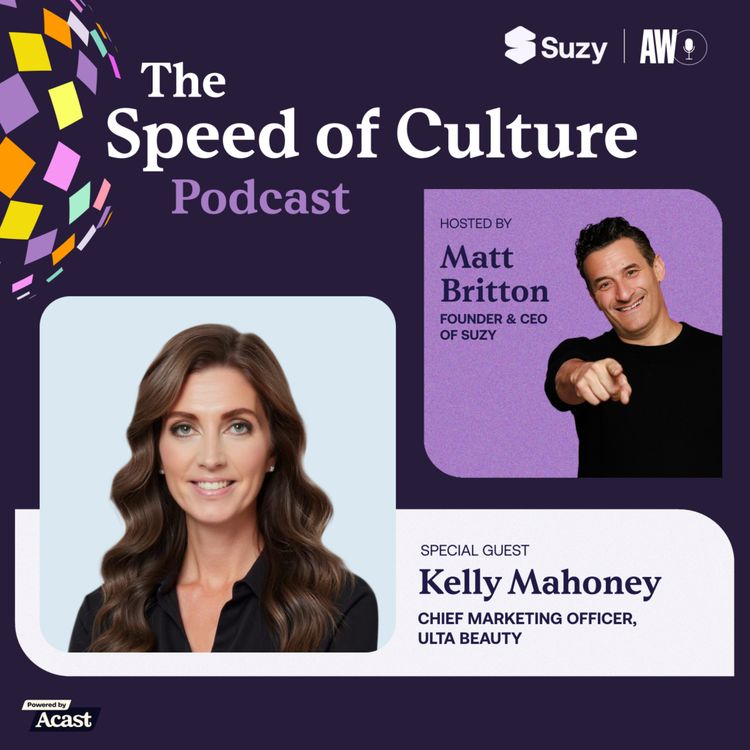
Opening: Building Brands Through Consumer Intelligence
In Episode 124 of The Speed of Culture Podcast, host Matt Britton, founder and CEO of Suzy, the AI-powered consumer intelligence platform, sits down with Isabelle Sakai, Global Chief Marketing Officer at Mark Anthony Brands International, to explore how strategic brand leadership drives market disruption. Recorded on August 6, 2024, this conversation uncovers the philosophy behind White Claw's sustained dominance in the hard seltzer category and how consumer-centric innovation reshapes beverage marketing in an era of shifting drinking habits.
Isabelle Sakai brings two decades of marketing expertise from industry titans Procter & Gamble and Mondelēz International to her role at Mark Anthony Brands, where she oversees a portfolio including White Claw, Cayman Jack, and emerging non-alcoholic options. Rather than relying on conventional marketing wisdom, Sakai emphasizes listening—truly listening—to what consumers want before they know they want it.
Her approach reveals a fundamental truth about modern marketing: the brands that win are those that understand the deeper human needs underlying purchase decisions. White Claw didn't just create a beverage; it created a category by recognizing that consumers craved "a lighter, more flavorful, gluten-free alternative to beer" long before the hard seltzer boom.
The conversation spans from Sakai's international experience—working across markets in Zurich, Dublin, and North America—to the tactical execution of campaigns like "Grab Life By The Claw", which directly confronts the modern paradox of digital connectivity breeding isolation. It also touches on the strategic imperative driving the launch of White Claw 0% Alcohol, addressing the demographic seismic shift toward reduced alcohol consumption, particularly among Gen Z and millennial consumers.
For marketing executives, brand strategists, and anyone interested in how consumer insights shape corporate strategy, this episode offers a masterclass in balancing global perspective with local execution, innovation with brand consistency, and commercial success with cultural relevance.
The Consumer Insight That Started Everything: From Niche to Category Leader
White Claw's origin story begins not with a desire to create a trendy beverage, but with a fundamental consumer insight: millions of people wanted an alternative to traditional beer that was lighter, more refreshing, and better suited to changing dietary preferences.
"We identified an unmet market need," Sakai explains.
That insight, backed by rigorous market research, became the north star for product development and brand positioning.
The hard seltzer category has exploded dramatically since White Claw's early dominance. The global hard seltzer market reached an estimated USD 18.97 billion in 2023 and is projected to grow to USD 60.16 billion by 2030, representing a compound annual growth rate of 8.5%. In the United States alone, the market is expanding at an even faster rate of 13.6% annually through 2030.
This growth trajectory reflects not just commercial success, but cultural adoption. According to CivicScience data cited by industry analysts, 46% of U.S. adults aged 21 and older have tried hard seltzer—a seven-point increase since 2020. Among younger demographics, adoption rates run even higher: 55% of Gen Z adults aged 21-24 report having tried hard seltzer, with another 23% planning to.
What distinguishes White Claw's approach from competitors is the methodical way Sakai and her team have doubled down on consumer understanding as a competitive advantage. Rather than resting on early market leadership, the brand conducts ongoing research to understand how consumer preferences evolve, particularly around health consciousness and lifestyle choices.
Health-conscious consumers, Sakai notes, are increasingly seeking lower-calorie, lower-sugar alternatives to traditional alcoholic beverages. This insight directly informed not just the initial hard seltzer formula, but subsequent innovations like White Claw 0% Alcohol, introduced in the U.S. market in January 2024, and regional flavor expansions tailored to local tastes.
The strategic lesson here extends beyond beverages. Sakai emphasizes that the most successful brands don't simply respond to trends—they anticipate them by staying deeply connected to consumer needs, values, and aspirations.
Global Perspective, Local Execution: How International Experience Shapes Brand Strategy
Isabelle Sakai's career path reflects a deliberate strategy of building global perspective before taking on leadership roles at major brands. Her tenure at P&G and Mondelēz was punctuated by international assignments—living in Zurich, working across Dublin offices, and traveling frequently between Canadian headquarters and regional markets.
"Working in different markets broadens your perspective. It makes you more adaptable, more dynamic in how you think about strategy."
This philosophy directly influences how Mark Anthony Brands approaches campaigns like "Grab Life By The Claw." While the campaign's core message—social connection and meaningful experiences—resonates globally, the execution varies significantly by market.
In the United States, the campaign launched with broadcast advertising and digital touchpoints emphasizing post-pandemic reconnection. However, White Claw's European markets received tailored approaches. In the UK and Germany, for instance, the brand introduced region-specific flavor portfolios, including White Claw Botanicals with juniper, sage, and hibiscus—positioning the brand as sophisticated and gin-inspired rather than purely recreational.
In June 2024, the UK market received summer-specific flavors (Pineapple and Passion Fruit), reflecting local preferences for tropical taste profiles during peak season.
This balance between global consistency and local relevance represents a fundamental evolution in brand strategy. Sakai's model prioritizes flexibility and collaboration, enabling regional teams to adapt global platforms to local contexts while maintaining the core brand promise.
The strategic implication is significant for multinational brands navigating an increasingly fragmented media landscape. Sakai's approach suggests that the most effective global brands combine clear central strategy with empowered regional execution—what organizational theorists call "glocalization."
"Grab Life By The Claw": Addressing Modern Isolation Through Strategic Experiential Marketing
In April 2024, White Claw launched its most ambitious global campaign: "Grab Life By The Claw." The creative concept confronts a paradox that defines modern consumer behavior—despite unprecedented connectivity through digital channels, many people, particularly younger demographics, experience profound loneliness and isolation.
"People feel really isolated," Sakai reflects.
The campaign positions White Claw not merely as a beverage, but as a social facilitator—a catalyst for genuine human connection.
The broadcast advertising component depicted a 30-second scenario showing how a case of White Claw brings together a diverse group of friends from different walks of life, emphasizing the emotional reward of reconnection.
White Claw invested significantly in experiential marketing—real-world brand activations that translate the "social connection" message into immersive experiences. The brand created "Shore Club" installations at major cultural events including SXSW (South by Southwest), Sundance Film Festival, and the Kentucky Derby.
These activations combined comfortable lounges, live music performances, branded merchandise, and interactive experiences, creating memorable moments that reinforced the brand message while generating social media content and word-of-mouth momentum.
This integrated approach reflects a broader shift in how CMOs allocate marketing budgets. Rather than treating channels as separate silos, Sakai orchestrates them as an interconnected ecosystem, ensuring each touchpoint reinforces the same emotional promise.
Innovation as Strategy: From White Claw 0% to Tequila Smash and Beyond
Perhaps the most revealing insight from Sakai's conversation with Britton concerns how innovation strategy shapes portfolio management. While many beverage companies respond to trends reactively, Mark Anthony Brands proactively identifies emerging consumer behaviors and develops products that satisfy them.
White Claw 0% Alcohol, introduced in January 2024, exemplifies this forward-thinking approach. Rather than dismissing the "sober curious" trend as niche or temporary, Sakai recognized significant demographic data: 70% of alcohol drinkers and a remarkable 80% of Gen Z and millennial consumers actively seek moderation in their alcohol consumption.
Equally strategic is the launch of White Claw Tequila Smash, a spirits-based ready-to-drink (RTD) offering that capitalizes on the explosive growth of tequila as the No. 1 cocktail trend in the United States. Similarly, the fast-growing Cayman Jack margarita line positions White Claw's parent company to dominate the high-growth RTD cocktail segment.
Under Sakai's leadership, Mark Anthony Brands has adopted what might be called "occasion-based portfolio strategy." Rather than thinking in terms of product categories, the company thinks in terms of consumer occasions and needs.
This agility is critical in beverage markets where consumer preferences evolve rapidly, particularly among younger demographics who drive category innovation.
Data-Driven Marketing and the Role of Consumer Intelligence Platforms
Throughout the conversation, Sakai references data—consumer insights, market research, demographic trends—as the foundation for strategic decisions. This reliance on consumer intelligence reflects a broader transformation in how leading brands approach marketing.
The partnership between Suzy and The Speed of Culture Podcast is itself instructive. Suzy, described as an AI-powered consumer intelligence platform, uses machine learning and behavioral data to help brands understand what consumers actually think, want, and will do.
For White Claw and Mark Anthony Brands, access to quality consumer data enables the company to identify opportunities like the hard seltzer category, anticipate demographic shifts toward moderation, and execute campaigns grounded in genuine consumer needs.
Key Takeaways
- Consumer Insight Drives Category Leadership: White Claw's dominant market position stems from identifying unmet consumer needs before competitors, demonstrating that deep consumer understanding creates sustainable competitive advantage.
- Global Perspective Enables Strategic Agility: Isabelle Sakai's international experience informed an organizational approach that balances global consistency with local execution.
- Experiential Marketing Creates Authentic Connection: The "Grab Life By The Claw" campaign addresses genuine consumer emotions and translates them into immersive brand experiences.
- Innovation Strategy Reflects Portfolio Diversification: Product launches including White Claw 0%, White Claw Tequila Smash, and Cayman Jack demonstrate occasion-based portfolio strategy.
- Data-Driven Decision-Making Powers Modern CMO Leadership: Successful brand strategy increasingly relies on consumer intelligence platforms and quantitative insights rather than intuition.
FAQ: Consumer Marketing Strategy and Brand Innovation
What makes White Claw's approach to consumer insight different from competitors?
White Claw's competitive advantage stems from treating consumer insight as an ongoing process rather than a one-time research project. Under Isabelle Sakai's leadership, this consumer-centricity extends throughout the organization, enabling faster response to market opportunities while maintaining brand consistency.
How does experiential marketing like Shore Club activations drive brand loyalty compared to traditional advertising?
Experiential marketing creates memorable moments that consumers actively participate in creating and sharing. Because the experience itself is the content, it generates user-generated media that reaches friends and social networks, creating social proof and authentic advocacy that paid advertising cannot replicate.
Why did Mark Anthony Brands develop White Claw 0% Alcohol when core sales are driven by alcoholic beverages?
The launch of White Claw 0% reflects recognition that 70% of alcohol drinkers and 80% of Gen Z and millennial consumers actively seek moderation. The strategic logic is that a non-alcoholic White Claw user is more likely to purchase alcoholic White Claw products in appropriate contexts than a consumer who never encounters the brand.
How does occasion-based portfolio strategy differ from category-based portfolio management?
Category-based thinking groups products by type, while occasion-based thinking organizes products around consumer moments and needs. This enables the company to think about the beverage for every moment in the consumer journey rather than defending a specific product category.
Looking Ahead: Consumer Intelligence in Modern Marketing
The conversation between Matt Britton and Isabelle Sakai reveals that successful brand strategy in 2024 and beyond depends on the ability to combine data-driven insight with human understanding of emotional needs.
While AI-powered consumer intelligence platforms like Suzy provide the data infrastructure for modern marketing, great leaders like Sakai translate that data into strategy that speaks to genuine human desires.
- The Speed of Culture Podcast features conversations with leading CMOs and brand innovators.
- Generation AI by Matt Britton explores how AI technologies are reshaping marketing and business strategy.
- AI Keynote Speaker services offer deep-dive explorations into how consumer behavior is changing.
- Speaker HQ provides resources for marketing leaders seeking expertise on consumer strategy and brand innovation.

%20(400%20x%20100%20px)%20(300%20x%2050%20px)%20(150%20x%2050%20px).avif)

.jpeg)


.jpeg)
.jpeg)