Opening: The Automation Revolution Is Here
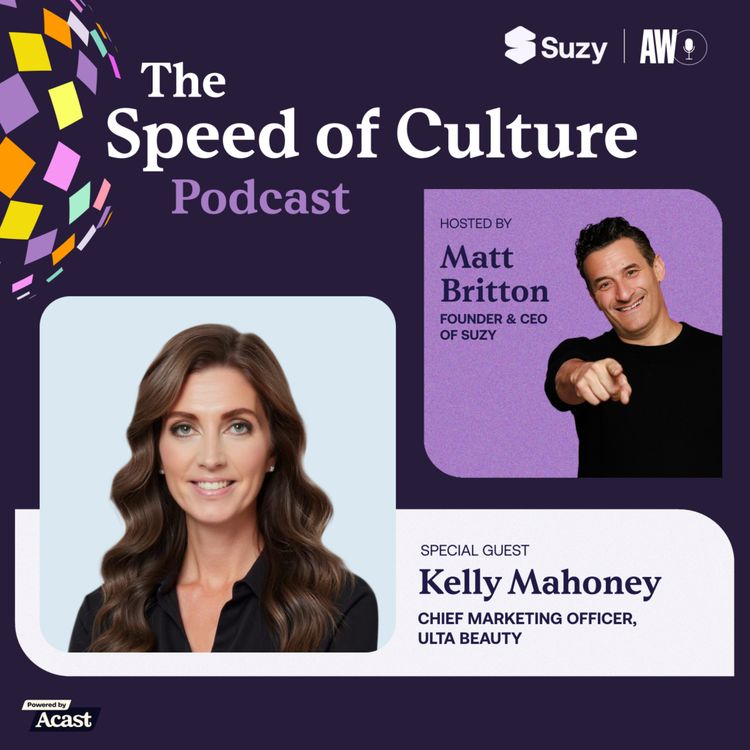
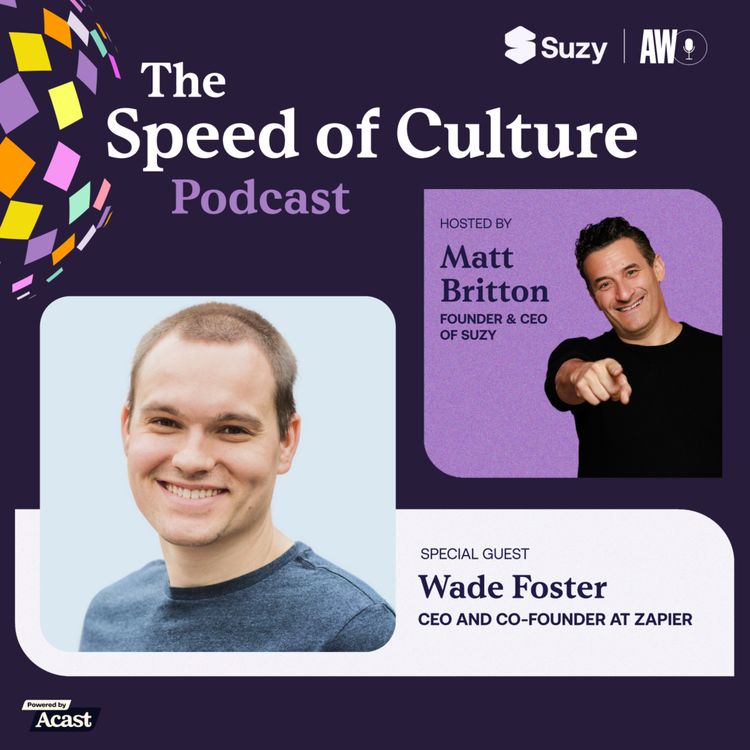
The future of work isn't about coding. It's about thinking. In episode 184 of The Speed of Culture Podcast, host Matt Britton, founder and CEO of Suzy, the AI-powered consumer intelligence platform, sits down with Wade Foster, CEO and Co-Founder of Zapier, to explore how no-code automation and artificial intelligence are fundamentally transforming how businesses operate.
What was once the exclusive domain of engineers and developers has become accessible to any team member willing to think strategically about process improvement.
Wade Foster's journey to building the world's leading automation platform offers valuable lessons for executives navigating the AI era. When Foster founded Zapier in 2011, the no-code movement didn't exist. Today, Zapier connects over 2 million users across the globe and has achieved a $5 billion valuation—all while maintaining a bootstrap-first philosophy that challenges Silicon Valley's growth-at-all-costs mentality.
The timing of this conversation is critical. As organizations increasingly recognize that artificial intelligence is not a future technology but a present reality, the question shifts from “How do we implement AI?” to “How do we democratize AI-driven automation across our organization?” Foster's insights reveal that the answer lies in collapsing the distance between ideas and execution.
This episode tackles the essential tension of our moment: AI is accelerating change at an unprecedented pace, yet the human skills of strategic thinking, creative problem-solving, and process optimization remain irreplaceable. Listeners will discover why hiring for AI fluency has become a strategic priority, how SEO-driven content can fuel sustainable growth, and why the best products blur the line between product and marketing.
For executives, product leaders, marketing strategists, and anyone responsible for digital transformation, this conversation illuminates a path forward: embrace no-code automation, invest in AI literacy across your organization, and empower your teams to experiment rapidly. The cost of standing still has never been higher.
The Evolution of Automation: From Rules to Intelligence
Zapier's foundational philosophy emerged from a moment of pure frustration. Wade Foster watched Andrew Warner struggle with repetitive data entry tasks. A simple solution—connecting a web form to an email list using basic automation logic—sparked a revelation: what if anyone could automate these processes without writing code?
In Zapier's early years, automation meant building “if-this-then-that” workflows. If a customer completes a form, then create a row in a spreadsheet. If an email arrives with certain keywords, then send a notification.
This rule-based approach proved transformative but limited. Complex scenarios involving unstructured data, PDFs with varying formats, or decisions requiring contextual reasoning remained beyond reach.
Artificial intelligence has shattered those limitations. Today's automation platform must handle complexity that would have required expensive engineering teams just five years ago. Zapier's AI capabilities now enable workflows that interpret messy documents, make nuanced decisions, and even delegate entire tasks to autonomous agents.
The shift from mechanical automation to intelligent automation represents a fundamental reimagining of what business process improvement can achieve.
This evolution matters strategically because it redefines competitive advantage. In a world where companies compete on execution speed, organizations that can rapidly prototype, test, and deploy new workflows gain measurable advantages.
Foster emphasizes that this isn't about replacing human judgment—it's about multiplying the impact of strategic thinking. A single team member wielding no-code automation and AI agents can accomplish what previously required three times the headcount.
The implications extend beyond efficiency metrics. Sales teams shift from administrative tasks to relationship building. Customer success representatives focus on strategic account management rather than manual data entry. Finance departments move from report compilation to strategic analysis.
The net effect is organizational leverage—the same team produces significantly more value.
Democratizing Technology: Breaking Down Barriers to Innovation
Wade Foster's approach to building Zapier fundamentally challenged venture capital orthodoxy. Rather than pursue aggressive scaling with massive funding rounds, Zapier bootstrapped its growth. This counterintuitive strategy forced the company to think differently about sustainable competitive advantage.
One insight stands out: the best product and the best marketing cannot be distinguished. Zapier's legendary distribution strategy—creating hyper-specific landing pages for niche integrations—wasn't a marketing tactic bolted onto a finished product. Instead, it was integral to the product experience.
When a user searched for “connect Typeform to Google Sheets,” they discovered a Zapier page optimized precisely for that query. The solution appeared when and where customers needed it.
This approach has profound implications for how organizations should think about customer acquisition and product development. Traditional SaaS companies build comprehensive products, then hire marketing teams to explain their value. Zapier inverted this model by building its go-to-market strategy into its core DNA.
The product itself became the marketing message—visible, valuable, and immediately applicable to specific business problems.
The democratization extends beyond distribution. Zapier has systematically removed barriers preventing non-technical users from automating their work. Today, a team member with zero coding experience can build sophisticated automation in minutes.
This democratization carries strategic weight because it shifts innovation from a centralized technology function to a distributed capability across the organization. The best ideas often surface from the people closest to the work, not from a central technology team.
For executives, the lesson is clear: accessibility itself becomes a competitive advantage. Companies that empower their teams with no-code tools and AI capabilities don't just improve efficiency—they unlock distributed innovation that centralized teams would never conceive.
AI Fluency as the New Competitive Priority
In 2025, Wade Foster announced a dramatic shift in Zapier's hiring strategy: 100% of new employees must demonstrate fluency with AI tools. This wasn't an offhand comment—it represents a calculated strategic decision that other organizations should understand deeply.
The rationale is straightforward but profound. AI is no longer an emerging technology that can be isolated to a dedicated team. Instead, it has become the operating system of knowledge work.
Just as computer literacy became a baseline expectation across organizations in the 1990s, AI literacy is becoming non-negotiable across functions and experience levels.
But Foster's strategy goes deeper than merely requiring tool familiarity. Hiring for AI fluency signals a commitment to a specific organizational culture: one that embraces experimentation, values continuous learning, and maintains intellectual agility.
The implications for talent acquisition are significant. Hiring for AI fluency emphasizes adaptability and curiosity—traits that carry across multiple roles, industries, and technology platforms.
For organizations building their own AI literacy initiatives, Foster's approach offers a template:
- Pilot AI adoption with early adopters in key functions.
- Support experimentation and celebrate both successes and productive failures.
- Build communities of practice where teams share what they're learning.
- Make AI competency part of performance evaluation and career progression.
- Demonstrate from leadership that AI fluency matters by visibly using these tools.
AI Agents: The Next Frontier of Automation
Beyond automating discrete tasks, Zapier is pioneering AI agents—autonomous systems that can delegate entire workflows and make complex decisions with minimal human oversight.
An AI agent differs fundamentally from traditional automation. Where a conventional workflow executes predetermined steps, an agent observes a broader context, evaluates options, makes decisions, and acts independently.
The implications for workforce productivity are substantial. These systems can handle email responses, manage calendar scheduling, process expense reports, and even conduct preliminary research for business decisions.
From a business strategy perspective, AI agents amplify organizational capacity more effectively than traditional automation. A 50-person team augmented with AI agents operating in customer service, operations, and sales functions can deliver output equivalent to a 70-person team, with the marginal cost of computation rather than human salary.
However, delegation to AI agents requires clear thinking about risk tolerance and acceptable error rates. Organizations implementing AI agents must establish appropriate human oversight mechanisms, audit trails, and fallback procedures.
Rather than eliminating jobs, AI agents shift the nature of work. The work becomes more engaging, requires stronger critical thinking, and typically commands higher compensation.
Building for Culture: How Great Products Become Movements
One of Foster's most elegant insights concerns how the best products blur the boundary between product and marketing. Zapier succeeded not because of superior sales teams or massive advertising budgets, but because the product itself communicated value to customers at the moment they needed it.
The best product and the best marketing cannot be distinguished.
In an era of AI-driven platforms and intense competition, this approach carries special relevance. Organizations building their own AI initiatives should ask not “How do we market this?” but rather “Can we build the product such that its value is obvious at the moment of need?”
This requires cultural changes—metrics must align, incentives must reward actual customer value rather than feature complexity, and leadership must resist the urge to pursue feature bloat in service of compelling marketing stories.
Intentional Growth Over Growth at All Costs
Zapier's trajectory challenges a dominant narrative in Silicon Valley: venture-backed companies must grow aggressively or die. By bootstrapping to a $5 billion valuation, Zapier proved that intentional, sustainable growth creates better outcomes for all stakeholders.
Rather than hiring in anticipation of expected growth, Zapier hired deliberately when concrete needs emerged. This kept the company lean while maximizing output per employee.
The company maintained cultural coherence as it scaled because team size remained manageable while revenue grew.
Zapier's success suggests that in fast-moving technology markets, sustainable competitive advantage comes from maintaining quality, responding to customers, and making thoughtful decisions about where to invest resources.
Key Takeaways
- AI Fluency Is Not Optional: Organizations hiring AI-fluent teams signal that AI competency is foundational to competitive advantage across all functions.
- Automation Amplifies Human Judgment: AI agents handle routine decisions within guardrails while humans focus on complex judgment and strategic decisions.
- Accessibility Drives Competitive Advantage: When anyone can automate workflows, unexpected efficiencies emerge across the organization.
- Product and Marketing Are Inseparable: Build customer acquisition strategy into product design from inception.
- Sustainable Growth Outperforms Aggressive Scaling: Intentional hiring and disciplined expansion produce better long-term outcomes.
Frequently Asked Questions
How Can Organizations Begin Implementing AI-Driven Automation?
Start with a clear assessment of repetitive, high-volume workflows where automation would free team members for higher-value work. Identify pain points that consume disproportionate time without requiring complex judgment. Begin with a pilot group in a single department and invest in training.
Measure success based on time freed for higher-value work and team engagement rather than simply cost reduction. As pilots succeed, expand to other departments while building institutional knowledge.
What Skills Will Remain Valuable as AI Agents Become More Capable?
Human agency, strategic thinking, and independent judgment become more valuable as AI agents handle routine decisions. The ability to identify problems worth solving, design solutions, evaluate trade-offs, and make decisions in ambiguous situations remains distinctly human.
Skills that complement automation—project management, team coordination, stakeholder communication, and change management—grow increasingly important.
How Should Organizations Address Employee Concerns About Automation and Job Security?
Transparency and involvement are essential. Involve team members in identifying automation opportunities and invest in training and role transitions so affected team members develop new capabilities for higher-value work.
Create clear pathways for career development that build on automation implementation. Organizations that engage their teams in this transition typically experience smoother implementation and stronger retention.
Looking Ahead
The conversation between Matt Britton and Wade Foster in episode 184 of The Speed of Culture Podcast reveals that the future of business isn't about choosing between human talent and artificial intelligence. It's about creating organizational environments where technology amplifies human capability, accessibility drives innovation, and strategic thinking remains the ultimate competitive advantage.
For organizations navigating digital transformation, several resources can support your journey:
- Explore consumer intelligence and market insights through Suzy, the AI-powered consumer intelligence platform.
- Listen to more episodes of The Speed of Culture Podcast featuring brand leaders and technology innovators.
- Deepen your understanding of AI strategy with Generation AI by Matt Britton.
- Access strategic perspectives through AI keynote speaker engagements.
- Connect with executive resources at Speaker HQ for consulting and advisory support.
The automation revolution Wade Foster has championed is no longer a future scenario—it's reshaping work today. Organizations that embrace no-code platforms, invest in AI literacy, and empower distributed innovation will thrive. Those that delay will find themselves competing with greater difficulty against more agile competitors.

%20(400%20x%20100%20px)%20(300%20x%2050%20px)%20(150%20x%2050%20px).avif)

.jpeg)


.jpeg)
.jpeg)