April 14, 2026
David Grutman
Founder
Groot Hospitality
Miami Heat: How David Grutman turned hospitality into a cultural empire

This is some text inside of a div block.
This is some text inside of a div block.
LISTEN ANYWHERE YOU FIND YOUR PODCASTS
%20(400%20x%20100%20px)%20(300%20x%2050%20px)%20(150%20x%2050%20px).avif)

In an era of infinite AI-generated content and algorithmic abundance, the scarcest commodity in business is no longer information. It is presence. Since 1987, the share of US consumer spending on live experiences and events has climbed 70 percent relative to total consumer outlays, and the global experiential marketing market is projected to grow from $55.53 billion in 2026 to $71.22 billion by 2035. For Fortune 500 brands navigating the collapse of traditional retail and the rise of algorithmic gatekeeping, the playbook is being rewritten in real time, and one of its most instructive authors is a hospitality entrepreneur who built an empire on the opposite of automation.
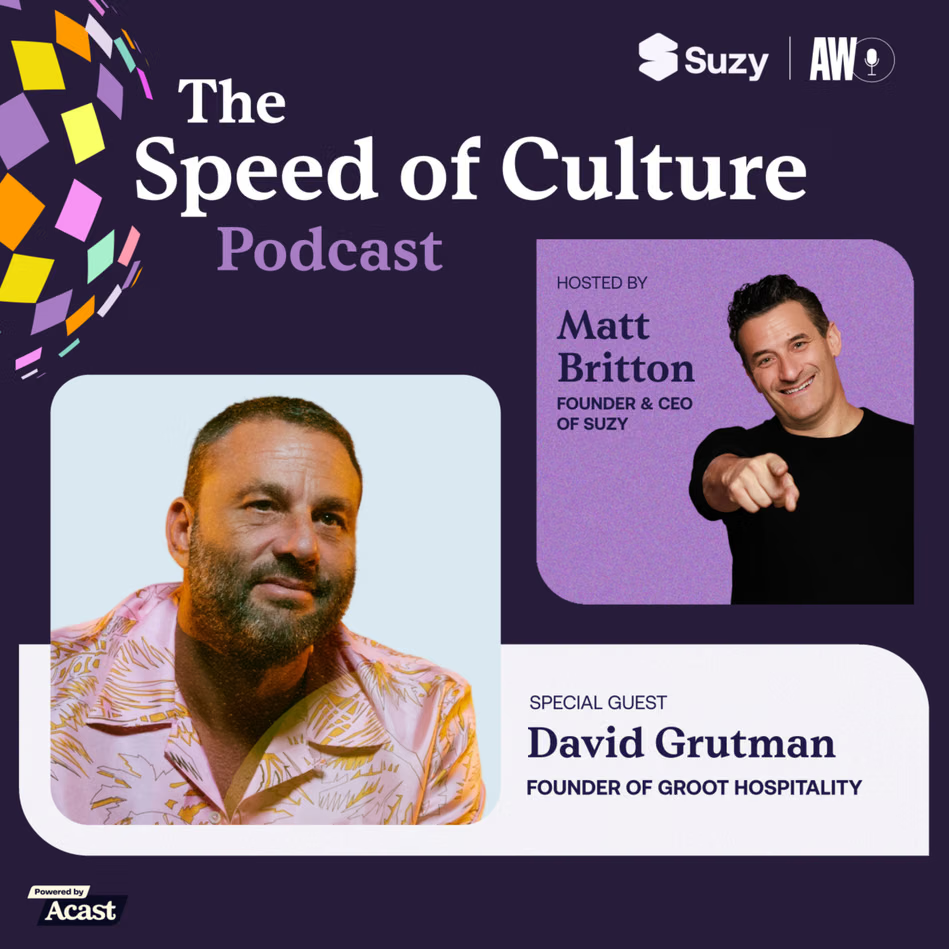
On the latest episode of The Speed of Culture podcast, Matt Britton sat down with David Grutman, founder of Groot Hospitality and the operator credited with transforming Miami into a global nightlife and dining destination. Grutman is the force behind LIV, Komodo, Papi Steak, Casadonna, and Gekkō, his Japanese-inspired steakhouse partnership with Bad Bunny. His new book, Take It Personal: How to Succeed by Building Relationships and Playing the Long Game, released April 14 through Zando with a foreword by Kim Kardashian, distills two decades of lessons into a framework that every enterprise leader should study.
The conversation is a masterclass in something most brands are failing at right now. While 84 percent of consumers say they value experiences over products and 83 percent agree brands should facilitate connections between people rather than just between people and products, most Fortune 500 marketing organizations are still optimizing for digital efficiency over human presence. Grutman has built a nine-figure portfolio by doing the opposite, and the strategic implications for every category, from retail to financial services to real estate, are significant.
The rise of generative AI has created a paradox that most boards have not fully reckoned with. As AI makes digital content abundant, frictionless, and individualized, human beings are increasingly willing to pay a premium for the one thing algorithms cannot replicate: sensory, unpredictable, in-person experience. Seventy percent of consumers believe in-person brand experiences are more trustworthy than digital-only interactions, and experiential campaigns are delivering three-to-one to five-to-one returns on spend, with high performers reaching ten-to-one ROI.
Matt Britton, founder and CEO of Suzy and author of the national bestseller Generation AI, has been making this case to Fortune 500 leadership teams for several years. The framework Britton delivers in his AI keynote presentations is straightforward. AI is compressing the decision journey for commodity purchases, which means the remaining value for brands will concentrate at the two poles: hyper-automated convenience at the bottom, and irreplaceable human experience at the top. The middle is evaporating.
Grutman has spent his career building at the top of that barbell. When he describes knocking an event out of the park, he is describing exactly the kind of multi-sensory choreography that no AI system can manufacture. The lighting, the music, the surprise performance, the plate service, the empty glass he corrects on the spot. This is not nostalgia for analog business. It is an unusually clear view of where enterprise value is migrating.
One of the most overlooked insights from the Speed of Culture interview is Grutman's framing of ecosystem. He does not think in terms of venues. He thinks in terms of keyholder relationships, where a single high-trust connection with a consumer creates gravitational pull across every asset he owns. A guest who dines at Komodo is a guest who parties at LIV, who invests in his consumer brands, who brings friends to Miami because Grutman is the person who makes sure everything is perfect.
This is the model Britton argues Fortune 500 brands must adopt in an era of eroding loyalty. Seventy-four percent of consumers switched brands in the past year, and 65 percent now say convenience matters more than brand loyalty. Against that backdrop, transactional marketing is a losing strategy. The brands that will retain premium pricing power are the ones that build ecosystems in which customers accumulate relational equity across multiple touchpoints.
Grutman's investment approach illustrates the principle at the portfolio level. He has taken positions in Olipop, Poppi, Coconut Cult, SkinnyDipped, Goodles, NeuroGum, and Vacation, often alongside the founders of GoPuff, turning himself into a go-to strategic partner for emerging consumer brands. He is not just writing checks. He is providing cultural velocity, distribution through his venues, and a network that accelerates brand building. This is the same logic Britton applies to his work with the FutureProof community and through his advisory relationships with Fortune 500 CMOs. Connections are the real asset class.
Grutman does his own social media. He was explicit about that with Britton, and it matters. In a media environment where consumers are increasingly suspicious of corporate communication, 87 percent of consumers believe experiential marketing has a greater emotional impact than traditional advertising, and authenticity has become the rarest signal of all. Grutman's refusal to outsource his own voice is a strategic choice that most CEOs and founders still get wrong.
The lesson for enterprise leaders is not that every executive should become a social media personality. The lesson is that the distinction between personal brand and corporate brand has collapsed for the operators who matter. Grutman's lifestyle, his network, his home, his tennis game, his investments, and his venues are all one continuous narrative. This is what Britton means when he talks about the default economy. In a world where AI can generate infinite corporate content, the default choice for consumers increasingly skews toward the human operator whose voice is unmistakable.
This dynamic is reshaping how CMOs think about talent, spokespeople, and executive visibility. Scott Galloway has it. Gary Vaynerchuk has it. Britton has built it across his keynote platform, The Speed of Culture podcast, and his FutureProof AI community. The underlying mechanic is the same one Grutman described. Show up consistently, share the ecosystem, and let people buy into the life behind the brand.
Grutman was unambiguous in the interview. He hates networking. What he does instead is build one or two authentic relationships at a time, and he does it over decades. The Bad Bunny partnership that led to the Gekkō restaurant and the Super Bowl halftime casita was built on a phone call Grutman made to connect the artist with Drake early in Bad Bunny's career. The Ed Razek relationship that led to the Victoria's Secret show moving to the Fontainebleau grand opening was built on showing up for a Super Bowl party and executing flawlessly years earlier.
This is relationship compounding, and it is one of the most underleveraged strategies in Fortune 500 business development. The data supports it. Loyal customers spend 67 percent more than new ones, existing customers are 50 percent more likely to try new products, and 86 percent of loyal customers will recommend a brand to friends and family. The math on long-term relationship investment beats the math on customer acquisition in almost every category, and yet most enterprise sales and marketing organizations are still optimizing for the latter.
Britton's writing formula, Observation to Insight to Implication to Forward View, applies directly here. The observation is that Grutman's network now includes Tom Brady, Serena Williams, David Beckham, Kim Kardashian, and Drake. The insight is that none of those relationships were built through a networking event. The implication is that enterprise leaders who are still optimizing for volume in their outreach are playing the wrong game. The forward view is that in an AI-saturated world, the return on one deeply cultivated relationship will dwarf the return on one thousand algorithmically targeted impressions.
One of the most revealing exchanges in the interview came when Britton asked Grutman how he reconciles letting his team operate with his own obsession with every detail. Grutman's answer was that he cannot help himself. He corrects the dirty plate, the empty glass, and the off-tempo lighting in the moment, not in an email the next day. His friends either love or hate going to dinner with him for this reason, and he was clear that he considers this a feature rather than a bug.
This is the operator mindset that Britton brings to his own work and that he argues Fortune 500 leaders need to recover. The shift to AI and automation is being sold to the C-suite as a way to reduce the overhead of operational detail. In reality, the brands that will win are the ones whose leaders still care about the small things, because the small things are now the only signal consumers have that a human was actually involved. Thirty-two to 33 percent of consumers will abandon a brand they love after just one bad experience. The details are not detail work. The details are the strategy.
For enterprise leaders who are building AI-enabled operations, the implication is that automation should liberate attention for the human touchpoints that matter most, not replace them. This is the same argument Britton makes in his keynotes on AI transformation. AI is a force multiplier for leaders who still take ownership of the experience their company delivers. It is a liability for leaders who use it to create distance between themselves and the customer.
Grutman titled his book Take It Personal because the philosophy that built his empire is that every interaction is a long-term investment. He does not keep score on transactions. He goes into every relationship asking how he can create a win-win, and he trusts that the math works out over time. Kim Kardashian wrote in her foreword that Grutman has built places where cultures blend, where barriers drop, and where people who might never cross paths end up sharing a moment they will never forget. That is the compounding effect of playing the long game at scale.
The business case is in the numbers. Loyalty program members generate 12 to 18 percent more incremental revenue annually than non-members, 90 percent of companies report positive ROI from loyalty programs with average returns of 4.8x to 5.2x, and increasing customer retention by just five percent can boost profits by 25 to 95 percent. Short-term thinking is expensive, and most enterprise incentive structures still reward it. Grutman's model is a reminder that the operators who ignore quarterly pressure in favor of decade-long relationship investment end up with the category-defining assets.
For Fortune 500 leaders reading this, the strategic takeaway is to audit the time horizon of your most important initiatives. If every significant bet in your organization is being evaluated on a two-to-four-quarter window, you are building for extraction, not for legacy. The brands that will matter in 2030 are being built by leaders who are willing to wait.
AI is polarizing consumer spending toward two extremes. At one end, automation is compressing the decision journey for commodity purchases. At the other, consumers are paying premium prices for sensory, unpredictable, in-person experiences that algorithms cannot replicate. Brands winning in 2026 are investing in both layers simultaneously and abandoning the transactional middle that AI renders obsolete.
Experiential campaigns deliver three-to-one to five-to-one ROI, with top performers reaching ten-to-one, because 70 percent of consumers trust in-person brand experiences more than digital-only interactions. In an AI-saturated media environment, live experiences cut through algorithmic noise and create the emotional and social memory that drives long-term loyalty, word-of-mouth, and premium pricing power.
Grutman has built a hospitality empire by operating at the opposite of automation, with obsessive attention to detail, long-term relationship investment, and ecosystem thinking across venues, consumer brand investments, and entertainment production. His playbook maps directly onto the strategic challenges Fortune 500 brands face as AI erodes the value of transactional marketing and rewards operators who can deliver irreplaceable human presence.
The distinction between personal brand and corporate brand has functionally collapsed for operators whose audiences demand authenticity. CEOs who own their executive voice and show up consistently with their own perspective create trust at a scale that corporate communications cannot match. In a world where AI can generate infinite branded content, the scarcest signal is a human operator whose voice is unmistakable.
The shift Matt Britton and David Grutman discussed on The Speed of Culture is already reshaping how Fortune 500 brands allocate capital, develop leadership, and design customer experience. The operators who understand that AI is a force multiplier for human presence rather than a substitute for it will define the next decade of enterprise growth. The ones who do not will find themselves competing on price in a market where price is already being optimized away.
Matt Britton has delivered more than 500 keynotes to Fortune 500 leadership teams on the intersection of AI, consumer behavior, and the experience economy. To bring these insights to your next event, explore Matt Britton's keynote platform or contact his team directly. For the full conversation with David Grutman, listen to the latest episode of The Speed of Culture podcast on Apple Podcasts, Spotify, or wherever you get your podcasts.
.jpeg)


.jpeg)
.jpeg)