July 8, 2025
Tim Ellis
Chief Marketing Officer
NFL
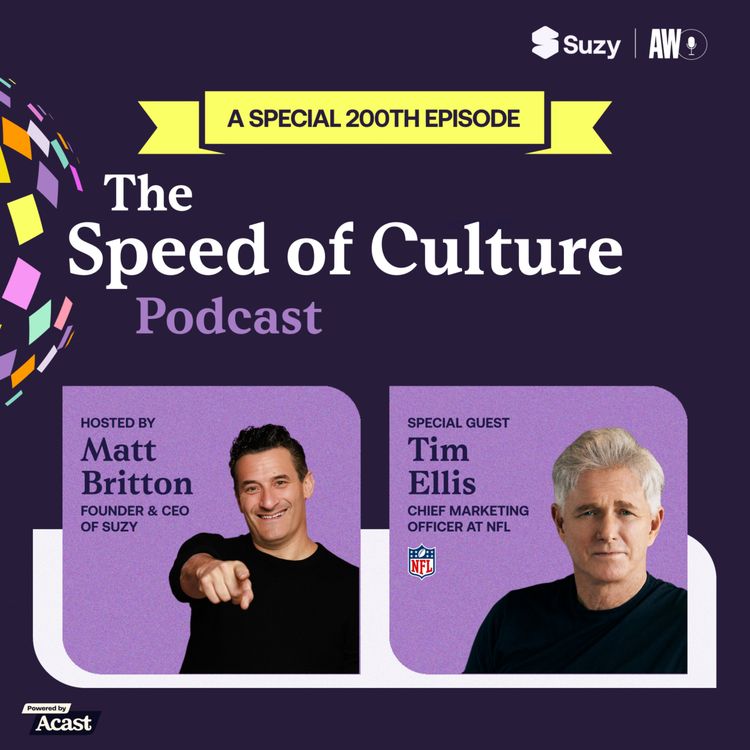
The 200th episode: Inside the NFL’s cultural revolution with CMO Tim Ellis
This is some text inside of a div block.
This is some text inside of a div block.
LISTEN ANYWHERE YOU FIND YOUR PODCASTS
%20(400%20x%20100%20px)%20(300%20x%2050%20px)%20(150%20x%2050%20px).avif)

The National Football League has quietly transformed itself into America's most powerful unifying brand. With over 200 million fans and dominating 86 of the top 100 television programs in 2025, the NFL stands as a marketing masterclass in relevance, adaptation, and cultural leadership. But reaching this pinnacle required courage—the willingness to innovate, challenge conventions, and fundamentally rethink how a century-old institution connects with tomorrow's consumers.
This transformation is the story of Tim Ellis, Chief Marketing Officer of the NFL, and his revolutionary approach to sports marketing. In the milestone 200th episode of The Speed of Culture Podcast, host Matt Britton, founder and CEO of Suzy, the AI-powered consumer intelligence platform, sits down with Tim to explore the "helmets off" strategy that humanizes the world's greatest athletes, the creator-led content that bypasses traditional gatekeepers, and the global expansion blueprint that's turning casual flag football players into lifelong fans.
For marketing executives, brand strategists, and anyone interested in building cultural relevance in a fragmented media landscape, this conversation reveals the playbook for futureproofing a legacy institution in the age of Gen Z and artificial intelligence.
Ellis's journey to this role is itself a lesson in cross-industry expertise. Before joining the NFL in 2018, he held executive positions at Activision, Volkswagen, and Volvo, driving breakthrough campaigns that understood the emerging desires of younger consumers. His appointment marked a turning point: the NFL wasn't hiring a traditionalist committed to defending the status quo. They were investing in someone who understood that the future belonged to brands willing to evolve, take risks, and meet audiences where they were—not where they used to be.
The results speak for themselves. Under Tim's stewardship, the NFL has cultivated the most diverse, youngest, and most engaged fanbase in league history. From the rise of flag football as a global participation driver to the bold "I Am Somebody" campaign celebrating inclusion and identity, the NFL is demonstrating that cultural relevance and commercial dominance aren't mutually exclusive. They're interdependent.
The cornerstone of Tim Ellis's marketing philosophy rests on a simple but powerful premise: fans don't just want to watch football. They want to understand the people playing it. The "helmets off" strategy removes the barrier between athletes and audiences, revealing the multidimensional humans beneath the uniforms.
This isn't a novel concept in marketing. Humanization has been a buzzword for years. What distinguishes the NFL's approach is scope and authenticity.
The league didn't create a sanitized content division designed to manufacture relatable moments. Instead, Ellis and his team empowered players to showcase their genuine passions: the gaming obsessions, music tastes, philanthropic work, and fashion interests that define them as people, not just competitors.
The strategic brilliance lies in understanding the audience. Gen Z and Gen Alpha consumers—the demographic growth engines for any brand seeking long-term relevance—expect authenticity from the institutions they support. They're skeptical of polished corporate messaging and gravitational toward genuine human connection.
By giving fans unprecedented access to players' real lives, the NFL transforms its greatest asset—world-class athletes—into relatable role models and content creators in their own right.
Consider the NFL's investment in its fashion editorial function. The league now employs a dedicated fashion editor, Kyle Smith, whose entire role centers on showcasing how players express themselves through clothing and personal style. This single hire represents a philosophical shift: acknowledging that what players wear, where they shop, and how they present themselves matters to fans as much as what they accomplish on the field.
It's Gen Z marketing at its finest—meeting consumers on platforms and in contexts where they're most engaged.
The quantitative impact of this strategy is substantial. The NFL tracks over 300 fan attributes to understand how different segments consume content and engage with players. This data reveals that fans exposed to player-centric, personality-driven content demonstrate significantly higher engagement rates across platforms.
They're more likely to visit team websites, purchase merchandise, stream games, and—critically—introduce younger family members to the sport.
The "helmets off" strategy also serves a secondary purpose: it creates a sustainable moat against competing entertainment options. The NFL competes not just against other sports leagues but against every content choice available to modern consumers.
Netflix specials, TikTok streams, Instagram stories, and gaming platforms all vie for the same scarce attention. By making players the center of the narrative, the NFL transforms its content from a commodity (anyone can broadcast a football game) into something differentiated and exclusive: intimate access to the world's greatest athletes as real people.
Traditional sports media operated within a scarcity paradigm. A finite number of camera angles, reporters, and editorial decisions determined which moments, narratives, and stories reached fans. Broadcast networks held gatekeeping power. Journalists filtered reality through editorial judgment.
Fans consumed what they were given.
The modern consumer rejects this model. They want to control their narratives, choose their perspectives, and participate in storytelling rather than passively receive it. Tim Ellis recognized this fundamental shift early and positioned the NFL not as a broadcaster but as a platform for distributed content creation.
The NFL's Live Content Creators (LCCs) stationed on sidelines and with players represent the physical manifestation of this philosophy. These aren't traditional broadcasters or corporate videographers. They're digital-native content creators trained to capture authentic moments in real-time and distribute them across social platforms where fans congregate.
A Live Content Creator might film a quarterback's reaction in the locker room minutes before game time, edit it into a 30-second Instagram story, and reach 500,000 fans before traditional media even acknowledges the moment exists.
This strategy generates content at scale while maintaining authenticity. The NFL isn't producing sterile, heavily branded content. It's enabling players, coaches, and other stakeholders to tell their own stories using formats and platforms younger audiences actually use.
The implied message: the NFL trusts its community to represent the league authentically without corporate message control.
Beyond internal creators, Ellis and his team engineered strategic partnerships with YouTube, Adobe, and Google specifically designed to empower fans to create and distribute their own NFL content. This represents a radical departure from traditional sports marketing, where leagues have historically policed fan-generated content and protected intellectual property zealously.
The NFL recognized a counterintuitive truth: by enabling fan creativity, it multiplies organic content production exponentially.
A teenage content creator producing NFL highlight compilations for TikTok isn't diluting the league's brand. They're extending its reach into communities traditional broadcasting never penetrates. They're driving engagement among peers who trust peer-created content more than corporate messaging.
They're converting casual viewers into invested fans by making them stakeholders in the storytelling process.
The metrics validate this approach. NFL clips and highlights generated by fans and Live Content Creators consistently outperform traditional broadcast content in engagement rates. The algorithm favors authentic, native-format content.
A vertical-video highlight reel produced by a player's personal creator will reach more Gen Z viewers than a polished, horizontally-framed broadcast analysis by a cable sports network. The NFL recognized this and restructured its content distribution strategy accordingly.
This democratization of storytelling also serves a strategic HR function. By enabling players to build personal brands through social media and creator partnerships, the NFL increases the non-football earnings potential of its talent.
Stars like Patrick Mahomes, Travis Kelce, and Tyreek Hill can generate significant income through content creation, merchandise, and brand partnerships. This increases the lifetime value of being an NFL player, which strengthens recruitment, retention, and player satisfaction.
The league grows by making its athletes more valuable to sponsors, audiences, and themselves.
The average age of NFL fans was rising—a cautionary demographic trend that threatened long-term viability. If the league couldn't attract younger audiences and convert them into lifelong fans, it risked obsolescence within a generation.
Tim Ellis made reversing this trend a strategic priority.
The approach operates on multiple levels. First, the NFL lowered barriers to participation. Flag football's inclusion in the LA 2028 Olympics isn't just a feel-good initiative about accessibility. It's a calculated investment in the primary funnel for fan conversion.
Data consistently shows that individuals who participate in casual flag football—requiring minimal athletic commitment and zero cost for entry-level play—convert to league fandom at rates four times higher than non-participants.
By making participation accessible to girls, boys, and adults regardless of athletic ability, the NFL isn't simply expanding the player base. It's dramatically widening the potential customer funnel.
A ten-year-old playing flag football has a higher probability of attending college football games, purchasing NFL merchandise, and watching professional games over a lifetime than a child who never touches a football.
The Olympics inclusion amplifies this effect globally, positioning flag football as an entry point to fandom across international markets.
Second, the NFL partnered with digital-first platforms where younger audiences actually spend time. Deals with YouTube TV, Netflix, and streaming services aren't just about broadcast rights. They're strategic positioning statements: the NFL exists where Gen Z consumes content.
Netflix's upcoming documentary series about the league isn't a vanity project; it's a content marketing play designed to introduce millions of casual viewers to storylines and personalities they might not encounter through traditional sports broadcasting.
The NFL also recognized that youth engagement requires content fragmentation. A Gen Z teenager doesn't want the same three-hour Sunday Night Football experience their parents consume.
They want mobile-friendly highlight compilations, player reaction videos, fantasy insights, and behind-the-scenes access distributed across TikTok, Instagram, YouTube Shorts, and Twitch.
The league developed content strategies specifically designed for these platforms—shorter, more frequent, more personality-driven, and infinitely more shareable.
Furthermore, the league's investment in diversity and representation directly supports youth engagement. When a young girl of color sees herself represented in NFL campaigns and among player personalities, she's more likely to develop affinity for the sport.
The "I Am Somebody" campaign, celebrating inclusion and identity across gender, race, and background, wasn't just a corporate social responsibility initiative. It was a statement that football belongs to everyone—a message that resonates with the values and expectations of younger consumers.
The strategic thinking extends to community partnerships. Rather than marketing the NFL exclusively through media channels, the league invests in grassroots programs, youth leagues, and school partnerships that normalize football participation across diverse communities.
When a charter school in South Los Angeles offers flag football as part of its athletic program, supported by NFL funding and resources, the league is building fandom at the source: among children for whom participation becomes a gateway to professional sport engagement.
The NFL's historical market was domestic. Super Bowl parties define American sports culture, but globally, football ranks as a niche entertainment product.
Tim Ellis identified global expansion as a critical lever for long-term growth—not just adding international viewers but building participation ecosystems in emerging markets that could sustain fandom for decades.
The strategy focuses on markets with large populations, growing disposable income, and existing soccer infrastructure—suggesting an appetite for team sports.
Brazil, Mexico, Germany, England, and emerging opportunities in Africa and Asia represent the league's expansion frontier.
In each market, the NFL isn't attempting to transplant American football culture wholesale. Instead, it's adapting its playbook to local contexts while maintaining strategic consistency.
Brazil represents a case study in this localization approach. With over 200 million people and deeply ingrained soccer culture, Brazil might seem an unlikely NFL market.
But the league recognized that football's appeal to younger Brazilians mirrors its appeal to American Gen Z: authentic player personalities, dynamic athleticism, and cultural impact beyond the game itself.
By positioning star players as global celebrities comparable to soccer's biggest names, the NFL is building equivalence in audience imagination.
Germany and Mexico represent different growth vectors. Germany's middle-class demographic and premium subscriber base make it ideal for streaming content and merchandise sales.
Mexico's geographic proximity to the United States, combined with a massive population and growing media consumption, creates a platform for bilingual content and cross-border fandom.
The league's investment in hosting games in international markets— increasingly normative post-pandemic—serves as a proof-of-concept for local support while generating valuable data on regional viewing habits, merchandise preferences, and fan behaviors.
The flag football strategy operates globally as well. By positioning casual football participation as inclusive, equipment-minimal, and accessible regardless of athletic background, the NFL creates local participation ecosystems that drive fandom conversion.
A teenager playing flag football with friends in Madrid has a path to professional NFL fandom that didn't exist five years ago.
Global expansion also benefits from the NFL's media partnerships. Netflix, YouTube, and Amazon operate globally, giving the league unprecedented international distribution capabilities.
A football documentary or player profile series isn't bounded by geography; it reaches audiences worldwide instantaneously.
This multiplier effect—creating content once and distributing globally—dramatically improves the return on production investment while building international awareness and fandom.
The long-term vision is clear: the NFL transforms from an American sports league with international distribution into a genuinely global institution.
This requires 15–20 years of consistent investment, but the strategic logic is powerful.
A market of 200 million people with even 1% NFL fandom penetration adds 2 million engaged consumers to the ecosystem. Across five key international markets, even conservative penetration rates multiply the addressable market dramatically.
Traditional sports sponsorships operated on a straightforward transactional model: corporations paid for logo placement and association with the sport's cultural cache.
The NFL received revenue; sponsors received exposure. The arrangement satisfied both parties, but the relationship remained fundamentally arm's-length.
Tim Ellis reimagined sponsorship as a co-creation opportunity. Partners aren't logos appended to stadium signage or mentioned in broadcast segments. They're collaborators who integrate their offerings authentically within the football ecosystem.
This requires sponsors to think beyond their traditional categories and consider how their products or services enhance fan experience or player performance.
Consider Budweiser's partnership with the NFL. Rather than simply sponsoring broadcasts, Budweiser integrates its products into the social fabric of football fandom.
The brand isn't a passive presence; it's a participant in the community experience.
Similarly, tech partnerships with Microsoft and Google create infrastructure for fan engagement—streaming platforms, data analytics, and interactive experiences—that deepen relationships with audiences while advancing sponsor business objectives.
This transformational approach to sponsorship creates several strategic advantages:
Multiple insurance companies might purchase Super Bowl ads; but a partner that enables fans to customize their viewing experience through tailored analytics and statistics offers value beyond traditional advertising.
The philosophy also grants the NFL leverage over sponsor behavior. When partnerships are transformational and mutually invested, the league has standing to request that sponsors align their broader corporate behavior with NFL values.
The league's commitment to social justice, diversity, and inclusion isn't purely altruistic; it's also a signal to sponsors about the league's standards for business partners.
The "Helmets Off" strategy removes the barrier between athletes and audiences by showcasing players' authentic personalities, interests, and passions beyond their on-field performance. This matters because Gen Z and Gen Alpha consumers expect authenticity and genuine connection from the institutions they support.
Traditional sports marketing that focused solely on athletic achievement no longer resonates with younger audiences. By revealing players as multidimensional humans—with gaming interests, music tastes, fashion sense, and philanthropic work—the NFL creates relatable role models and sustainable fan loyalty.
The league's investment in this strategy includes hiring a dedicated fashion editor to showcase player style choices, demonstrating that what athletes wear and how they present themselves matters as much as their performance.
The NFL recognized that it competes against Netflix, TikTok, gaming, and every other content choice available to modern consumers.
Rather than relying solely on traditional broadcast partnerships, the league deployed Live Content Creators positioned on sidelines and with players to capture authentic moments in real-time and distribute them across social platforms.
The NFL also partnered with YouTube, Adobe, and Google to empower fans to create and distribute their own NFL content. This democratization of storytelling multiplies organic content production exponentially while leveraging the algorithm's preference for authentic, native-format content.
A vertical-video highlight reel produced by a player's personal creator typically reaches more Gen Z viewers than a polished broadcast analysis, validating the league's content distribution strategy shift.
Flag football serves as the primary funnel for fan conversion. Data consistently shows that individuals who participate in casual flag football—requiring minimal athletic commitment and zero cost barriers—convert to league fandom at rates four times higher than non-participants.
By making participation accessible to girls, boys, and adults regardless of athletic ability, the NFL dramatically widens its potential customer base.
Flag football's inclusion in the LA 2028 Olympics amplifies this effect globally, positioning casual participation as an entry point to fandom across international markets.
A teenager playing flag football anywhere in the world has a higher probability of becoming a lifelong NFL fan than a non-participant, creating a sustainable competitive advantage for the league.
While specific metrics vary, Ellis and his team track multiple dimensions of success: viewership dominance (86 of the top 100 television programs in 2025), fan base diversity (growth driven by youth, women, and Latino communities), total fan reach (over 200 million fans), global participation in flag football, and engagement rates across digital platforms.
The league also tracks 300+ fan attributes to understand how different segments consume content and engage with players.
Perhaps most importantly, the NFL measures success through demographic shift: the league's average fan age is declining while diversity indices increase, indicating that the cultural revolution is successfully attracting and retaining younger, more diverse audiences as primary consumers rather than legacy audiences.
The Speed of Culture Podcast Episode 200 represents a pivotal moment in sports marketing discourse. Tim Ellis's conversation with Matt Britton illuminates how century-old institutions can futureproof themselves through courageous innovation, authentic engagement, and strategic adaptation to emerging consumer behaviors.
For marketing executives, the NFL's playbook offers transferable insights regardless of industry. Humanization over spectacle. Authenticity over polish. Participation over spectatorship. Global thinking with local execution.
These principles transcend sports marketing; they define how any brand builds cultural relevance in the 2020s.
The conversation also underscores the critical importance of data-driven consumer insights. Matt Britton's expertise in understanding emerging consumer behaviors and generational psychology—embedded in Suzy's AI-powered platform—represents the intelligence infrastructure that enables marketing excellence.
In an era where brands compete for fractured attention across dozens of platforms and contexts, understanding what consumers actually want (rather than assuming based on historical patterns) is the difference between relevance and obsolescence.
As you consume this content, consider how the NFL's strategic principles apply to your organization. Are you humanizing your team, products, and brand? Are you creating opportunities for your audience to participate in storytelling rather than passively consuming it?
Are you designing your growth strategy around primary markets where participation drives lifetime value? Are you thinking globally while executing locally?
The NFL's cultural revolution didn't happen because the league had more money, bigger platforms, or more talented creative teams than competitors.
It happened because leadership—exemplified by Tim Ellis—asked fundamental questions about what modern consumers actually value and had the courage to restructure the entire organization around those insights.
That's the enduring lesson from Episode 200.
.jpeg)


.jpeg)
.jpeg)