Opening: Where Entertainment Meets Strategy in Modern Advertising
In an era where consumer attention spans continue to shrink and technological disruption defines competitive advantage, Advertising Week stands as a beacon of relevance. For two decades, the industry's premier platform has managed to stay ahead of seismic shifts in how brands connect with audiences—a feat that speaks volumes about thoughtful leadership and strategic vision.
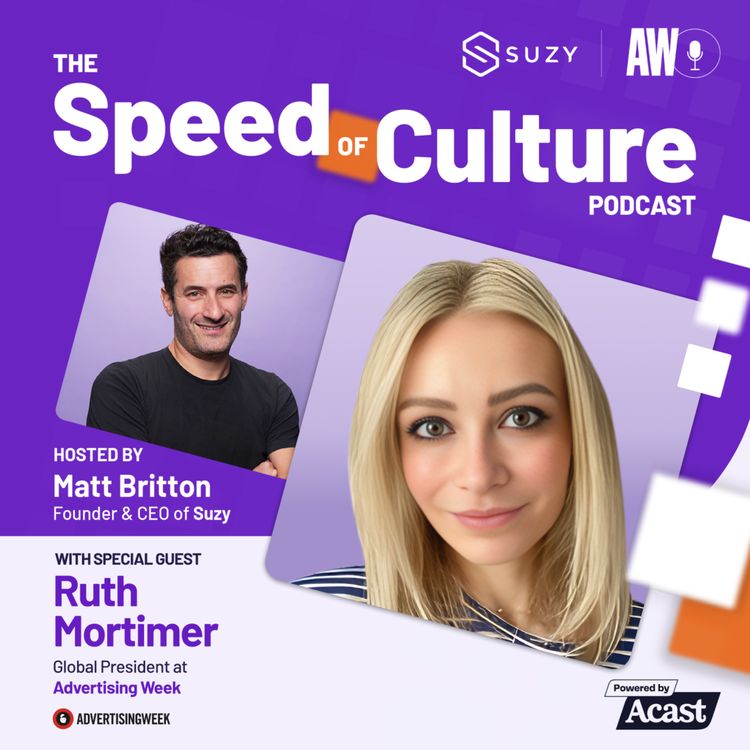
On Episode 151 of The Speed of Culture Podcast, Matt Britton, founder and CEO of Suzy, the AI-powered consumer intelligence platform, engages Ruth Mortimer, Global President of Advertising Week, in a compelling conversation that explores how the industry's most influential convening event continues to evolve in an age of artificial intelligence, creator economics, and increasingly demanding consumer expectations.
The episode, released on January 2, 2025, captures a critical moment in advertising history. As generative AI reshapes creative production, as authenticity becomes premium currency, and as traditional agency structures give way to distributed creative networks, Advertising Week remains a pivotal forum for understanding where the industry is heading.
Ruth's insights offer a masterclass in how organizations stay relevant while navigating technological transformation—a lesson that extends far beyond advertising professionals to anyone leading innovation in their field.
For the past two decades, Advertising Week has perfected the delicate balance of blending education with entertainment, ensuring that attendees leave inspired with actionable strategies they can implement immediately. Under Ruth's leadership, this formula has expanded globally, creating unique platforms for discussions that shape the future of the industry.
As she discusses in her conversation with Matt, the key to staying relevant isn't about predicting the future—it's about maintaining curiosity, fostering inclusivity, and creating spaces where different perspectives collide in productive ways.
Small AI, Big Impact: How Technology Is Reshaping Creative Work Without Replacing Human Genius
When discussing artificial intelligence's role in advertising, Ruth Mortimer emphasizes a critical distinction that too many organizations miss: the difference between theoretical AI applications and practical, implementable solutions. In her conversation with Matt, she champions what she calls "small AI"—focused, tactical uses of artificial intelligence that solve specific problems rather than attempting wholesale digital transformation.
This pragmatic approach stands in stark contrast to the hype cycle that has dominated AI discourse since the release of ChatGPT. While many organizations scrambled to integrate AI into their processes without clear strategy, Advertising Week has positioned itself as a platform for grounded, results-oriented applications.
Ruth's examples are telling: automating email subject lines to dramatically improve deliverability rates, using machine learning to optimize ad targeting, or leveraging natural language processing to analyze consumer sentiment in real time.
The statistics support this measured approach. According to recent industry data, 86% of DTC (direct-to-consumer) advertisers plan to increase their use of AI for research and ideation in 2025, while 79% anticipate expanding AI's role in creative production.
Simultaneously, AI-driven creative production has experienced a 220% increase in usage during 2024, enabling unprecedented levels of personalization and real-time optimization. Yet the most successful brands aren't those throwing the most computing power at their problems—they're the ones balancing automation with human oversight, using AI to amplify human creativity rather than replace it.
Ruth's perspective addresses one of advertising's most pressing tensions: as automation increases, the value of human creativity paradoxically increases. There's a fascinating paradox emerging in modern marketing: in a world where more and more operational work becomes automated, human creativity develops a level of emotional quality and interpersonal resonance that becomes increasingly desirable.
The brands winning in 2025 and beyond are those using AI to handle the repetitive, data-intensive work while freeing their creative teams to focus on strategy, storytelling, and emotional connection.
The practical implications are significant. Where traditional advertising might produce three to five variations of a campaign, AI enables the creation of dozens—even hundreds—of personalized variations, each optimized for different audience segments, platforms, and contexts.
But the underlying creative insight, the strategic narrative, the emotional core that makes people care? That remains stubbornly human. Ruth understands that the role of Advertising Week is to help the industry navigate this transformation thoughtfully, ensuring that organizations leverage AI as an accelerant for human creativity rather than a replacement for it.
Edutainment as Strategic Imperative: How Advertising Week Balances Education with Entertainment
One of the most distinctive elements of Advertising Week's 20-year evolution has been its commitment to blending education with entertainment—a formula that Ruth Mortimer champions as essential to the platform's continued relevance. This "edutainment" approach isn't merely about keeping attendees engaged during conferences; it's a strategic philosophy that reflects how successful brands now operate in an attention economy.
The data reveals why this blend is so powerful. According to recent research, 66% of social media users find edutainment content to be the most engaging type of brand content—outperforming skits, memes, and even serialized content.
This isn't surprising when you consider how audiences consume information. People naturally gravitate toward content that entertains them, but they're far more likely to retain and act on information when it's wrapped in compelling storytelling and memorable experiences.
As neuroscience research consistently demonstrates, people remember stories and experiences exponentially better than plain facts.
Advertising Week's approach to edutainment operates on multiple levels. The conference programming itself exemplifies the philosophy: keynote addresses aren't passive lectures but interactive conversations that challenge conventional wisdom.
Awards ceremonies celebrate creativity while simultaneously teaching the industry about emerging trends and winning strategies. Panel discussions don't simply feature expert talking heads; they spark debate, introduce conflicting perspectives, and model the kind of collaborative problem-solving that the industry needs.
This edutainment philosophy extends to how Ruth positions Advertising Week's content strategy for the creator economy. In 2025, Advertising Week dedicates four content tracks specifically to creators—the highest number ever—with a creator lounge sponsored by Meta.
Rather than treating creators as a new phenomenon to be studied at arm's length, the platform has integrated them into the heart of the conversation. This reflects a deeper strategic shift: the realization that creators aren't a separate category of marketing channels but rather the vanguard of authentic, engaging content creation.
The evolution of edutainment also speaks to how brands should be approaching their own content strategy. Successful brands in 2025 aren't just selling products or services; they're offering valuable insights, entertaining perspectives, and educational content that helps their audiences navigate an increasingly complex world.
Duolingo's gamified approach to language learning, HubSpot Academy's free educational courses, and Nike Training Club's integration of expert fitness education with interactive challenges all embody this principle. The brands winning consumer attention aren't competing on features alone—they're competing on ability to educate while entertaining.
Ruth's leadership of Advertising Week reflects an understanding that the industry itself needs edutainment. Marketers come to the conference stressed, overwhelmed by rapid change, and hungry for both inspiration and practical guidance.
The platform must deliver on both fronts: entertainment that energizes and education that equips attendees with actionable strategies they can implement immediately upon returning to their organizations.
Creativity in a Tech-Driven World: Authenticity, Scale, and the Human Element
Perhaps the most compelling theme in Ruth's conversation with Matt centers on a paradox that defines modern advertising: as technology becomes more sophisticated, authenticity becomes more valuable. This contradiction reflects deeper shifts in consumer psychology and brand strategy that organizations must navigate carefully to remain competitive.
The empirical evidence is striking. Lo-fi and authentically imperfect creative content is systematically outperforming high-production, polished advertising.
Forty-two percent of the top-spending ads now utilize unpolished aesthetics that mirror user-generated content. Consumers are increasingly fatigued by perfection; they gravitate toward content that feels real, relatable, and human.
This has profound implications for how brands approach creative production, especially in an age where AI can generate technically flawless content at scale.
The successful brands are those that have learned to weaponize imperfection. Point-of-view (POV) videos and diary-style posts, where the creator's voice feels front and center, resonate precisely because they mimic the content formats native to social media platforms where audiences spend their time.
There's an irony worth examining: technology enables brands to create content that looks like it was made by real people without professional equipment, yet this technology must remain invisible. The moment audiences sense that they're being manipulated by algorithmic precision or artificial perfection, engagement plummets.
Humor is another critical element making a comeback in advertising after years of cause-driven, serious messaging. In a world filled with tension and divisiveness, humor cuts through noise, lightens the mood, and fosters genuine connection.
This isn't frivolous humor for humor's sake; it's strategic use of emotion to create memorable, shareable experiences that audiences actively want to engage with.
The scale paradox also deserves attention. With AI-enabled creative production, brands can now generate hundreds of personalized ad variations rather than the traditional three to five iterations.
But this scale must serve personalization and authenticity rather than undermining it. The goal is to deliver the right message to the right person in the right context—not to weaponize technology to manipulate at scale.
Ruth's approach to Advertising Week reflects this understanding: the platform must help brands figure out how to use technology in service of human connection rather than in place of it.
Ninety-two percent of business leaders report using AI-driven personalization strategies to drive growth. However, the most sophisticated organizations recognize that personalization powered by AI must still feel human.
The challenge isn't technical—it's emotional and strategic. Brands must deploy artificial intelligence and automation thoughtfully, ensuring that their technology stack serves their creative vision and brand values rather than replacing those fundamentals.
The Role of Inclusivity and Diverse Perspectives in Shaping the Future of Advertising
A subtle but significant theme that emerges from Ruth's conversation with Matt concerns the importance of inclusivity and diverse perspectives in driving innovation and staying relevant. Advertising Week's evolution over two decades reflects a deliberate effort to broaden the voices contributing to industry conversations and expanding whose perspectives shape strategic direction.
This matters more than many organizations realize. Diversity in creative teams and leadership directly correlates with better creative outcomes, deeper consumer insights, and stronger business results.
When organizations only listen to voices that think like them, they miss emerging trends, fail to understand shifting consumer expectations, and become vulnerable to disruption from unexpected competitors.
Ruth's emphasis on staying curious—a phrase that recurs throughout her conversation with Matt—points to a specific leadership philosophy. Curiosity, by definition, requires openness to perspectives different from your own.
It means asking questions before making assumptions, engaging with viewpoints that challenge conventional wisdom, and remaining humble about the limits of your own knowledge.
In an industry as fast-moving as advertising, organizations led by people committed to intellectual humility and continuous learning tend to outpace those led by executives convinced they already understand their market.
The 2025 expansion of creator-focused content at Advertising Week exemplifies this philosophy in action. By creating dedicated tracks and spaces for creators, the platform acknowledges that some of the most important innovation in advertising is happening outside traditional agency structures and corporate marketing departments.
Creators bring different perspectives shaped by direct audience interaction, authentic relationship-building, and fluid, experimental approaches to content creation. These perspectives are increasingly essential to understanding where consumer attention is moving.
The global nature of Advertising Week also speaks to Ruth's commitment to diverse voices. The platform operates in multiple regions—New York, Europe, and globally—ensuring that advertising professionals from different cultures, markets, and contexts can share their approaches.
What works in one market may need significant adaptation in another, but the underlying principles of creative excellence, strategic thinking, and audience connection remain universal.
By creating spaces for global conversation, Advertising Week ensures that innovation benefits from multiple cultural perspectives rather than defaulting to a single market's approach.
Looking Ahead: The Future of Advertising Week and the Industry It Shapes
As the advertising industry stands at a crossroads—buffeted by AI disruption, creator economics, shifting media consumption, and evolving consumer expectations—organizations like Advertising Week become increasingly valuable.
Ruth's leadership positions the platform to serve as both validator and challenger: validating the strategies that work while challenging the industry to evolve beyond yesterday's playbooks.
The next chapter of Advertising Week's evolution will almost certainly center on helping the industry integrate artificial intelligence thoughtfully, maintaining creativity and authenticity even as automation increases, and expanding the definition of who "advertising professionals" are.
The platform is already making moves in these directions, with expanded creator programming, dedicated AI content tracks, and programming that addresses the intersection of technology and storytelling.
For individual professionals and organizations, the lessons from Ruth's conversation with Matt are clear:
- Stay curious and remain open to new perspectives that challenge conventional wisdom.
- Remain committed to human creativity even as you leverage technology to increase efficiency and scale.
- Understand that authenticity is premium currency in modern advertising.
- Recognize that diversity of perspective is essential to innovation and long-term relevance.
The brands and organizations winning in the next decade won't be those with the most sophisticated technology—they'll be those with the deepest understanding of human psychology, the strongest commitment to authentic connection, and the wisdom to use technology in service of those fundamentals.
Advertising Week's 20-year track record of staying relevant offers a template: continuously question assumptions, listen to diverse voices, invest in both education and inspiration, and remember that at its core, advertising is about human connection.
In an age of AI, that human element becomes more precious, not less.
Key Takeaways
- Practical AI Implementation Beats Hype: Focus on "small AI" solutions that solve specific problems—like optimizing email subject lines or improving ad targeting—rather than chasing comprehensive AI transformation. The most successful organizations use AI as an accelerant for human creativity, not a replacement.
- Edutainment Drives Engagement and Retention: Audiences find educational content combined with entertainment 66% more engaging than other types of brand content. The brands winning consumer attention balance information with entertainment, ensuring messages are both memorable and actionable.
- Authenticity Outperforms Perfection: Forty-two percent of top-spending ads now use unpolished, authentic aesthetics that mirror user-generated content. In a technology-driven world, human imperfection and relatability paradoxically become more valuable competitive advantages.
- Diversity of Perspective Accelerates Innovation: Staying curious and creating spaces for different viewpoints—including creators outside traditional structures—keeps organizations aligned with emerging consumer behaviors and market shifts that more homogeneous teams might miss.
- Scale Must Serve Connection, Not Replace It: While AI enables creation of hundreds of personalized variations, success depends on ensuring technology enhances human connection rather than enabling manipulation at scale. Personalization powered by AI must still feel genuinely human.
Frequently Asked Questions
What is "small AI" and why does Ruth Mortimer advocate for it?
"Small AI" refers to focused, tactical applications of artificial intelligence that solve specific, measurable problems rather than attempting wholesale digital transformation. Ruth emphasizes that while automation increases, the most successful organizations use AI tools to handle repetitive, data-intensive work while freeing creative teams to focus on strategy, storytelling, and emotional connection.
Examples include automating email subject lines to improve deliverability or using machine learning to optimize ad targeting. Small AI wins are achievable, measurable, and directly tied to business outcomes—making them far more valuable than ambitious but vague AI initiatives that fail to deliver ROI.
How does edutainment apply to modern marketing strategy?
Edutainment—the blend of education and entertainment—has become essential because audiences crave both information and engagement. Successful brands don't just sell products; they offer valuable insights and entertaining content that helps their audiences.
Duolingo teaches languages through gamification, HubSpot Academy offers free marketing courses, and Nike Training Club combines expert fitness education with interactive challenges. At Advertising Week, the philosophy ensures that attendees leave inspired and equipped with actionable strategies.
For marketers, it means recognizing that content marketing isn't about selling—it's about providing genuine value in ways that are engaging enough that audiences want to share and interact with the content.
How should brands balance AI-generated content with authenticity?
The paradox is real: as technology becomes more sophisticated, authenticity becomes more valuable. Brands must use AI to enable content creation at scale—producing hundreds of personalized variations rather than three to five—while ensuring each variation feels genuinely human and relatable.
The technology should remain invisible; audiences should never feel manipulated by algorithmic precision. This means using AI for optimization and personalization while human creators drive strategy, emotional resonance, and authentic voice.
Lo-fi, imperfect content often outperforms polished corporate content because it feels real. The goal is technology that enhances human creativity and connection, not technology that replaces or manipulates.
Why does Advertising Week allocate four content tracks to creators in 2025?
Creators represent the vanguard of authentic, engaging content creation and are reshaping how audiences discover and interact with brands. Rather than treating creators as a separate marketing channel, Advertising Week has integrated them into the core conversation because the future of advertising increasingly happens through creator networks and distributed creative ecosystems rather than through traditional agency structures alone.
By dedicating tracks and even a creator lounge (sponsored by Meta), the platform acknowledges that significant innovation is happening outside corporate marketing departments and ensures industry professionals understand this shift.
Looking Ahead
The Speed of Culture Podcast continues to bring forward the perspectives shaping modern business and culture. For deeper insights into AI, consumer behavior, and marketing strategy, explore these resources:
- Suzy — The AI-powered consumer intelligence platform founded by Matt Britton
- The Speed of Culture Podcast — Hosted by Matt Britton, featuring industry leaders discussing culture and business
- Generation AI: The Book — Matt Britton's best-selling exploration of AI and its impact
- AI Keynote Speaker — Matt Britton's speaking services on AI and consumer trends
- Speaker HQ — Professional speaking and thought leadership resources
This blog post explores Episode 151 of The Speed of Culture Podcast, featuring Ruth Mortimer, Global President of Advertising Week, in conversation with Matt Britton, founder and CEO of Suzy. Published January 2, 2025.

%20(400%20x%20100%20px)%20(300%20x%2050%20px)%20(150%20x%2050%20px).avif)

.jpeg)


.jpeg)
.jpeg)