Opening
The meal kit industry once promised convenience wrapped in a mandatory subscription model. Blue Apron built its empire on this premise, but consumer preferences shifted faster than quarterly earnings reports could capture. What happens when a category-defining brand realizes that its core business model no longer fits the lives of its customers? This question became the driving force behind one of the food industry's most ambitious reinventions.
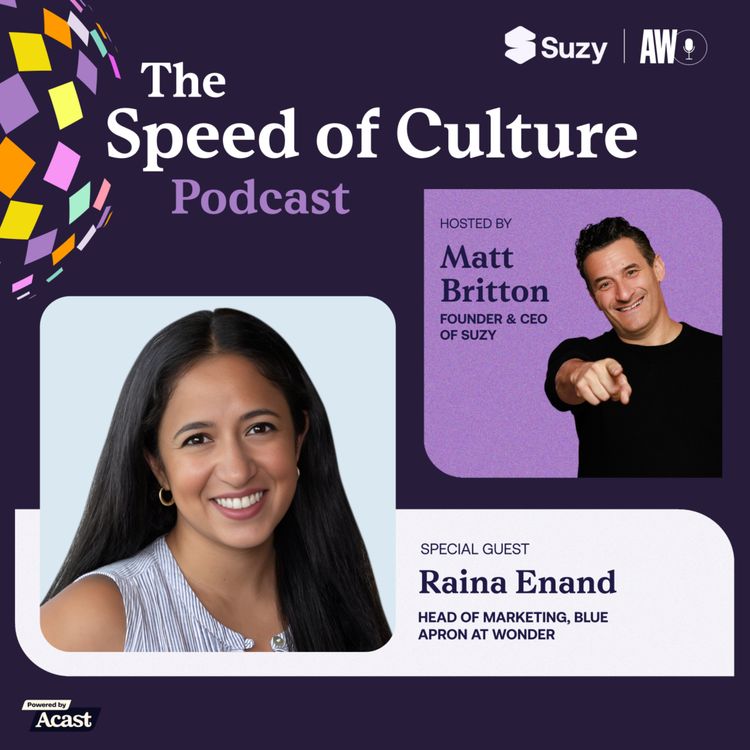
In Episode 219 of the Speed of Culture Podcast, host Matt Britton, founder and CEO of Suzy, the AI-powered consumer intelligence platform, sits down with Raina Enand, Head of Marketing at Blue Apron, a Wonder company. The conversation unpacks the strategic decisions, consumer insights, and bold bets that shaped Blue Apron's transformation from a subscription-dependent service to a flexible commerce platform that empowers customers to shop on their own terms.
Blue Apron's pivot isn't merely a product tweak or marketing refresh—it represents a fundamental reimagining of how a mature brand responds to evolving consumer expectations. Under Wonder's umbrella, alongside portfolio companies like Tastemade and Grubhub, Blue Apron has eliminated mandatory subscriptions, expanded its product offerings to address contemporary health trends, and embraced creator partnerships at scale. The decision reflects a deeper insight: modern consumers don't want to fit into a brand's business model anymore. Instead, brands must fit into people's lives.
Raina Enand brings a distinctive perspective to this challenge. Her background spanning beauty, ecommerce, and food and beverage positions her to understand how consumer psychology shifts across categories. Her approach balances data-driven decision-making with human-centered design, allowing Blue Apron to navigate the delicate balance between innovation and heritage.
As the company courts a new generation of customers while maintaining relationships with core loyalists, every marketing dollar, every product feature, and every creator partnership carries strategic weight.
This episode speaks to a pivotal moment in commerce: the death of friction-inducing subscription traps and the rise of customer-first business models. It's a masterclass in how legacy brands survive disruption by listening to their customers and having the courage to dismantle the very model that built them.
The Subscription Paradox: Why Blue Apron's Original Model Couldn't Survive
Blue Apron launched during a time when subscription services commanded consumer reverence. The model seemed bulletproof: recurring revenue, predictable customer lifetime value, and a built-in barrier to switching. Yet underneath this financial elegance lay a critical flaw—friction.
Consumers tolerated subscription models when their alternatives were limited, but as competition proliferated and consumer preferences fractured, the mandatory subscription became the primary reason customers avoided the service rather than embraced it.
"I want flexibility. I want control. I don't want friction."
This wasn't a whisper in consumer research—it was the dominant chorus. As time-starved professionals, dual-income households, and busy parents juggled competing priorities, a meal kit service that forced them into twelve-week commitments felt antiquated, almost disrespectful of their autonomy.
The pandemic accelerated this sentiment. After eighteen months of pantry hoarding and supply chain uncertainty, consumers developed a visceral preference for on-demand shopping. Subscription fatigue—a phenomenon that crept across streaming services, fitness platforms, and digital entertainment—infected the meal kit category too.
Customers began asking: Why should I commit to meals I might not want next week? What if my schedule changes? Why can't I pause without punishment?
Blue Apron's leadership recognized a hard truth: the subscription model that funded their growth had become a liability. The brand was leaving enormous market opportunity on the table by gatekeeping their service behind a commitment requirement. To compete in an era where flexibility is table stakes, they needed to tear down the walls they'd spent years building.
The pivot to flexible commerce represented more than a tactical shift. It was a philosophical reset—an admission that the original business model, however profitable, didn't serve customer needs. This kind of humility is rare in corporate America, where defending legacy approaches often takes precedence over serving customers better.
Yet in a market defined by rapid iteration, where generational wealth-building hinges on customer satisfaction and retention, doubling down on outdated models is a slow-motion corporate death.
Flexible Commerce as Consumer Philosophy: Rethinking the Meal Kit Experience
Flexible commerce sounds like a buzzword, but it represents a genuine paradigm shift in how companies structure customer relationships. Rather than asking "How do we get customers to commit to recurring deliveries?" the question becomes "How do we make it so easy and valuable that customers want to return?" This inversion of logic drives Blue Apron's transformation.
The practical implementation includes three primary purchasing pathways:
- À la carte shopping: Customers can select individual meals from rotating weekly menus without any obligation. This pathway appeals to infrequent users, trial customers, and those with unpredictable schedules.
- Auto Ship & Save: A customizable recurring program with discounts and flexibility. Unlike the old subscription model, customers can pause, skip weeks, or modify their selections with minimal friction.
- Blue Apron+: A premium membership tier at $9.99 monthly, offering exclusive benefits and additional value for committed customers—a carrot rather than a stick approach.
This tiered structure reflects a sophisticated understanding of customer heterogeneity. Not all customers have the same needs, preferences, or shopping habits. Rather than forcing a one-size-fits-all subscription model, Blue Apron now meets customers wherever they are in their lifecycle.
A college student ordering one meal kit per month receives equal respect as a mother of three ordering weekly. Neither feels coerced. Neither resents the brand for imposing unnecessary barriers.
The expansion from meal kits to a product portfolio demonstrates how flexible commerce enables portfolio strategy. Blue Apron's 100+ weekly rotating meals now include original meal kits, Assemble & Bake dishes, and Dish by Blue Apron—single-serve, heat-and-eat meals with zero assembly required.
Different occasions, different time budgets, and different skill levels now have tailored solutions. A customer pressed for time on Tuesday can grab Dish by Blue Apron; on Saturday when cooking feels recreational, they can tackle an original meal kit.
This portfolio approach solves a critical problem that plagued the original subscription model: the all-or-nothing trap. Flexible commerce erases this binary. It enables stickiness through optionality rather than obligation.
Protein-Forward Positioning and Contemporary Consumer Health Trends
Buried in Blue Apron's product innovation strategy lies a crucial insight about how health consciousness has evolved. The original Blue Apron meal kits optimized for nutritional balance and ingredient quality. But the contemporary health consumer now prioritizes protein intake with almost singular focus.
Each Dish by Blue Apron meal contains 20 to 40 grams of protein, deliberately engineered to address current consumer consciousness. This isn't a minor nutritional tweak. It reflects how marketing must evolve alongside consumer behavior shifts.
Where fitness-focused consumers once calculated macronutrients across an entire day, the contemporary health-conscious consumer wants immediate clarity: Does this meal contain sufficient protein? Can I trust this company understands my priorities?
The protein-forward positioning serves multiple strategic purposes. First, it signals alignment with influential health trends without requiring Blue Apron to make unsubstantiated claims. Second, it creates a clear differentiator in a crowded market.
Third, it demonstrates that Blue Apron listens—that the brand evolves when consumer needs evolve. A company that ignored the protein trend would appear tone-deaf and out of touch.
This approach represents a broader truth about contemporary marketing: authenticity emerges from alignment with genuine consumer values, not through advertising gymnastics. Rather than launching an expensive campaign explaining why protein matters, Blue Apron simply formulated meals people actually want.
Creator Partnerships and the Evolution of Authentic Food Marketing
The original Blue Apron playbook relied on celebrity endorsements and polished, Instagram-friendly imagery. Yet contemporary consumers increasingly distrust traditional celebrity advertising. They crave authenticity, relatability, and genuine kitchen moments from people who resemble them and face similar time constraints.
Raina Enand's "Own the Feed" strategy represents a sophisticated response to this authenticity hunger. Rather than outsourcing influencer relationships to agencies, Blue Apron brought creator management in-house, partnering with hundreds of everyday food and lifestyle creators to tell stories about their real cooking experiences.
These creators—TikTok personalities, Instagram cooks, podcast hosts, and community leaders—share how Blue Apron fits into their actual lives, not some aspirational fantasy version.
This approach achieves several objectives simultaneously. First, it generates authentic content at scale. Second, it democratizes food storytelling by partnering with creators of various sizes, backgrounds, and aesthetic styles.
Third, the in-house creator management model allows for rapid iteration and testing. The responsiveness that Enand emphasizes—"testing, learning, and collaboration"—extends directly into creator partnerships.
The broader implication deserves emphasis: food marketing has fundamentally shifted from product-centric to narrative-centric. Contemporary consumers want to understand the stories behind meals—how they fit into real schedules, how they accommodate dietary preferences, and how they connect families and friends.
Wonder's Ecosystem Strategy: From Siloed Services to Integrated Mealtime Solutions
Blue Apron's reinvention cannot be fully understood in isolation. As a Wonder company sitting alongside Tastemade and Grubhub, the brand functions within a broader ecosystem designed to own the entire mealtime experience.
Consider the addressable market expansion. A customer who uses Grubhub for restaurant delivery and occasionally wants home-cooked options now has a natural pathway to Blue Apron—without leaving the Wonder ecosystem.
This integrated approach also enables data advantages. When Wonder combines insights from restaurant ordering behavior, food content consumption, and meal kit preferences, the resulting customer intelligence becomes extraordinarily sophisticated.
From a consumer perspective, the ecosystem reduces friction. Rather than juggling multiple apps and loyalty programs, customers navigate a unified destination for all mealtime needs.
The ecosystem strategy also mitigates individual brand risk. If Blue Apron faces market headwinds, the company doesn't collapse because it is one brand within a diversified portfolio.
Building Consumer Trust Through Transparency and Customization
The meal kit category suffered from a trust problem even before subscription fatigue set in. Blue Apron's transformation addresses this legacy problem directly through radical transparency and customization.
The fact that 70% of Blue Apron's meals are customizable sends a powerful message: the company trusts customers to modify recipes, adjust portions, and make substitutions.
Similarly, the prominence of nutritional information, ingredient sourcing transparency, and dietary accommodation reflects a maturation of trust-building practices. Customers can see exactly what they're getting and verify that meals align with their dietary values.
Trust-building also manifests in how Blue Apron communicates mistakes or product limitations. This honesty—harder to execute than flowery claims but far more effective—builds long-term relationship equity.
The connection between transparency and flexible commerce deserves emphasis. Flexible commerce inverts the dynamic: customers can verify value with every transaction. If a meal delivers as promised, they return. If not, they try something else without penalty.
Key Takeaways
- Subscription Models Have Become Liabilities in Experience-Driven Categories: Blue Apron's willingness to dismantle its original business model demonstrates that sustained growth requires evolving alongside customer preferences.
- Flexible Commerce Enables Portfolio Strategy: By offering à la carte shopping, customizable recurring programs, and premium membership tiers, Blue Apron serves heterogeneous customer needs simultaneously.
- Product Innovation Must Reflect Contemporary Consumer Consciousness: The protein-forward positioning demonstrates that authentic marketing emerges from products genuinely aligned with current health priorities.
- Creator Partnerships Outperform Celebrity Endorsements: The "Own the Feed" strategy generates culturally relevant content at scale while signaling inclusivity and authenticity.
- Ecosystem Integration Creates Competitive Advantages: Wonder's portfolio approach enables data advantages, reduced friction, and multiple conversion pathways.
Frequently Asked Questions
What makes Blue Apron's flexible commerce model different from its original subscription approach?
The original subscription model required recurring commitments, creating friction and limiting market opportunity. Flexible commerce removes this requirement, allowing customers to shop à la carte, customize auto-delivery, or opt into premium membership—all on their terms.
How does the protein-forward positioning of Dish by Blue Apron align with current consumer health trends?
Each Dish meal contains 20-40 grams of protein, directly addressing contemporary consumer priorities influenced by GLP-1 adoption and evolving wellness trends.
Why did Blue Apron bring creator management in-house instead of working through agencies?
In-house creator management enables rapid iteration, authentic partnerships, and immediate responsiveness to emerging trends—supporting Enand's emphasis on testing, learning, and collaboration.
How does Wonder's ecosystem strategy benefit Blue Apron customers and the company itself?
For customers, the ecosystem creates one unified destination for all mealtime needs. For the company, integration provides data advantages, multiple conversion pathways, and reduced acquisition costs.
Looking Ahead
The conversation between Matt Britton and Raina Enand illuminates a broader truth about contemporary business: the companies that thrive are those willing to question foundational assumptions when customer needs shift.
Blue Apron's transformation from mandatory subscriptions to flexible commerce represents not a retreat but an evolution. It demonstrates that authenticity in marketing emerges from product-customer alignment, not advertising investment.
The meal kit category has matured beyond its growth phase. Survival now depends on understanding that customers don't exist to fit into brand business models. Brands exist to fit into customer lives.
To learn more about consumer intelligence, business transformation, and marketing in an AI-powered world, explore these resources:
- Suzy – The AI-powered consumer intelligence platform helping enterprises understand what customers truly want
- The Speed of Culture Podcast – In-depth conversations exploring how brands navigate cultural shifts and consumer evolution
- Generation AI: The Book – Matt Britton's definitive guide to how artificial intelligence is reshaping consumer behavior, society, and business
- AI Keynote Speaker – Access Matt Britton's expertise on AI trends, consumer insights, and business transformation through keynote presentations
- Speaker HQ – Connect with thought leaders and industry experts on emerging business and technology topics

%20(400%20x%20100%20px)%20(300%20x%2050%20px)%20(150%20x%2050%20px).avif)

.jpeg)


.jpeg)
.jpeg)