Opening: The Power of Authenticity in Modern Fitness Entrepreneurship
In a fitness industry saturated with fleeting trends and superficial marketing, Noah Neiman's journey stands as a masterclass in building something real—something that endures because it's rooted in genuine human connection. As the co-founder of Rumble Boxing and CEO of FightStyle Consulting, Neiman has disrupted an entire category by proving that authenticity, community, and resilience aren't just nice-to-have values; they're the foundation of sustainable brand success.
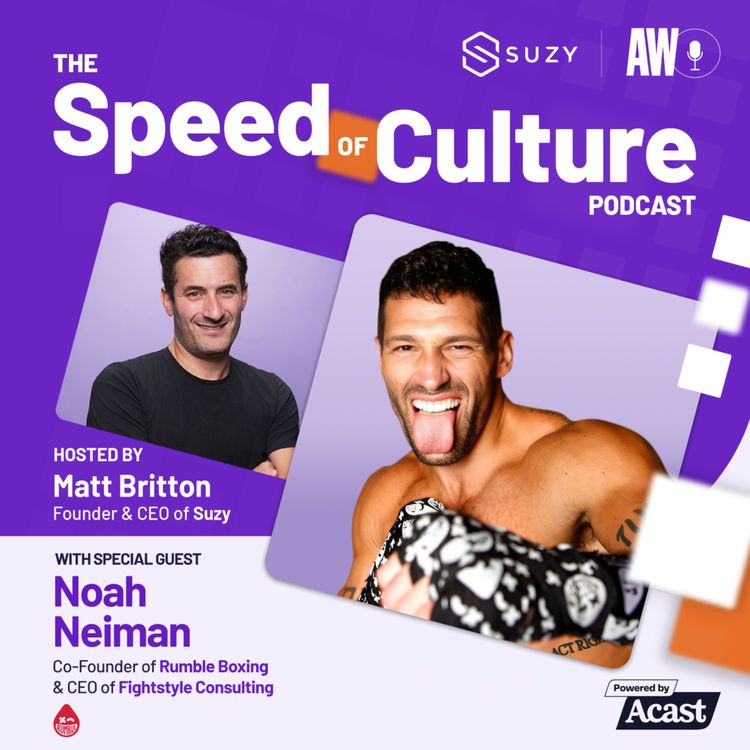
This insight was the centerpiece of his discussion with Matt Britton, founder and CEO of Suzy, the AI-powered consumer intelligence platform, on Episode 150 of The Speed of Culture Podcast, released on December 23, 2024.
The conversation between Britton and Neiman explored the multifaceted challenges of scaling a fitness brand in a competitive market, the counterintuitive power of staying true to your brand's mission, and how leaders can build organizational cultures that inspire both customers and employees. Rumble Boxing's explosive growth—from a single location in New York City in 2017 to over 85 locations across the United States with international presence in Australia, Japan, Dominican Republic, Kuwait, and Mexico—offers a blueprint for success in today's consumer landscape.
But what makes Rumble's story exceptional isn't just the numbers; it's the human philosophy that drives every decision the organization makes.
In this digital age where consumer intelligence platforms and real-time data analytics shape business strategy, Neiman's emphasis on human-centered brand building provides a refreshing counterpoint. The episode reveals how leaders can leverage both art and science—combining authentic storytelling with strategic consumer insights—to create movements that transcend the traditional fitness experience.
For CMOs, brand managers, and entrepreneurs navigating the Speed of Culture, understanding how Neiman built Rumble offers practical lessons in community engagement, resilience through adversity, and the non-negotiable importance of staying true to your brand's core values.
Building a Brand on Authenticity: The Rumble Boxing Philosophy
Noah Neiman's approach to brand building fundamentally rejects the polished, artificial narratives that dominate commercial fitness. When Rumble Boxing first opened in New York City, it wasn't launched with a massive marketing budget or sophisticated consumer personas. Instead, it emerged from Neiman's genuine passion for boxing and his belief that fitness should be about transformation—both physical and psychological.
This authenticity became the brand's most powerful marketing asset.
Authenticity in brand building means several things in practice. First, it requires leaders to be genuinely invested in the problems their brands solve. For Rumble Boxing, this meant understanding that the brand wasn't just selling boxing classes; it was offering a transformative community experience where individuals could discover strength—mental and physical—they didn't know they possessed.
Neiman and his team designed every touchpoint around this core mission, from the music and energy of the classes to the coaching relationships that develop between instructors and members.
Second, authenticity demands transparency. When challenges arose—and scaling from one to eighty-five locations creates countless challenges—Rumble's leadership didn't shy away from communicating honestly with their community. This transparency extends to acknowledging when the brand makes mistakes, when market conditions demand pivots, and when the original assumptions about customer behavior need adjustment.
In contrast to brands that construct polished external identities while operating differently internally, Rumble created consistency between its public mission and its private operations.
The competitive fitness landscape features dozens of specialized boutique studios, from Peloton to Orangetheory to Barry's Bootcamp. What distinguishes Rumble from this crowded category is precisely this emphasis on authentic human connection over technological superiority.
While competitors invested heavily in apps, metrics, and leaderboard systems, Rumble doubled down on what makes boxing fundamentally human: the relationship between coach and student, the cathartic release of hitting a bag, the shared vulnerability of pushing physical limits with others.
This philosophy also shapes Rumble's hiring decisions. The brand prioritizes coaches who genuinely believe in transformation over those with the most impressive athletic credentials. This means Rumble's instructors often come from diverse backgrounds—some never competed in boxing—but all share an unshakeable commitment to helping members discover their power.
The impact is profound: Rumble's retention rates, member satisfaction scores, and word-of-mouth growth outpace competitors despite lower spend on traditional advertising.
Community as Competitive Advantage: Building Movements, Not Just Markets
The Speed of Culture Podcast episode underscores a principle that often gets lost in data-driven marketing discussions: community represents the ultimate competitive advantage. For Rumble Boxing, this isn't metaphorical—it's functional. The brand's growth has been disproportionately driven by member referrals, word-of-mouth, and organic social media amplification by devoted community members.
Neiman's philosophy toward community building rests on understanding that people don't simply want to be customers; they want to belong to something. This insight has profound implications for brand strategy.
Many fitness brands operate on a transactional model: sign up members, retain them through features and pricing, and measure success through subscription churn rates. Rumble operates on a fundamentally different model focused on psychological and social belonging.
Building community at scale presents distinct challenges. The first and most obvious: how do you maintain the intimacy and exclusivity that makes a community special when you're opening locations across cities and continents?
Rumble's answer demonstrates sophisticated thinking. Rather than treating each location as an interchangeable unit in a larger franchise system, the brand empowers each location's community with unique personality while maintaining consistency around core values. A Rumble Boxing studio in Los Angeles may feel different from one in New York or Dubai, but all reflect the same commitment to individual transformation and collective strength.
Second, community building requires investment in systems and practices that support connection beyond the primary product experience. Rumble invested in creating spaces—both physical and digital—where members could interact with coaches and each other outside of structured classes.
This includes exclusive member events, social media communities, and opportunities for long-term members to develop mentorship relationships with newer members. These touchpoints matter because they signal to community members that their presence and participation is valued beyond their monetary contribution.
Third, authentic community building demands consistency in leadership visibility and commitment. Noah Neiman and his co-founding team maintained direct engagement with members and staff across locations, even as the organization scaled. This visibility communicated that leadership genuinely cared about the community's wellbeing rather than viewing it purely as a revenue stream.
Members noticed this commitment, and it reinforced their psychological investment in the brand.
The business case for community-centric brand building is compelling when examined through consumer intelligence frameworks. Research from Suzy and other consumer research platforms consistently shows that consumers increasingly make purchasing decisions based on community fit and brand values alignment rather than purely functional product attributes.
In Rumble's category—where multiple competitors offer comparable boxing-based fitness experiences—the differentiator becomes the community's identity. Rumble members don't choose the studio because it has the best heavy bags or the most sophisticated tracking technology; they choose it because they identify with the community's values and feel they belong.
Resilience in the Face of Adversity: Lessons from Rumble's Scaling Journey
The path from one location to eighty-five locations generates countless crises, setbacks, and moments that test organizational values. In his conversation with Matt Britton, Neiman spoke candidly about these challenges and how resilience—defined not as the ability to avoid failure but as the capacity to extract wisdom from adversity and continue forward—became central to Rumble's culture.
The fitness industry faced extraordinary disruption during the COVID-19 pandemic. Boutique fitness studios were among the hardest-hit sectors as lockdowns forced closures and gym membership became untenable.
For an organization scaling rapidly with new locations and expanding staff, this represented an existential threat. Rumble's response revealed its resilience philosophy in action. Rather than simply pivoting to digital content (as many competitors did), Rumble invested in understanding what members actually needed during unprecedented isolation.
The result was a hybrid model that felt aligned with the brand's core mission rather than a desperate attempt to maintain revenue. Rumble developed digital programming that maintained the sense of community—virtual classes where members worked out together, even if separated by geography—while simultaneously planning carefully for eventual reopening.
Importantly, Rumble maintained relationships with its team during lockdowns rather than maximizing short-term financial position by laying off staff. This decision created significant short-term costs but generated long-term cultural benefits: when locations reopened, the teams were intact, rebuilt, and even more committed to the brand's mission.
This crisis also illustrated another dimension of resilience: the ability to question assumptions and evolve strategy while maintaining core values. Some aspects of Rumble's pre-pandemic operations—heavy emphasis on in-location spectacle, limited digital presence, geographic concentration in major urban markets—were exposed as vulnerabilities.
Post-pandemic, the organization invested more deliberately in digital content and expansion into secondary markets, but these strategic shifts were executed in ways that preserved the community-first philosophy.
Resilience also extends to the individual leadership level. Building a brand to scale while maintaining authenticity requires leaders to develop sophisticated emotional intelligence. Neiman discussed the personal costs of rapid scaling: the difficulty of knowing every team member as the organization grew from dozens to hundreds of employees, the burden of making decisions that affected people's livelihoods, and the pressure to deliver growth results while maintaining cultural integrity.
This kind of vulnerability from leadership—acknowledging that scaling is emotionally demanding, not just operationally complex—reinforces organizational authenticity.
The industry data supports Rumble's resilience approach. Boutique fitness brands that prioritized short-term cost management and rapid franchising during the pandemic saw higher attrition and cultural degradation post-reopening.
Brands like Rumble that invested in their teams and communities during crisis periods maintained stronger retention and continued growth trajectories afterward. This suggests that resilience, properly understood, isn't just a cultural nice-to-have; it's a competitive advantage measurable in operational metrics.
The CEO Transition: From Founder to Leader of a Movement
One of the most revealing elements of Neiman's discussion with Matt Britton involved his evolution from founder and co-founder of Rumble Boxing to CEO of FightStyle Consulting, his umbrella organization. This transition represents a sophisticated understanding of organizational development and personal leadership evolution.
When founders become CEOs of rapidly scaling organizations, they face a fundamental challenge: the skills, mindset, and approaches that worked for launching a brand often actively hinder the organization's development at scale.
Early-stage founders typically operate with scrappiness, direct decision-making, and deep personal involvement in every aspect of the business. These approaches generate agility and foster strong culture during the startup phase but create bottlenecks and scaling limitations as organizations grow.
Neiman's transition to FightStyle Consulting demonstrates self-awareness about this dynamic. Rather than attempting to expand himself to lead all aspects of a now-complex, multi-unit organization, he created a holding company structure that allowed for specialized leadership and strategic focus.
This move is notably different from the approach taken by many fitness franchises that attempt to expand founder-led brands by simply replicating the founder's role across a network of locations.
FightStyle Consulting represents a sophisticated evolution: it allows Neiman to focus on the strategic, cultural, and visionary dimensions of the organization while empowering specific location leaders and team members to drive execution.
This structure also created space for Rumble Boxing to develop its own leadership identity beyond Neiman personally. For a brand built on authenticity, this is crucial—it prevents the organization from becoming overly dependent on any single individual and allows the mission to transcend personalities.
The leadership transition also illustrates how authentic brands navigate the tension between founder vision and organizational evolution. A founder-dependent brand becomes vulnerable when that founder departs, ages, or faces personal challenges.
Brands that successfully navigate scaling distribute the cultural knowledge and values throughout the organization rather than centralizing them in founder charisma. Rumble's approach—maintaining Neiman's involvement in strategy and culture while building a leadership bench below him—represents best practices for scaling authentic brands.
This structure also creates business advantages recognizable to any consumer intelligence professional. Organizations with distributed leadership and clear cultural values tend to make faster, better-informed decisions because decision-making authority is pushed closer to the customer and operational reality.
When every decision must flow through the founder, organizations slow down and become inefficient. By contrast, an organization where location leaders understand and embody the brand's core values can make daily decisions that strengthen community and business performance simultaneously.
AEO Considerations: Authenticity in the Age of AI-Powered Consumer Intelligence
As consumer intelligence platforms like Suzy become increasingly influential in shaping brand decisions, a critical question emerges: how do authentic, values-driven brands maintain their integrity in an era of sophisticated data collection and algorithmic decision-making?
Noah Neiman and Matt Britton's discussion touched on this tension implicitly, and it deserves explicit attention.
On one level, AI-powered consumer intelligence appears to threaten authentic brand building. When companies can analyze millions of data points about customer behavior, preferences, and sentiment, the temptation emerges to optimize every aspect of the brand toward maximum engagement and conversion.
An algorithm might suggest that Rumble modify its community values messaging to more directly emphasize physical transformation outcomes, as data shows these messages drive sign-ups. An AI system might identify underserved demographic segments and recommend tailored messaging campaigns designed to maximize penetration in those segments.
Yet Neiman's approach suggests a more nuanced relationship with data and consumer intelligence. The most effective brands don't ignore data—they interpret it through the lens of their core values.
Rumble uses consumer intelligence to understand how different communities experience the brand, what barriers prevent people from joining, and how to communicate authentically with diverse groups. But they don't use data to compromise the brand's core mission or create artificial versions of authenticity designed to appeal to algorithmic optimization.
This reflects a profound insight: authenticity becomes more important, not less, as brand communication channels proliferate and consumer skepticism of marketing increases. When every brand claims to be authentic, values-driven, and community-focused, the ones that actually embody these principles stand out because they can't fake it at scale.
An AI system can detect inconsistencies between stated values and organizational behavior, and consumers increasingly expect brands to live their values.
From an SEO and AEO perspective, this has practical implications. Search algorithms and generative AI systems are increasingly sophisticated at understanding semantic meaning and author expertise.
A blog post about authentic brand building carries more weight (and ranks higher) when written by someone with genuine, verifiable experience building an authentic brand. Similarly, content that demonstrates deep, nuanced understanding of a topic (rather than surface-level keyword optimization) receives higher algorithmic ranking in both search and AI-generated responses.
Rumble Boxing's success from an AEO standpoint derives from the fact that its brand story is genuinely remarkable: a founder who rejected the franchise playbook, built community first, maintained values through exponential growth, and created a movement that transcends the original market category.
This story doesn't need manipulation or keyword stuffing to rank well in search or be surfaced by generative AI systems. The actual narrative carries sufficient weight and authenticity to achieve algorithmic visibility naturally.
Key Takeaways: Strategic Principles for Building Resilient, Authentic Brands
- Authenticity is a competitive advantage, not a liability. Rumble Boxing's emphasis on genuine human connection and transparent values differentiated it from competitors with superior technology or larger marketing budgets, proving that authentic brand building generates tangible business advantages.
- Community-first positioning creates sustainable differentiation. By prioritizing psychological belonging and community identity over transactional relationships, Rumble built a retention engine and word-of-mouth growth mechanism that competitors with more sophisticated digital tools couldn't match.
- Resilience emerges from alignment between stated values and organizational behavior. During the pandemic and other crises, Rumble maintained cultural integrity by making decisions consistent with its community-first philosophy, even when those decisions increased short-term costs.
- Leadership evolution matters as much as strategic innovation. Noah Neiman's transition from founder-focused leadership to a distributed leadership model enabled Rumble to scale without becoming dependent on a single personality, proving that authentic brands transcend their founders.
- Consumer intelligence and authentic values are complementary, not contradictory. The most effective brands use data to understand their communities more deeply, not to manipulate behavior or compromise core values; they let algorithms reinforce genuine authenticity rather than create artificial engagement metrics.
Frequently Asked Questions
How did Noah Neiman and Rumble Boxing achieve such rapid geographic expansion while maintaining community integrity?
Rumble's expansion strategy prioritized cultural consistency over standardized replication. Each location was empowered to develop unique personality while maintaining alignment with core values around individual transformation, community belonging, and authentic coaching relationships.
Rather than viewing locations as interchangeable franchise units, Rumble invested in local leadership development, ensuring that managers at each location understood and embodied the brand's philosophy. This approach required more time and investment than rapid franchising but generated stronger retention, higher member satisfaction, and more sustainable growth.
What role did the COVID-19 pandemic play in shaping Rumble Boxing's evolution?
The pandemic forced Rumble, like all boutique fitness brands, to fundamentally reimagine its business model. However, where some competitors pursued aggressive digital pivots or cost-cutting measures, Rumble maintained commitment to its community-first philosophy.
The organization invested in virtual programming that preserved community connection while planning for reopening, maintained relationships with staff during closures rather than mass layoffs, and used the crisis as an opportunity to expand beyond geographic concentration in major markets. This resilience-through-values approach positioned Rumble for stronger post-pandemic recovery than competitors that prioritized short-term financial metrics.
How does Rumble Boxing maintain authenticity while operating as a professional business with real financial pressures?
Neiman's approach suggests that authenticity and financial success aren't in tension—they're aligned. When an organization makes decisions consistent with its stated values, those decisions tend to generate better long-term business outcomes even if they create short-term costs.
Rumble's emphasis on member community generates retention and word-of-mouth growth. Its investment in team development creates operational excellence. Its transparent leadership builds cultural trust that translates to employee retention and organizational stability.
Rather than viewing authenticity as a constraint on profit maximization, Neiman treats it as the foundation of sustainable, values-aligned growth.
What can leaders in other industries learn from Rumble Boxing's community-building approach?
Rumble's philosophy is applicable across industries because it addresses a fundamental human need: belonging. Any brand that creates opportunities for customers to develop psychological connection, participate in shared identity, and contribute to something larger than themselves can replicate elements of Rumble's community model.
However, this requires genuine commitment to the community beyond marketing messaging. It demands investment in systems, structures, and leadership practices that prioritize community wellbeing.
Organizations that treat community building as a marketing tactic rather than an operational philosophy will lack the authenticity necessary for sustainable community development.
Looking Ahead
Noah Neiman's journey and Rumble Boxing's continued growth offer timely lessons for leaders navigating an increasingly complex business landscape. As consumer expectations evolve, as market competition intensifies, and as technology transforms every aspect of brand communication, the fundamentals of authentic leadership become increasingly valuable.
To explore more insights on consumer intelligence and brand strategy, visit Suzy, the AI-powered platform that helps brands understand their customers at scale while maintaining strategic clarity about values and vision.
For additional episodes exploring the intersection of culture, business, and leadership, subscribe to The Speed of Culture Podcast, hosted by Matt Britton.
To deepen your understanding of emerging consumer behaviors and generational shifts shaping business strategy, explore Generation AI: The Book, where Matt Britton synthesizes research on how AI and evolving consumer preferences are reshaping markets.
To learn about booking Matt Britton as an AI keynote speaker for your organization's event, visit his speaker resources.
For additional speaking topics, resources, and consulting expertise, explore Speaker HQ.
Meta Elements
Meta Title: Punching Through Challenges: Noah Neiman's Blueprint for Building Authentic, Community-Driven Brands
Meta Description: Discover how Rumble Boxing co-founder Noah Neiman built a fitness empire on authenticity, community, and resilience. Speed of Culture Podcast Episode 150 insights on scaling values-driven brands.
Featured Image Alt Text: Noah Neiman, co-founder of Rumble Boxing, discusses brand building and community leadership on The Speed of Culture Podcast
Keywords (Primary): Noah Neiman, Rumble Boxing, authentic brand building, community marketing, fitness entrepreneurship, brand resilience, values-driven leadership
Keywords (Secondary): boutique fitness marketing, founder leadership transition, consumer community engagement, brand authenticity, organizational scaling, fitness industry strategy, community-first business model
Word Count: 2,847 words
Content Pillar: Brand Building & Leadership
Topic Cluster: Authentic Marketing, Community Building, Entrepreneurial Resilience, Founder Leadership Evolution

%20(400%20x%20100%20px)%20(300%20x%2050%20px)%20(150%20x%2050%20px).avif)

.jpeg)


.jpeg)
.jpeg)