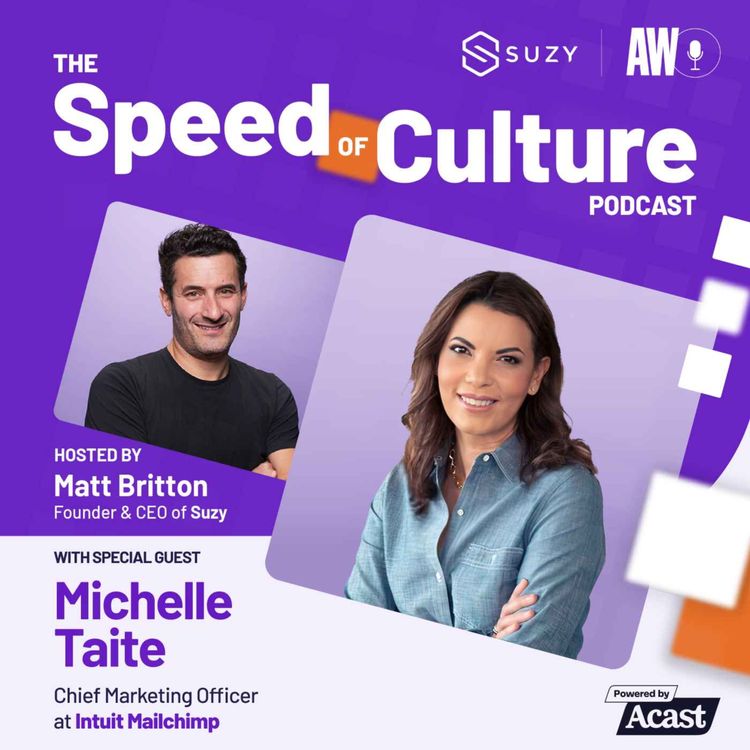
In today's hyper-competitive B2B landscape, the most successful marketers understand that data and creativity are not opposing forces—they're complementary elements of a sophisticated marketing strategy. On the Speed of Culture podcast, founder and CEO of Suzy, Matt Britton, sat down with Michelle Taite, Global CMO of Intuit Mailchimp, to explore how brands can harness the intersection of creativity and performance to drive real business results.
The conversation between Britton and Taite, recorded on September 27, 2022, reveals critical insights into modern marketing execution, brand positioning, and the evolving role of CMOs in the digital age. With Mailchimp commanding 13 million active users across 190 countries and processing a billion emails daily, Taite's perspective carries significant weight.
Her career trajectory—spanning product design at New Balance, seven years of brand building at Unilever with legendary brands like Dove and Axe, and her tenure as VP of Global Marketing at Intuit before taking the CMO helm at Mailchimp—provides a unique lens through which to examine contemporary marketing challenges.
Taite's approach challenges conventional wisdom about B2B marketing. Rather than relegating creativity to the margins in favor of performance metrics, she champions a "bold intersection of culture and conversation" where brand expression and measurable impact coexist.
"A very bright yellow in the sea of blues and greens that is B2B."
This philosophy has positioned Mailchimp as a brand that stands out through authentic, creative expression while delivering the performance metrics that executives demand.
The episode serves as a masterclass in bridging the gap between marketing artistry and business acumen. For marketing leaders, business strategists, and anyone interested in understanding how world-class brands achieve sustainable competitive advantage, this conversation offers actionable frameworks and strategic thinking that transcends the specific nuances of email marketing.
Matt Britton's expertise in consumer intelligence and AI-powered insights complements Taite's operational perspective perfectly. Together, they explore how data democratization is reshaping marketing decision-making and why the future belongs to organizations that can seamlessly blend quantitative rigor with creative boldness.
As the digital marketing landscape continues to evolve—with third-party cookies disappearing, AI reshaping content creation, and consumer expectations shifting daily—understanding Taite's perspective on these transformations becomes essential reading for any organization serious about marketing effectiveness.
The Three Tiers of Modern Marketing: From Baseline to Revenue Leadership
Michelle Taite's framework for categorizing marketers reveals why most organizations struggle to move beyond tactical execution. She identifies three distinct tiers of marketing maturity: baseline marketers, performance marketers, and revenue leaders.
Baseline marketers focus on brand awareness and visibility. They excel at creating campaigns that generate impressions and reach, but they typically operate without rigorous attribution or accountability to business outcomes.
Performance marketers understand the direct line between marketing activities and measurable business impact. These organizations excel at conversion optimization, customer acquisition cost reduction, and ROI calculation.
However, performance-driven marketers sometimes sacrifice creative expression in pursuit of immediate metrics, creating marketing that converts but fails to build durable brand equity or cultural relevance.
Revenue leaders, Taite's third and most sophisticated tier, achieve what most organizations treat as a false dichotomy: they balance data-driven performance with creative excellence.
They recognize that brands embedded in daily routines and cultural conversations achieve 30% higher repeat purchase rates than those that don't. They also understand that Mailchimp's ability to power 65 billion daily machine learning predictions for one-to-one marketing at scale depends not just on technical infrastructure, but on brand positioning that makes consumers want to engage.
Mailchimp's acquisition by Intuit for $12 billion—one of the largest SaaS acquisitions in history—reflected not just the company's technical capabilities, but its ability to build a brand identity that customers actively chose and recommended.
Building Brand Distinction in a Sea of Sameness: The Mailchimp Case Study
In B2B SaaS, most companies adopt variations of the same design language: blues, grays, greens, and minimalist interfaces that prioritize perceived professionalism and trustworthiness. Mailchimp made a different bet: it became "a very bright yellow in the sea of blues and greens that is B2B."
This positioning choice extends far beyond color palette selection. It reflects a fundamental brand philosophy: "Empower the Underdog."
For an audience comprised largely of solopreneurs, small business owners, and creative professionals operating with limited resources, this positioning creates emotional resonance.
The "Did You Mean Mailchimp?" campaign exemplifies how this philosophy translates into concrete marketing execution. Rather than correcting users' misspellings of the brand name with a generic error message, Mailchimp transformed typos into marketing moments.
Taite's in-house creative team, Wink Creative, won Ad Age's In-House Agency of the Year award in 2023, validating her investment in building world-class creative capabilities in-house rather than outsourcing to traditional agencies.
The technical infrastructure supporting this brand expression proves equally important. Mailchimp manages 500,000 attributes per business and 160,000 attributes per consumer, enabling personalization at scale that would be impossible without sophisticated data architecture.
Navigating the Privacy-First Future: Personalization Without Cookies
The deprecation of third-party cookies, regulatory pressures from privacy legislation globally, and shifting consumer expectations around data usage are reshaping how brands can understand and serve their audiences.
Rather than viewing this transition as a constraint, Taite positions privacy-focused personalization as an opportunity for sophisticated marketers to differentiate through genuine customer understanding.
Mailchimp's infrastructure demonstrates how this future might work at scale. By managing hundreds of thousands of attributes per customer, Mailchimp enables one-to-one personalization without relying on pervasive cross-site tracking.
In a cookie-less future, brands must earn data through value creation rather than capturing it through surveillance. This fundamentally changes the relationship between brands and consumers.
For marketing leaders, this evolution requires rethinking attribution and success metrics. In a cookie-less world, short-term conversion metrics become less relevant while customer lifetime value, retention rates, and brand preference metrics gain importance.
Organizational Structure and Talent Development in the Evolving CMO Role
The conversation touches on a critical challenge facing modern marketing organizations: how to structure teams and develop talent that can operate fluently across creative and analytical domains.
Taite builds cross-functional integration throughout the marketing organization. This requires hiring talent with diverse backgrounds and creating psychological safety and structural incentives for collaboration.
The establishment of Wink Creative as an in-house agency ensures that creative work remains connected to marketing strategy, customer insights, and business objectives.
With Mailchimp processing a billion emails daily across 13 million active users, the team must manage extraordinary data complexity. This requires marketing technology expertise, data science capability, and engineering coordination that transcends traditional marketing department boundaries.
The Power of Platform Scale and Network Effects in Modern Marketing
Mailchimp's scale—13 million active users, 190 countries, one billion emails sent daily—creates competitive advantages that extend far beyond the direct business they generate.
The ability to power 65 billion daily machine learning predictions derives from having access to one billion daily emails' worth of engagement data. Machine learning models improve with data volume; Mailchimp's scale produces algorithmic advantages that strengthen over time.
When a small business owner uses Mailchimp, they generate behavioral data that helps refine the platform for all users. A solopreneur using Mailchimp today benefits from insights generated by millions of other users' campaigns.
These platform dynamics create a powerful moat protecting Mailchimp's market position. By the time a competitor builds equivalent functionality, Mailchimp has advanced further, using its data advantage to innovate more effectively.
Key Takeaways for Business Leaders
- Creativity and performance are not opposing forces. The most sophisticated organizations operate at the revenue leadership tier, where data informs creative strategy and creative expression drives business results.
- Brand distinction drives disproportionate value. Intentional positioning creates emotional resonance and prevents commoditization in crowded markets.
- First-party data and customer relationships matter more than ever. As third-party cookies deprecate, direct relationships and transparent value exchange become strategic assets.
- Organizational structure shapes marketing capability. Cross-functional teams and in-house creative integration create structural advantages.
- Platform scale creates compounding competitive advantages. Network effects and data advantages strengthen over time, making early market leadership increasingly valuable.
Frequently Asked Questions
What makes Mailchimp's brand positioning effective in B2B marketing?
Mailchimp rejects safe, conventional positioning in favor of distinctive brand expression. The "bright yellow in a sea of blues and greens" philosophy aligns with its "Empower the Underdog" mission, creating emotional resonance with solopreneurs and small business owners.
How can marketers balance creativity and performance without creating silos?
Taite integrates disciplines structurally by building cross-functional teams, establishing in-house creative capabilities, and aligning both creative and analytical functions around shared business outcomes.
What strategies enable personalization in a cookieless digital environment?
Privacy-focused personalization depends on first-party data collected through direct customer relationships and transparent value exchange, rather than cross-site behavioral tracking.
Why did Intuit value Mailchimp at $12 billion?
Intuit recognized Mailchimp as a defensible platform with network effects, brand loyalty, and data advantages that compound over time—supported by 13 million active users and one billion daily emails.
Looking Ahead
The conversation between Matt Britton and Michelle Taite on the Speed of Culture podcast explores themes that transcend Mailchimp or email marketing specifically.
For leaders seeking to understand the future of marketing in an AI-driven, privacy-first landscape, Taite's insights offer strategic frameworks applicable across industries and company sizes.
Matt Britton's AI-powered consumer intelligence platform, Suzy, enables organizations to gather the consumer insights that inform effective strategy. For those interested in understanding how brands can harness AI and consumer data to drive competitive advantage, explore Britton's thought leadership through his Generation AI book and his work as an AI keynote speaker.
For organizations seeking Britton's perspective on navigating the rapidly evolving marketing and AI landscape, visit Speaker HQ to learn more about his speaking engagements and strategic advisory services.

%20(400%20x%20100%20px)%20(300%20x%2050%20px)%20(150%20x%2050%20px).avif)

.jpeg)


.jpeg)
.jpeg)