February 11, 2025
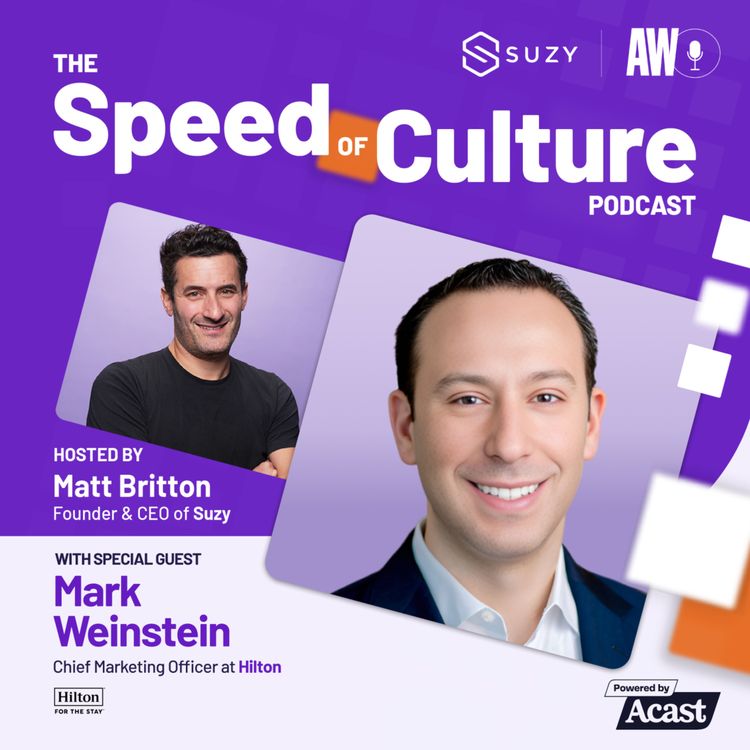
Mark Weinstein
CMO
Hilton
How Hilton is Turning Fandom into First-Class Stays—Insights from CMO Mark Weinstein
This is some text inside of a div block.
This is some text inside of a div block.
LISTEN ANYWHERE YOU FIND YOUR PODCASTS
%20(400%20x%20100%20px)%20(300%20x%2050%20px)%20(150%20x%2050%20px).avif)

The future of hospitality marketing is no longer about convincing travelers why they should stay at a hotel—it's about transforming the stay itself into an experience worth traveling for. In Episode 162 of the Speed of Culture Podcast, recorded on February 11, 2025, host Matt Britton, founder and CEO of Suzy, the AI-powered consumer intelligence platform, sat down with Mark Weinstein, Chief Marketing Officer of Hilton Hotels, to explore how one of the world's largest hospitality brands is fundamentally redefining the guest experience through fandom-driven marketing, first-party data intelligence, and hyper-personalization.
Weinstein's tenure at Hilton spans over 14 years, during which he has orchestrated some of the hospitality industry's most transformative campaigns. From rebranding Hilton Honors—expanding it from 25 million members to over 200 million—to launching the iconic “Hilton. For the Stay” platform and the award-winning “It Matters Where You Stay” campaign, Weinstein has consistently demonstrated an ability to blend marketing creativity with data-driven strategy.
But his latest initiative takes a bold step forward: recognizing that modern travelers—particularly Gen Z and younger millennials—are making destination decisions not based on geography or amenities alone, but on cultural moments, passions, and identities they want to immerse themselves in.
This shift represents a seismic change in how the hospitality industry conceptualizes its value proposition. Rather than offering a place to sleep, Hilton is now offering entry points into the cultural universes their guests care most about. Whether it's a Taylor Swift concert, an F1 Grand Prix, a fashion week event, or even the glamorous world of a celebrity lifestyle, Hilton has begun positioning its properties as gateways—combining premium accommodations with experiential marketing that speaks directly to guest passions.
The implications for other brands extend far beyond hotels. In an era where AI enables unprecedented personalization, where first-party data has become the most valuable asset in marketing, and where guest loyalty hinges on emotional connection rather than transactional rewards, Hilton's approach offers a masterclass in modern hospitality marketing.
This episode explores how brands can leverage data intelligence, understand cultural inflection points, and build marketing strategies that transform fans into loyal customers. More importantly, it reveals how the convergence of personalization technology, cultural insight, and human-centered design can create competitive advantages that transcend industry boundaries.
For decades, the hospitality industry operated under a transactional paradigm. Hotels marketed beds, amenities, location, and price. Marketing teams relied on demographic segmentation, broad channel strategies, and loyalty programs designed primarily to incentivize repeat bookings through points accumulation.
The industry's leading metrics—occupancy rates, average daily rates (ADR), and customer lifetime value—reflected a fundamentally functional view of the guest relationship.
Mark Weinstein's approach at Hilton represents a fundamental departure from this model.
“What if the stay itself could be the reason to travel?”
This philosophical shift unlocks new possibilities for personalization and guest engagement.
Weinstein's strategy begins with recognizing that consumer behavior has fundamentally changed. Modern travelers—particularly Gen Z, which now represents a significant and growing share of travel bookings—don't simply travel to reach destinations. They travel to participate in moments, to experience cultures, to feel part of communities.
A Taylor Swift Eras Tour creates a cultural phenomenon that transcends music. An F1 Grand Prix in Monaco attracts not just motorsports enthusiasts but fashion-forward travelers seeking the aesthetic and status associated with the event. Even the resurgence of celebrity-inspired experiences reflects deeper desires for aspirational living and identity expression.
Hilton's “Stay Like” campaign, launched in September 2024, represents the operational manifestation of this insight. The campaign reimagined what a hotel experience could be by blurring the lines between hospitality, fandom, and live experience.
Rather than positioning hotels as backdrops to guest adventures, Hilton began designing stays that were themselves the adventure.
A flagship example is “Stay Like an Infinite Icon” at the Beverly Hilton in Los Angeles. The concept invited guests into the glamorous universe of Paris Hilton, with rooms outfitted with authentic memorabilia, detailed replicas, and design elements that immersed guests in her world.
This wasn't simply a themed room—it was a fan experience delivered through accommodation. Guests weren't staying at a hotel; they were experiencing a lifestyle, creating shareable moments, and engaging with the brand on an emotional level that traditional loyalty programs cannot match.
The strategic brilliance lies in understanding that fandom is now a core motivator of travel behavior. Brands like Hilton have extensive reach across major event destinations—whether concerts, sporting events, fashion weeks, or cultural moments.
By strategically positioning properties near these events and designing experiences around them, Hilton transforms its hotel portfolio into infrastructure that supports fan engagement, while simultaneously creating exclusive, memorable experiences that drive brand loyalty and social media amplification.
This evolution also reflects broader changes in how brands approach consumer relationships. In the AI-driven marketing era that dominates 2025, successful brands recognize that data intelligence should serve emotional connection, not replace it.
The most effective personalization strategies combine technological capability with cultural understanding—knowing not just what guests prefer, but why those preferences matter to their identity and aspirations.
While experiential marketing and fandom-driven strategies capture attention and drive emotional engagement, the operational backbone enabling Hilton's transformation is fundamentally technological: the systematic collection, analysis, and activation of first-party data at unprecedented scale.
For hospitality brands, data collection opportunities exist across the entire guest journey. From initial booking through post-stay engagement, brands capture preference signals—room types, temperature preferences, pillow firmness, check-in times, dining preferences, amenity usage, and countless behavioral indicators that reveal who a guest is and what experiences will resonate with them.
Historically, much of this data remained siloed, inaccessible across properties, or underutilized for personalization.
Hilton's competitive advantage stems partly from its Connected Room platform, which functions as a proprietary data collection mechanism operating at the point of experience—inside the guest's room. This IoT ecosystem captures behavioral data that competitors like Marriott, Accor, and IHG lack systematic mechanisms to understand.
What does a guest do inside their room? How do they interact with smart room controls? What entertainment, dining, and service preferences do they express? These insights represent unstructured, behavioral data that reveal deeper truths about guest preferences than survey responses ever could.
The scale of Hilton's loyalty program amplifies this advantage. With over 200 million Hilton Honors members generating transaction data across more than 8,400 properties spanning 24 brands in 140 countries, Hilton operates one of the world's largest behavioral datasets in hospitality.
Each stay contributes preference data, browsing behavior, price sensitivity, booking patterns, and engagement metrics. Over time, this creates a comprehensive behavioral profile that enables increasingly sophisticated personalization.
The impact on marketing effectiveness is substantial and measurable. Hilton has reported a 20% increase in conversion rates from its marketing campaigns as a result of data-driven personalization.
Email marketing powered by data from Hilton Honors members achieves open rates 25% above industry average. Direct channels—channels where Hilton controls the customer relationship and data—now generate over 60% of all bookings and nearly 70% of total revenue.
First-party data also provides resilience as the digital advertising landscape continues fragmenting. With third-party cookies becoming obsolete and platform-specific data becoming increasingly restricted, brands that built first-party data capabilities before the privacy shift gained irreplaceable competitive advantages.
Hilton's loyalty program and direct customer relationships create a channel where the brand maintains unmediated access to guest intelligence, enabling personalization without reliance on third-party data brokers or platform-dependent targeting.
The strategic implications extend beyond immediate marketing performance. First-party data creates a “moat” that makes the brand increasingly sticky.
Guests who recognize that the brand understands their preferences—who experience rooms configured to their specifications, who receive recommendations aligned with their interests, who feel individually recognized—develop higher switching costs. They stay because the experience, informed by data, is demonstrably superior.
However, Weinstein's approach also reveals an important nuance often overlooked in data-driven marketing discussions: data is only valuable insofar as it serves guest experience.
The collection and analysis of first-party data isn't a marketing play—it's a foundational capability for delivering hospitality. Guests don't care about data strategy; they care about being understood.
When a brand demonstrates understanding through action—adjusting room temperature to known preferences, offering room service recommendations based on previous visits, recognizing the guest by name and accommodating their specific needs—the data infrastructure becomes invisible, replaced by the perception of attentive, personalized service.
Beyond the transactional data generated through hotel stays, Hilton's marketing strategy reveals an equally important insight: fandom itself functions as a first-party data source.
Understanding what guests are passionate about—what cultural moments they're traveling for, what communities they identify with, what experiences fuel their aspirational identities—represents a form of behavioral intelligence that enables even more nuanced personalization.
Modern travel behavior reflects a fundamental shift in how people make destination decisions. Geographic and functional factors remain relevant but increasingly secondary to what the industry calls “cultural travel.”
Gen Z and younger millennials travel to Taylor Swift concerts not because they need accommodation in that city, but because participating in that cultural moment feels essential to their identity and sense of belonging.
Recognizing this shift, Hilton began asking: How can we position our properties to serve these cultural moments?
The practical answer involved strategic property positioning—ensuring hotels near major event venues, concert halls, and cultural centers. But the strategic answer involved deeper insight: understanding that fans traveling to events represent captive audiences with demonstrated passion and willingness to spend.
The “Stay Like” campaign operationalized this insight by designing stays around fandom. “Stay Like an Infinite Icon” at the Beverly Hilton invited guests into the universe of Paris Hilton.
From a data strategy perspective, this approach generates multiple valuable insights:
The broader implication is that successful modern hospitality marketing requires understanding guests not as demographic categories, but as individuals with passions, aspirations, and identity markers.
The most effective personalization combines explicit data (what guests tell you), behavioral data (how they act), and cultural data (what they care about and aspire to be).
The transition to fandom-driven, data-informed personalization requires solving a fundamental operational challenge: delivering individually customized experiences across thousands of properties serving millions of guests annually.
At a technical level, Hilton has invested substantially in AI systems capable of processing guest data, predicting needs, and recommending experiences at scale.
Smart room technology represents one visible manifestation. Based on guest preferences saved in Hilton Honors profiles, rooms can automatically adjust lighting, temperature, and entertainment upon arrival.
But the more sophisticated application involves anticipatory personalization. Rather than waiting for requests, AI systems analyze patterns to predict what guests might want.
The impact on operational efficiency is significant. Personalization improves guest experience while simultaneously improving operational economics.
However, Weinstein's approach emphasizes a critical counterbalance: technology should amplify human connection, not replace it.
AI handles routine adjustments and data synthesis. Staff, informed by AI-generated insights and freed from routine tasks, focus on genuine human interaction.
The most sophisticated hospitality experiences involve technology working invisibly in the background while human connection remains visible and primary.
Scaling personalization also requires organizational integration. Insights, marketing, and operations teams must align around real-time customer understanding.
By integrating these functions, Hilton ensures that data insights, marketing strategy, and operational execution align seamlessly.
The convergence of AI-driven personalization, experience-driven travel behavior, and first-party data capabilities is fundamentally reshaping competitive advantage in hospitality.
Every brand increasingly operates in the “experience economy,” where functional differentiation has commoditized and emotional experience drives loyalty.
The episode of the Speed of Culture Podcast featuring Mark Weinstein illustrates principles broadly applicable to modern marketing.
Successful strategies integrate three elements: first-party data capturing real behavior, cultural intelligence understanding what customers care about, and human-centered design ensuring technology enhances authentic connection.
Hilton's “Stay Like” campaign works not because of superior algorithms alone, but because it reflects deep understanding of how people make travel decisions and what experiences resonate emotionally.
The future of travel will continue this trajectory. Expect more properties positioned around cultural moments, more sophisticated personalization, and continued investment in AI-driven service prediction.
But differentiation will belong to brands that deliver personalization that feels authentically human—where technology works invisibly and genuine connection remains primary.
Weinstein's leadership demonstrates that the most future-ready hospitality brands aren't those investing most heavily in technology, but those understanding most deeply how technology serves the human experience of travel.
Traditional hospitality marketing focused on promoting features—rooms, amenities, location, pricing. Fandom-driven marketing inverts this approach by designing the stay itself to be the reason to travel.
“Stay Like” experiences position hotels as gateways into cultural universes guests care about, creating stronger loyalty through identity-based positioning rather than feature-benefit messaging.
Hilton's 200+ million Hilton Honors members provide proprietary behavioral intelligence that enables precise targeting, direct performance measurement, channel efficiency, operational coordination, and resilience amid third-party data decline.
Direct channels powered by first-party data generate over 60% of bookings and nearly 70% of revenue, reducing reliance on paid advertising.
Personalization feels service-oriented when AI enhances comfort and convenience—automatically adjusting room temperature or enabling proactive service.
By keeping human connection visible and primary, Hilton ensures AI handles optimization while staff focus on genuine relationship building.
Any brand can understand the communities and aspirations their customers identify with, position products as entry points into those communities, and design experiences aligned with identity markers.
The principle—that modern customers respond to brands serving their aspirational values—applies broadly across industries.
The conversation between Matt Britton and Mark Weinstein on Episode 162 of the Speed of Culture Podcast highlights how leading brands integrate data intelligence, cultural insight, and human-centered design.
.jpeg)


.jpeg)
.jpeg)