Opening
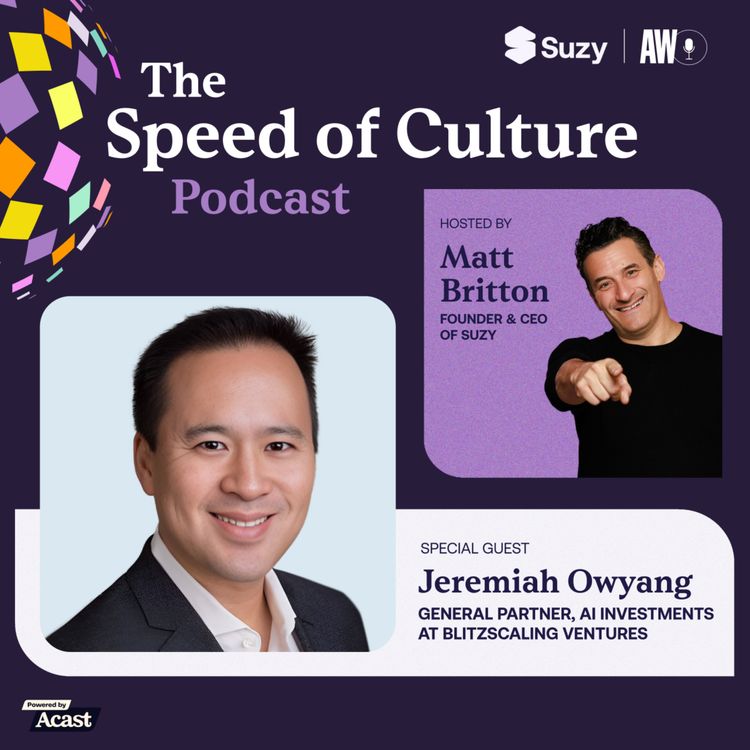
The influencer marketing landscape is undergoing its most profound transformation since the rise of TikTok creators. In a new episode of the Speed of Culture Podcast, Matt Britton, founder and CEO of Suzy, the AI-powered consumer intelligence platform, sits down with Jeremiah Owyang, General Partner at Blitzscaling Ventures, to explore a fundamental shift: artificial influencers are no longer theoretical—they're reshaping how brands connect with consumers and make purchase decisions.
This conversation arrives at a critical inflection point. As brands have traditionally pivoted from bloggers to YouTubers to TikTok stars, they now face a new reality that's more radical than any previous shift. The next wave of influencers won't be human. They'll be AI agents—sophisticated systems capable of learning, improving, and even recruiting other AI agents to make autonomous purchasing decisions on behalf of consumers.
Owyang's central thesis is disarmingly simple yet transformative: there's a new influencer in town, and it's not a human—it's an AI agent. This isn't about distant future speculation. The shift is already underway, with consequences for every brand's marketing strategy, from consumer goods to B2B enterprises.
Traditional advertising, as we've known it, faces what Owyang describes as a "tectonic shift." As consumers increasingly turn to AI tools like ChatGPT, Claude, and Perplexity for information and recommendations, the digital advertising real estate that brands have relied on for two decades is effectively disappearing.
The implications extend far beyond marketing tactics. They touch on fundamental questions about how brands build trust, how consumers make decisions, and where the real competitive advantages lie in an AI-driven economy. The conversation between Britton and Owyang reveals that success in this new era won't come from simply replicating traditional influencer marketing strategies with AI—it requires rethinking discoverability, agency, and the human skills that will matter most when AI becomes the primary interface between brands and buyers.
The Rise of AI Influencers: From Bloggers to AI Agents
The history of influencer marketing reveals a consistent pattern: each technological shift introduces a new type of influencer, and brands that adapt fastest gain competitive advantage. In the early 2000s, brands discovered blogs. Then came YouTube creators, Instagram influencers, TikTok stars, and Twitch streamers.
Each transition required brands to fundamentally rethink how they reached audiences and built authentic connections. The shift to AI influencers follows this same trajectory, but with one critical difference: the influencer is no longer a human with a personal brand.
Jeremiah Owyang's research and investment thesis at Blitzscaling Ventures centers on a provocative observation: AI agents are becoming the new decision-makers in the consumer purchasing journey. These aren't simple chatbots or recommendation engines. Advanced AI agents can self-learn, improve over time, and even recruit other AI agents to expand their influence and decision-making capability.
What makes this shift so significant is its fundamental nature. In previous waves, the influencer was always the consumer—or more precisely, a trusted personality that the consumer followed. A YouTuber didn't make purchasing decisions for their audience; they influenced how those audiences thought about products and services.
With AI influencers, the dynamic inverts. The AI agent becomes the decision-maker itself. When a consumer asks ChatGPT, "What laptop should I buy for professional video editing?" they're not getting a recommendation from a human influencer—they're receiving a decision from an AI system that has synthesized millions of data points, reviews, specifications, and price comparisons.
The AI doesn't just influence; it decides.
This transformation is already driving significant economic consequences. A substantial portion of consumer search behavior has migrated from traditional search engines to conversational AI platforms. Brands that historically paid for search engine marketing to appear in the top positions for relevant queries now face a new problem: their visibility within AI-driven recommendation systems is far less certain.
A banner ad means nothing to an AI agent. Retargeting pixels cannot track an AI's decision-making process.
The market dynamics reflect this urgency. Industry data shows that global influencer marketing spending reached approximately $32.55 billion in 2025, with projections suggesting continued growth. However, this growth masks an underlying structural shift.
Brands are now allocating budget not just to human influencers but to optimizing for AI agent discovery. This includes ensuring their products appear in AI-generated recommendations, sponsoring AI training data, and building partnerships with platforms that power these agents.
Advertising's Tectonic Shift: When the Interface Itself Changes
For seventy years, the fundamental premise of advertising remained consistent: reach large groups of people with a compelling message, and some percentage will convert. The channel changed—from radio to television to digital—but the basic model persisted.
Digital advertising companies built a multi-trillion-dollar industry on the foundation of capturing attention through banners, search results, and feed-based content. This model is collapsing, not gradually, but rapidly.
This is a “tectonic shift”—the kind of fundamental change that reshapes entire industries.
The driver is straightforward: consumers are increasingly asking AI systems for answers rather than searching the web or browsing social media.
The data tells a striking story. Usage of conversational AI platforms like ChatGPT, Claude, and Perplexity has grown exponentially since late 2022. More importantly, consumer behavior is shifting not just in terms of volume but in intentionality.
People no longer browse the web; they query AI systems with specific questions and expect comprehensive answers. When someone asks, "What's the best productivity software for remote teams?" they receive a detailed response from an AI trained on thousands of expert reviews and real-world implementations.
They don't see ads. They receive information synthesized by an intelligent system.
For brands, this creates an existential challenge. The traditional discovery channels—Google search results, Facebook feeds, sponsored content—were designed for an era when the user interface was fundamentally human-driven.
A person scrolling social media could be interrupted by an ad. A person searching for a product could see sponsored results at the top of the page. These friction points in the user experience are where brands inserted themselves.
But AI-driven interfaces work differently. An AI system doesn't get interrupted. It doesn't get distracted by ads. When asked for a recommendation, it synthesizes information and provides an answer based on logic and data—not because an ad captured its attention.
This shift demands a complete rethinking of brand strategy. Traditional banner advertising becomes virtually useless. Retargeting becomes impossible. Search engine marketing loses effectiveness when the user isn't searching on Google but asking Claude for advice.
Brands face a critical question: How do you ensure your product or service appears in an AI agent's recommendation?
The answer is complex and multi-layered. It involves ensuring accurate product information is available to AI training systems, building partnerships with AI platforms, sponsoring AI-generated content, and engaging in what might be called "AI marketing"—optimizing products and services themselves to be naturally recommendable by intelligent systems.
For junior marketers and executives, understanding this shift represents an opportunity. Those who can explain to their leadership how to market in an AI-first interface gain immense value. Those who can architect strategy for a world where the consumer interface is no longer a human scrolling a feed but an AI synthesizing recommendations become invaluable assets.
The Business Opportunity: Blitzscaling in the AI Age
Jeremiah Owyang's position at Blitzscaling Ventures places him at the intersection of startup velocity and artificial intelligence disruption. Blitzscaling—a concept developed by venture capitalist Reid Hoffman and popularized through his work with Owyang—describes a mode of business growth that prioritizes speed over efficiency.
In traditional startup scaling, founders carefully manage burn rate, obsess over unit economics, and grow methodically. Blitzscaling throws this out the window: grow as fast as possible, capture market share, and sort out profitability later.
For decades, the challenge with blitzscaling was that it required massive amounts of capital and large teams. To compete with established players, startups needed to spend hundreds of millions of dollars and hire thousands of people.
AI changes this equation fundamentally. Startups are now achieving billion-dollar valuations with teams of ten people. This represents an unprecedented shift in startup economics.
The answer lies in AI's compounding impact. When a startup can leverage AI to automate complex workflows, scale operations without proportional headcount growth, and access open-source infrastructure, the traditional requirement for massive funding disappears.
For brands seeking to understand AI influencers, this has direct implications. The virtual influencers, AI agents, and generative content systems that will shape marketing are being built by startups that previously couldn't have existed.
A team of five people can now build AI content generation systems that would have required a studio of fifty a decade ago. A handful of engineers can create AI agents that handle customer service, product recommendations, and purchasing decisions with sophistication that rivals human experts.
This creates opportunity for brands willing to innovate. Instead of waiting for large companies to build AI influencer solutions, forward-thinking brands can partner with early-stage companies building specialized AI agents for their industry.
The business opportunity extends to talent as well. Owyang emphasizes that younger employees who deeply understand AI tools possess competitive advantage within their organizations.
This represents a genuine inversion of traditional corporate hierarchy—those early in their careers can leapfrog their peers by mastering technologies their leaders are still learning.
Human Skills in an AI-Driven Future: Empathy, Storytelling, and Community
One of the most counterintuitive insights from Owyang's work is this: as AI becomes more capable, human skills become more valuable. While AI will certainly automate many tasks, the leaders who will thrive in an AI-driven world aren't those who compete directly with AI on analytical tasks.
They're those who possess distinctly human capabilities that AI cannot easily replicate.
The skills Owyang identifies are striking in their humanity: empathy, storytelling, and community-building. These aren't technical skills. A deep understanding of machine learning will become commodified—available to anyone willing to learn it.
But the ability to understand what humans truly need, to craft narratives that resonate emotionally, and to build communities of people who trust and follow you remain distinctly human.
This has profound implications for how brands should think about AI influencers. The brands that will succeed won't simply create AI agents and hope they influence consumer behavior.
Rather, they'll use AI to amplify their human storytellers and community builders. They'll deploy AI to scale the impact of authentic human connections.
Consider a practical example: A brand wants to reach Gen Z consumers with a message about sustainability. Rather than creating an AI influencer that talks about the brand's sustainability commitment, a more effective approach might be to identify genuine community leaders and use AI to amplify their reach.
The AI doesn't replace the human; it scales what the human is already doing.
This distinction matters because it touches on a fundamental challenge facing AI influencers: authenticity. A 2025 study found that approximately 52 percent of consumers expressed concern about brands posting AI-generated content without disclosure.
The solution isn't to stop using AI in marketing. Rather, it's to use AI to enhance human-driven strategy.
Strategic Implications: What Every Brand Must Do Now
The convergence of AI influencers, tectonic shifts in advertising, and blitzscaling dynamics creates an urgent moment for brands. This isn't a consideration for some distant future. The shifts are happening now.
First, brands must audit their current advertising spend and ask a fundamental question: how much of our budget depends on human interface assumptions?
Second, brands need to understand how their products appear in AI-generated recommendations. When Perplexity AI is asked "What's the best project management tool for distributed teams?" what answer does it give? Does your product appear?
Third, brands should begin experimenting with AI-generated content and virtual influencers, with clear guardrails around disclosure and authenticity.
Fourth, brands must invest in the human skills Owyang emphasizes: storytelling, community-building, and empathy.
Fifth, brands should be actively recruiting and developing talent with deep AI expertise. Brands that invest in AI literacy programs and empower younger talent to lead AI strategy will be better positioned for rapid adaptation.
Key Takeaways
- AI agents are becoming decision-makers, not just influencers: Advanced AI agents now autonomously make purchasing recommendations and decisions, requiring fundamental shifts in marketing strategy.
- Traditional advertising channels are losing effectiveness: As consumers migrate to conversational AI platforms, the interfaces where brands historically inserted themselves are becoming less relevant.
- Blitzscaling dynamics have changed because of AI: Startups with minimal headcount can now achieve billion-dollar valuations by leveraging AI infrastructure.
- Human skills are becoming more valuable as AI becomes more capable: Empathy, storytelling, community-building, and authentic connection become competitive advantages.
- Brands must act immediately to ensure AI discoverability: Waiting risks invisibility in recommendation systems that increasingly mediate consumer discovery.
Frequently Asked Questions
What exactly is an artificial influencer, and how is it different from traditional influencers?
An artificial influencer is a synthetic personality—typically a combination of generative AI, natural language processing, and sometimes visual deepfakes—that engages with consumers to influence purchasing decisions. Unlike traditional influencers who are real people with authentic followings, artificial influencers are created entities without independent agency or genuine personal stakes in the products they promote.
The key difference is that advanced AI agents aren't just engaging consumers; they're actually making autonomous purchasing decisions on behalf of consumers, fundamentally changing the nature of influence from persuasion to decision-making.
How will AI influencers actually change marketing budgets and strategies?
Brands will need to fundamentally reallocate resources. Traditional digital advertising was built around capturing human attention within interfaces designed for human browsing.
As consumers shift to conversational AI for information discovery, budgets will shift toward ensuring product visibility in AI recommendation systems, partnerships with AI platforms, sponsorships of AI-generated content, and investments in authentic human storytelling that AI can amplify at scale.
What are the ethical concerns with artificial influencers, and how should brands navigate them?
The primary ethical concern is transparency and authenticity. Consumers increasingly expect disclosure when content is AI-generated, and regulations require brands to clearly identify virtual influencers to protect consumer perception.
Brands should navigate these concerns by being transparent about AI use, ensuring clear disclosure of synthetic influencers, and prioritizing human-driven storytelling amplified by AI over purely synthetic personalities.
How can smaller brands or startups compete if AI influencer marketing requires expensive partnerships and technology?
Smaller brands can partner with emerging startups building specialized AI agents rather than waiting for large platforms to develop solutions. Open-source AI infrastructure enables smaller teams to experiment at a fraction of the historical cost.
The real competitive advantage comes from understanding how to position products to be naturally recommendable by AI systems—primarily a function of strategy and clarity, not expensive technology.
Looking Ahead
The conversation between Matt Britton and Jeremiah Owyang in Speed of Culture Podcast Episode 185 captures a pivotal moment in marketing history. The shift to AI influencers isn't coming—it's here.
For deeper insights into consumer behavior in the age of AI, explore the resources that inform this conversation:
- Suzy — The AI-powered consumer intelligence platform providing brands with real-time insights to navigate shifting consumer behavior
- The Speed of Culture Podcast — Weekly conversations with industry leaders about consumer trends, technology, and cultural shifts
- Generation AI — Matt Britton's comprehensive guide to how AI is redefining consumer behavior, education, creativity, and human connection
- AI Keynote Speaker — Bring expert perspectives on AI and consumer behavior to your organization through keynote speaking engagements
- Speaker HQ — Connect with industry leaders and experts for speaking engagements focused on emerging technologies and cultural transformation
The future of influencer marketing isn't about finding the next TikTok star or YouTube celebrity. It's about understanding how to build brand visibility, trust, and influence in systems where the primary decision-maker is artificial intelligence.
The brands that win will be those that understand this shift, invest in the human skills that AI can't replicate, and begin now to optimize for discovery in an AI-first world.

%20(400%20x%20100%20px)%20(300%20x%2050%20px)%20(150%20x%2050%20px).avif)

.jpeg)


.jpeg)
.jpeg)