June 7, 2022
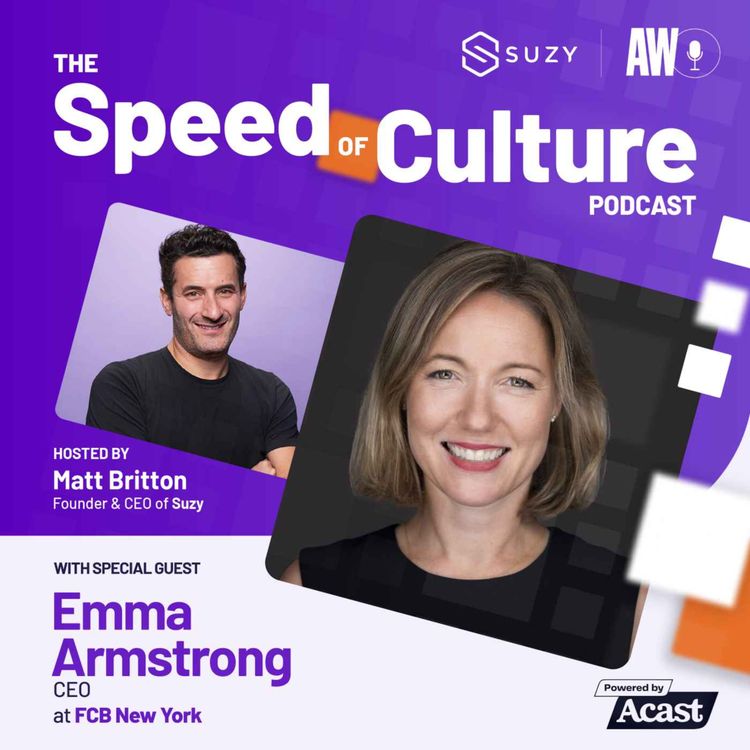
Emma Armstrong
CEO
FCB New York
The Competitive Edge of Creativity with Emma Armstrong, CEO at FCB New York

This is some text inside of a div block.
This is some text inside of a div block.
LISTEN ANYWHERE YOU FIND YOUR PODCASTS
%20(400%20x%20100%20px)%20(300%20x%2050%20px)%20(150%20x%2050%20px).avif)

In an era where brands have more direct access to consumers than at any point in history, a provocative question persists: do agencies still matter? According to Emma Armstrong, CEO at FCB New York, the answer is not only yes—agencies have never been more essential.
The reason lies in their unique function as translators between the complexities of the outside world and the strategic needs of brands navigating unprecedented change. Matt Britton, founder and CEO of Suzy, the AI-powered consumer intelligence platform, has observed this dynamic firsthand through decades of work at the intersection of consumer behavior and brand strategy.
On The Speed of Culture podcast, Britton and Armstrong explored how creativity serves as an economic multiplier for business growth, why bespoke solutions outperform templated approaches, and what the evolving role of agencies means for the future of marketing.
Armstrong, who holds a master's degree in biological anthropology from Cambridge University and has built a career spanning digital, media, and brand leadership across three continents, brings a uniquely analytical perspective to the creative industries. Under her leadership, FCB New York has tripled in size, won over 30 new brands, and consistently ranked among the world's most awarded agencies.
Her conviction that creativity is the only sustainable competitive advantage offers a framework that extends far beyond the advertising industry.
Armstrong's most compelling argument for the continued relevance of agencies centers on their function as translators. Agencies translate the outside world—consumer trends, cultural shifts, competitive dynamics, technological disruptions—into strategic direction for brands.
Then they take the brand's product, service, and values and translate them back out to consumers in ways that create meaningful connections. This translation function has become more valuable, not less, as the marketing landscape has grown more complex.
Brands today must navigate fragmented media environments, rapidly shifting consumer expectations, global cultural dynamics, emerging technologies, and an explosion of data that often obscures rather than clarifies strategic direction. The internal teams of even the largest corporations cannot maintain expertise across every dimension of this complexity.
Agencies provide concentrated expertise, cross-client learning, and external perspective that internal teams simply cannot replicate.
The translation metaphor also captures something subtle about the agency value proposition: effective translation requires deep understanding of both languages. An agency that understands consumer culture but not brand strategy, or vice versa, produces poor translations that fail to resonate in either direction.
The best agencies develop fluency in both domains, moving fluidly between consumer insights and brand articulation.
As Britton has observed through his work with Fortune 500 companies, the organizations that invest in genuine consumer intelligence—through platforms like Suzy—and combine it with creative agency partnerships produce marketing that is both strategically grounded and creatively compelling. Neither capability alone is sufficient.
Armstrong's assertion that truly creative thinking—approaching problems from unexpected angles and developing bespoke solutions—is the only way to achieve sustainable competitive advantage has significant implications for how businesses allocate resources.
The traditional view of creativity in business positions it as a cost center: a necessary expense associated with producing advertisements and marketing communications. Armstrong's view repositions creativity as an economic multiplier—an investment that generates returns far exceeding its cost.
The distinction is not merely semantic. When creativity is viewed as a cost, organizations optimize for efficiency: standardized processes, templated outputs, and minimized production expenses.
When creativity is viewed as an economic multiplier, organizations optimize for impact: breakthrough ideas, distinctive positioning, and cultural relevance that drives business growth.
The evidence supporting creativity as an economic multiplier is substantial. Research from the Institute of Practitioners in Advertising has consistently demonstrated that creatively awarded campaigns deliver significantly higher market share growth, profit growth, and return on investment compared to non-awarded campaigns.
Brands that achieve cultural relevance through creative marketing generate organic amplification—earned media, social sharing, and word-of-mouth—that extends campaign impact far beyond paid media investment.
For business leaders evaluating agency relationships and creative investment, the implication is clear: the return on creative excellence is not incremental—it is exponential. But achieving creative excellence requires genuine investment in talent, process, and client-agency relationships that enable bold work rather than safe, committee-approved mediocrity.
Armstrong's conversation with Britton also addressed the structural changes reshaping the agency industry. Traditional agency business models, built around full-time equivalent billing and long-term retainer relationships, are evolving under pressure from clients seeking more flexible, outcome-oriented partnerships.
The evolution reflects broader changes in how businesses approach external expertise. Rather than maintaining standing relationships with agencies across every marketing discipline, many organizations are adopting more fluid models—engaging specialist agencies for specific challenges, building internal capabilities for ongoing execution, and measuring agency value through business outcomes rather than hours billed.
Armstrong's perspective on this evolution is pragmatic rather than defensive. She acknowledged that agencies must evolve their business models while maintaining their core value proposition.
The agencies that will thrive are those that demonstrate clear connections between creative work and business results, build unified teams aligned with client objectives, and maintain the talent density required to produce consistently excellent work.
This evolution creates opportunities for agencies willing to rethink how they operate. Agencies that move beyond the billable-hour model toward outcome-based pricing, that invest in proprietary data and analytics capabilities, and that attract talent capable of bridging creative and strategic disciplines will differentiate themselves in an increasingly competitive market.
For client organizations, the evolution means that selecting the right agency partner requires evaluating not just creative portfolio quality but business model alignment, outcome measurement capability, and cultural compatibility.
Beyond creative strategy, Armstrong emphasized that companies need to understand the foundational infrastructure required for exceptional customer experiences. This observation bridges the gap between marketing creativity and operational execution—two domains that are increasingly inseparable in the eyes of consumers.
A brilliant brand campaign that generates consumer excitement becomes a liability if the customer experience fails to deliver on the brand promise.
Infrastructure—the systems, processes, and technologies that enable consistent, personalized, and responsive customer interactions—determines whether creative marketing drives sustainable growth or creates expectations that damage brand trust when unmet.
This infrastructure imperative is revolutionizing industries beyond marketing. Retail, healthcare, financial services, hospitality, and virtually every consumer-facing sector is investing in experience infrastructure as a competitive differentiator.
The brands winning in these categories are those that align their creative ambition with their operational capability, ensuring that every touchpoint reinforces the brand narrative that marketing establishes.
As Britton explores in Generation AI, the expectations of AI-native consumers will only accelerate this demand for seamless, intelligent customer experiences. Organizations investing in experience infrastructure today are building the foundation for meeting consumer expectations that will become table stakes in the coming decade.
Armstrong's vision for the future of agencies and brands alike centers on a single resource: human talent. The ability to attract, develop, and retain smart, creative people determines long-term competitive position more decisively than any technology investment or strategic pivot.
This talent imperative carries particular urgency in the current environment. The most capable marketers, strategists, and creatives have more employment options than ever before—agency, client-side, consulting, entrepreneurial ventures, and creator economy opportunities all compete for the same talent pool.
Organizations that fail to create compelling environments for creative excellence will find themselves unable to execute the strategies that differentiate them in the market.
Armstrong's own background illustrates the value of diverse talent development. A biological anthropology degree from Cambridge might seem unconventional for a marketing agency CEO, but the analytical framework and human behavior understanding that anthropological training provides directly informs strategic marketing thinking.
The lesson for organizations is that creative excellence often emerges from unconventional backgrounds and intersecting disciplines rather than narrow specialization.
Building teams that combine analytical rigor with creative instinct, strategic thinking with executional excellence, and cultural fluency with business acumen requires deliberate investment in talent acquisition, development, and retention.
For agencies, this means creating environments where the best people want to work—environments defined by meaningful client challenges, creative freedom, collaborative culture, and career growth opportunities.
Advertising agencies remain highly relevant because they serve a unique translation function—interpreting external market dynamics for brands and articulating brand value to consumers. As marketing complexity increases through media fragmentation, technological disruption, and evolving consumer expectations, the concentrated expertise and cross-client perspective that agencies provide has become more valuable. The most successful brands combine internal capabilities with strategic agency partnerships.
Creativity generates competitive advantage by producing distinctive brand positioning, cultural relevance, and consumer engagement that competitors cannot easily replicate. Research consistently shows that creatively excellent campaigns deliver significantly higher market share and profit growth. Creativity also generates earned media amplification—social sharing, word-of-mouth, and press coverage—that extends campaign impact far beyond paid media investment.
Brands should evaluate agency partners across multiple dimensions: creative portfolio quality, business outcome track record, strategic thinking capability, cultural compatibility, talent quality, and business model alignment. The most productive agency relationships are those built on genuine partnership—shared objectives, transparent communication, and mutual investment in outcomes rather than transactional service delivery.
Customer experience infrastructure determines whether marketing promises are fulfilled or broken at the point of consumer interaction. A campaign that generates excitement creates a liability when customer experience fails to deliver. Successful brands align creative marketing ambition with operational capability, investing in systems, processes, and technologies that ensure consistent, personalized consumer interactions across every touchpoint.
Emma Armstrong's vision of creativity as the ultimate competitive differentiator challenges business leaders to rethink how they invest in creative talent, agency partnerships, and customer experience infrastructure. In a landscape of accelerating complexity and fragmentation, the organizations that thrive will be those that combine deep consumer understanding with creative excellence and operational execution.
Explore more conversations with the leaders defining the future of marketing on The Speed of Culture podcast. To bring insights on creativity, consumer transformation, and competitive strategy to your next leadership event, visit Matt Britton's speaking platform.
.jpeg)


.jpeg)
.jpeg)