October 21, 2025
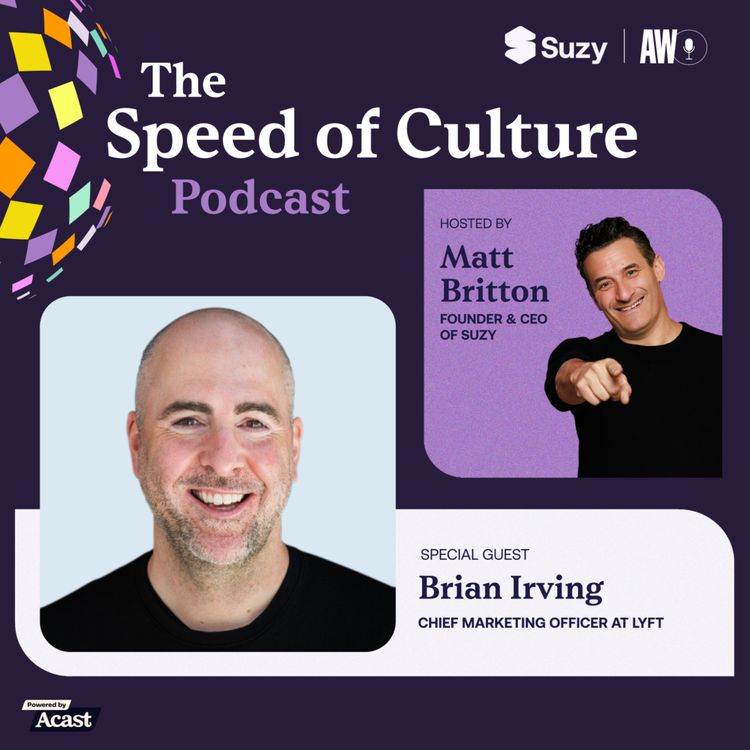
Brian Irving
Chief Marketing Officer
Lyft
Purpose-Driven: How Lyft Balances Tech, Trust & Human Connection

This is some text inside of a div block.
This is some text inside of a div block.
LISTEN ANYWHERE YOU FIND YOUR PODCASTS
%20(400%20x%20100%20px)%20(300%20x%2050%20px)%20(150%20x%2050%20px).avif)

The rideshare industry has long been characterized as a race to the bottom: driver acquisition, market saturation, price wars, and the relentless pursuit of efficiency. Yet amidst this chaos, Lyft is charting a distinctly different course—one rooted in purpose, human connection, and a fundamental belief that technology should amplify rather than replace human experience.
In Episode 216 of The Speed of Culture Podcast, host Matt Britton, founder and CEO of Suzy, the AI-powered consumer intelligence platform, sits down with Brian Irving, Chief Marketing Officer at Lyft, to explore how the rideshare platform is navigating one of the most complex business challenges of the 2020s: balancing cutting-edge technology, building trust across a two-sided marketplace, and maintaining authentic human connection at scale.
Irving brings two decades of marketing excellence to Lyft, having shaped iconic brands at Meta, Eventbrite, Apple, Google, and Airbnb—where he led the celebrated “Live There” campaign that transformed how travelers think about authentic local experiences. Today, he faces a different challenge: reimagining Lyft not as a ride-hailing company, but as a comprehensive mobility ecosystem that serves drivers, empowers riders, and prepares for an autonomous future without losing sight of what made Lyft distinctive in the first place.
This conversation reveals critical insights for any executive navigating rapid technological change while managing stakeholder expectations across multiple constituencies. For CMOs, brand leaders, and innovation-focused entrepreneurs, the episode offers a masterclass in purpose-driven marketing—the strategic discipline of defining, defending, and activating organizational purpose in ways that create measurable business outcomes and genuine human impact.
The Speed of Culture Podcast, presented in collaboration with Suzy and Adweek, has become essential listening for anyone seeking to understand how the world’s leading brands remain relevant in an age of accelerating change. This episode exemplifies why: it grapples with the most pressing questions facing modern marketing while grounding insights in real-world strategy and execution.
Lyft has always positioned itself as the purposeful rebel in the rideshare market. Unlike competitors who lead with efficiency metrics or market dominance, Lyft’s founding philosophy centers on the belief that transportation should enhance human connection, not diminish it. The pink mustache, the front-seat fist bumps, and the emphasis on driver-rider relationships weren’t marketing gimmicks—they were expressions of corporate purpose that became competitive advantages.
In his conversation with Britton, Irving articulates how this purpose-first mentality shapes strategic decision-making across the organization. When Lyft faces a choice between maximizing short-term revenue and investing in driver retention, the purposeful approach wins out. This is not altruism; it is sophisticated business strategy.
Drivers who feel valued and supported deliver better service, reduce churn, and generate organic word-of-mouth marketing that paid acquisition channels cannot replicate.
The Purpose Paradox—the counterintuitive insight that purposeful organizations often outperform purely profit-maximizing ones—has become empirically validated across industries. Research from Suzy’s consumer intelligence platform reveals that 72% of consumers across all generations prefer brands with a clear social or environmental purpose, and they reward these brands with increased loyalty and word-of-mouth advocacy.
For a marketplace business like Lyft, where driver satisfaction directly impacts service quality, purpose becomes both a moral imperative and a financial necessity.
Lyft’s strategy of positioning itself as a “purposeful rebel” serves multiple functions simultaneously. Internally, it provides employees and contractors with a sense of meaning that extends beyond compensation, creating psychological safety and encouraging the kind of innovation that requires risk-taking. Externally, it differentiates Lyft in a crowded market, giving riders and drivers a compelling reason to choose Lyft over purely functional alternatives.
Strategically, it provides a framework for decision-making when facing new market pressures or technological disruptions.
Irving emphasizes throughout the episode that this purpose-driven approach is not static. As Lyft expands beyond traditional ridesharing into bikes, scooters, and eventually autonomous vehicles, the company must continuously reinterpret and reinvent how it expresses its core purpose of “serving and connecting.”
The expansion into Lyft Silver, the affordable service tier that serves underserved communities and provides flexible earning opportunities for drivers, exemplifies this evolution—it’s a direct application of purpose-driven strategy to a pressing social need while simultaneously addressing business goals around market expansion and driver retention.
The complexity of managing a two-sided marketplace—where Lyft must simultaneously serve drivers and riders with often-conflicting interests—is where technology becomes truly critical. Yet Irving’s insights suggest that the most important role for technology is not optimizing logistics or squeezing costs, but rather building trust infrastructure across all stakeholders.
Trust is the foundational currency of any marketplace. Riders need to trust that drivers will arrive safely and on time. Drivers need to trust that they’ll earn fair compensation and be treated with dignity. The platform itself needs to be trustworthy—transparent about how it operates, fair in how it allocates work and sets prices, and protective of both parties’ privacy and security.
Traditional marketing messages—“Choose Lyft!”—cannot manufacture this trust. Only consistent experience combined with transparent communication can build it.
Lyft’s approach to trust-building through technology includes several sophisticated components:
More subtly, Lyft’s marketing strategy emphasizes the human faces and real stories behind both drivers and riders. Rather than celebrating algorithmic efficiency or technological sophistication, Lyft’s hero content showcases real people—the driver supporting her family through education, the rider connecting with her community, the driver-rider relationships that transcend the transactional nature of the ride.
This approach is backed by data: consumer research reveals that human faces in advertising, strategically positioned just above calls-to-action, generate 28% higher engagement and better conversion rates.
For Lyft, the strategic choice to lead with human stories is simultaneously a creative choice, a data-driven choice, and a purpose-driven choice.
Irving and Britton discuss how AI is becoming increasingly central to this trust infrastructure. Rather than replacing human judgment, the most effective AI applications in Lyft’s ecosystem function as trust amplifiers.
In each case, the technology exists to serve a human purpose—trust building—rather than purely commercial optimization.
The conversation also touches on what Irving calls “psychological safety,” the organizational concept that extends beyond the company to the entire ecosystem. Drivers need psychological safety to know they won’t be deactivated arbitrarily. Riders need safety to know their information is protected and their safety during rides is paramount.
This extends even to employees, who Irving emphasizes need psychological safety to experiment with AI tools and new marketing approaches without fear of failure shutting down innovation.
As AI continues to reshape every function within organizations, Irving brings a uniquely balanced perspective to the question: Is AI a threat to marketing excellence, or an enabler? His answer, articulated clearly in the podcast conversation, is neither—AI is fundamentally a multiplier of human capacity, but only when deployed with strategic intention and human judgment.
The conventional narrative suggests that AI will automate away marketing roles, replacing human creativity and judgment with algorithmic optimization. Irving’s experience suggests something different.
At Lyft, where his marketing organization manages brand strategy, product marketing, creative production, campaign measurement, and communications across a global, diverse audience, AI tools are shifting work away from time-consuming aggregation, data compilation, and routine report generation toward higher-value activities: strategy formulation, creative conception, insight synthesis, and decision-making.
This is the AI Multiplier Effect in practice.
A marketer who previously spent 40% of her time compiling data into presentations can now spend 80% of her time interrogating that data, challenging assumptions, and developing strategic recommendations. A creative team that previously spent weeks researching trend reports and competitor activity can now access synthesized insights in hours, freeing more time for actual creative ideation and production.
A marketing analyst who spent days preparing statistical models can now focus on interpretation, context, and strategic implications.
At Suzy, the consumer intelligence platform that powers much of The Speed of Culture Podcast’s insights, AI applications are similarly designed to multiply human intelligence rather than replace it. Suzy enables brand teams to conduct rapid, iterative research cycles that would previously have required weeks or months with traditional market research vendors and agency partnerships.
By automating the mechanical aspects of research aggregation and analysis, Suzy allows strategic insights to emerge faster, enabling agile decision-making that keeps pace with culture and consumer sentiment shifts.
Irving emphasizes throughout the episode that this multiplier effect only works when organizations build proper “AI-native” cultures.
The conversation addresses a particularly important concern: bias in AI systems. When AI tools are trained on historical data, they can perpetuate historical biases—both in the algorithms themselves and in the insights they surface.
For a brand like Lyft, which explicitly values diversity, inclusion, and serving underserved communities, awareness of AI bias is not a peripheral concern but a core part of responsible marketing strategy. Irving advocates for continuous auditing of AI outputs, diverse teams that can identify blind spots, and human judgment that remains superior to algorithmic recommendations when values are at stake.
Perhaps the most forward-looking element of Irving’s conversation with Britton concerns Lyft’s strategy around autonomous vehicles (AVs). This is where Lyft’s purpose-driven philosophy meets genuine existential business questions: As AV technology advances, what role does a rideshare platform play?
Irving frames Lyft’s AV strategy with refreshing clarity:
“We’re just buying tickets to the stadium right now.”
In other words, Lyft doesn’t need to develop autonomous vehicle technology itself. Instead, Lyft is positioning itself as the fleet platform and onboarding partner for AV manufacturers.
Waymo, Aurora, and other AV developers need a user base, a fleet management system, and operational expertise to bring autonomous vehicles to market at scale. Lyft can provide all three, while avoiding the R&D costs and technical complexity of developing proprietary AV technology.
This strategy is purpose-driven because it allows Lyft to remain true to its core mission—connecting people, enabling flexible income, and providing safe, reliable transportation—while neither pretending to be an AI robotics company nor ceding the autonomous future to external partners entirely.
Lyft becomes the essential bridge between AV manufacturers and the market, the platform where autonomous fleets operate, earn revenue, and continuously improve through real-world performance data.
The marketing implications of this AV strategy are profound. As autonomous vehicles become more prevalent on Lyft’s platform, the company’s messaging must evolve to address rider concerns about safety, reliability, and the psychological factors of riding without a human driver present.
Research conducted through Suzy’s platform reveals that consumer comfort with autonomous vehicles varies significantly by generation, geography, and prior experience. Building that comfort requires transparent communication, real-world performance data, and continued emphasis on the human-centered values that have always defined Lyft.
Internally, the shift toward AVs creates both opportunity and challenge. If a significant portion of Lyft’s future rides are autonomous, what happens to the driver-partner community that has been central to Lyft’s purpose and brand identity?
Irving’s emphasis on Lyft’s “purposeful rebel” positioning suggests an answer: as a purposeful organization, Lyft won’t simply eliminate drivers but will support workers displaced by AV adoption through training, transition programs, and opportunities within the broader mobility ecosystem (bikes, scooters, fleet maintenance, etc.).
This is not costless, but it is aligned with Lyft’s purpose and likely to generate the kind of loyalty and authentic brand advocacy that no marketing budget can buy.
One of the more innovative elements of Irving’s strategy at Lyft is the company’s emerging focus on creator partnerships and creator-driven marketing. In an era where traditional advertising is increasingly tuned out, and where consumer attention is fragmented across dozens of platforms and content streams, Lyft is exploring how creators can authentically integrate Lyft into their storytelling.
This is distinct from traditional influencer marketing, where brands pay creators to promote products. Instead, Lyft’s creator strategy explores symbiotic relationships.
The conversation touches on how this creator-focused strategy aligns with Lyft’s broader cultural positioning. Lyft’s founding audience—urban, culturally engaged, values-aligned—is precisely the audience that follows creators for authentic perspectives and recommendations.
By investing in creator relationships rather than traditional paid media, Lyft signals that it cares about authentic voices and trusted recommendations rather than invasive advertising.
From a marketing efficiency standpoint, creator partnerships offer compelling advantages: lower cost per engagement, higher authenticity and trust, built-in audience segmentation, and performance measurement through engagement metrics rather than impression counts.
But Irving’s emphasis throughout the episode is that Lyft’s creator strategy succeeds precisely because it’s rooted in purpose and authenticity rather than treated as a growth hacking tactic. Creators choose to partner with Lyft because they genuinely align with the brand’s values, and that alignment translates into content that resonates far more powerfully than paid promotions.
Lyft approaches this balance through transparent technology infrastructure that builds trust with both sides simultaneously. Real-time pricing displays, earnings visibility, and safety features like in-app communication and emergency support ensure that drivers trust they’ll earn fair compensation and riders trust they’ll receive reliable service.
Irving emphasizes that trust-building technology ultimately serves both stakeholder groups better than approaches that optimize purely for one side or the other. The company’s expansion into Lyft Silver demonstrates how purpose-driven strategy can address market gaps while serving both drivers (flexible earning) and riders (affordable mobility) better than purely transactional approaches.
According to Irving, AI’s primary value in marketing is multiplying human capacity by automating routine aggregation, compilation, and report-generation work. Organizations that succeed with AI adoption invest in proper training, maintain psychological safety so employees experiment rather than fear displacement, and keep human judgment paramount for strategy and ethical decisions.
Rather than asking “How can AI replace our marketing team?”, leaders should ask “How can AI free our team to focus on higher-value strategic and creative work?” Suzy’s platform exemplifies this principle—by automating research synthesis, it enables marketers to focus on interpretation and strategic implication.
Lyft is positioning itself not as an AV technology developer but as the platform and fleet partner for AV manufacturers—“buying tickets to the stadium” rather than building the stadium. This allows Lyft to remain true to its purpose while avoiding massive R&D investments.
The brand strategy challenge involves building consumer comfort with driverless rides while maintaining Lyft’s values around worker support and community impact. Rather than simply replacing drivers with technology, Lyft’s purposeful approach suggests supporting driver transition and maintaining the human-connection values that have always defined the brand.
Marketing messaging will need to address safety, reliability, and the psychological dimensions of autonomous rideshare as AVs become more prevalent.
In an attention-fragmented, trust-skeptical media environment, creator partnerships offer distinct advantages over traditional paid advertising: they deliver authentic, trusted voices; they reach engaged, segmented audiences; they generate authentic storytelling rather than invasive promotional content; and they align with Lyft’s values around authenticity and community.
Rather than paying creators to promote Lyft, the company invests in symbiotic relationships where creators with aligned values integrate Lyft authentically into their storytelling. This approach delivers superior engagement and trust compared to traditional influencer marketing while being far more aligned with Lyft’s brand positioning as a purpose-driven, values-aligned organization.
The conversation between Matt Britton and Brian Irving reveals a leadership perspective increasingly rare in Silicon Valley: the belief that purpose, trust, and authentic human connection aren’t constraints on growth and innovation, but catalysts for durable competitive advantage.
For any executive navigating rapid technological change, stakeholder complexity, and the pressure to demonstrate growth, the episode offers a strategic masterclass. It shows that the choice between purpose-driven values and commercial success is a false dichotomy—the most sophisticated business strategy increasingly demands integration of both.
To explore more insights on consumer behavior, AI’s impact on marketing and business strategy, and how leading brands navigate culture at speed, visit:
.jpeg)


.jpeg)
.jpeg)