Opening
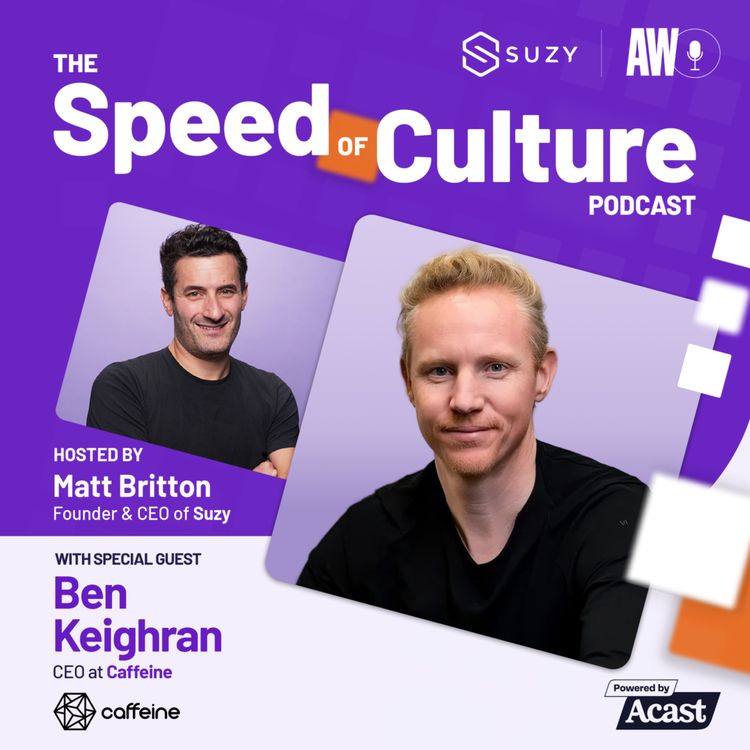
In an era where traditional sports broadcasting models are colliding with the rise of digital platforms, Matt Britton, founder and CEO of Suzy, the AI-powered consumer intelligence platform, sat down with a visionary entrepreneur reshaping how millions of fans experience live sports. Ben Keighran, the founder and CEO of Caffeine, brought his extensive background in technology innovation—from Apple's early ecosystem development to creating pioneering social platforms—to tackle one of media's biggest challenges: how to make sports broadcasting more interactive, accessible, and fan-centric.
The Speed of Culture Podcast Episode 102, recorded on April 11, 2024, captures a pivotal conversation about the evolution of live streaming, the transformative role of gaming in modern media, and how niche sports platforms are carving out unprecedented opportunities in the competitive world of digital broadcasting. Keighran's journey from computer science enthusiast to technology executive reveals crucial insights into how entrepreneurs can identify market gaps, build passionate communities, and scale platforms that resonate with highly engaged audiences.
For brand leaders, marketing executives, and media professionals, this episode explores the intersection of consumer behavior, technology innovation, and content strategy—three forces that are fundamentally reshaping how sports organizations, leagues, and broadcasters connect with their audiences. The conversation demonstrates why understanding platform architecture, fan psychology, and real-time interactivity has become essential for anyone involved in media, entertainment, or audience engagement strategies in 2024 and beyond.
As the global interactive streaming market is projected to expand from $24.5 billion in 2023 to $107.0 billion by 2030—a compound annual growth rate of 24.9%—the strategic insights shared in this episode offer practical intelligence for executives navigating the rapidly evolving sports media landscape. Ben Keighran's perspective on building sustainable streaming platforms, monetizing passionate fan communities, and designing for engagement rather than just viewership provides a masterclass in digital transformation for traditional media businesses.
The Evolution of Live Streaming: From Gaming Culture to Sports Broadcasting
The story of Caffeine begins not with sports, but with an understanding of gaming culture and community engagement that emerged from Ben Keighran's years at Apple. After leaving his position at Apple, where he had worked on the company's TV ecosystem and app development, Keighran recognized a fundamental shift occurring in how audiences—particularly younger, tech-native viewers—expected to engage with live content.
"The gaming community understood something that traditional broadcasters were slow to grasp," Keighran explains in the episode.
Live streaming wasn't simply about broadcasting content; it was about creating participatory experiences where viewers were active participants rather than passive observers. Gaming platforms like Twitch had demonstrated this principle at scale, but the potential extended far beyond esports and casual gaming content.
Keighran's insight was that the same interactive principles that made gaming platforms successful—real-time chat, audience agency, direct creator-to-viewer connections, and community-driven features—were entirely absent from traditional sports broadcasting. Despite sports being one of the most engaging content categories globally, fans watching their favorite teams and athletes had no more interaction with the broadcast experience than viewers in the 1980s.
When Caffeine launched in 2016, the platform positioned itself at the intersection of gaming, entertainment, and sports. Rather than attempting to compete directly with massive traditional broadcasters or gaming-focused platforms, Keighran deliberately chose to focus on long-tail and niche sports content—the thousands of smaller sports leagues, local competitions, and passionate fan communities that traditional media couldn't profitably serve.
This strategic positioning was crucial. While major networks focused exclusively on the highest-revenue sports with mass-market appeal, Caffeine identified that smaller sports segments possessed something equally valuable: deeply passionate, highly engaged audiences. A parent watching their child's local youth soccer league streamed on Caffeine wasn't just a viewer—they were a member of a community.
Building Platforms Around Fan Engagement and Interactivity
The core differentiator of Caffeine's approach centered on a fundamental principle: modern audiences don't simply want to watch sports anymore—they expect to participate. The platform was engineered from the ground up to enable interaction that traditional broadcast technology couldn't support.
Keighran's design philosophy incorporated features that may seem standard in gaming platforms but were revolutionary in sports broadcasting. Viewers could engage in real-time conversations through integrated chat, enabling fans to discuss plays, react to moments, and connect with other community members simultaneously. The platform included sophisticated moderation and community management tools that kept these conversations constructive and brand-safe—a critical requirement for sports leagues and broadcasters.
Beyond chat, Caffeine implemented interactive features including live polling, viewer voting on camera angles, and 3D items and reactions that viewers could share in the chat field. These seemingly small features dramatically extended average viewing time and increased engagement metrics. Market research highlighted in the episode demonstrates that interactive viewers spend 33% longer watching content than passive viewers—a quantifiable business impact that transcends engagement metrics.
The technical architecture supporting these features required sophisticated thinking about latency and real-time data processing. Caffeine achieved sub-second latency in its streaming technology, meaning that interactions felt instantaneous to viewers. This fundamentally affects how communities form around broadcasts, preserving the sense of synchronized connection among thousands of fans.
Keighran emphasizes throughout the episode that these interactive features weren't added as afterthoughts—they were foundational to the platform's architecture. This design-from-first-principles approach meant that Caffeine wasn't retrofitting gaming features onto a traditional broadcasting backend, but instead building a native platform optimized for the expectations of modern audiences.
The monetization implications were equally important. Interactive features didn't just improve engagement; they created measurable value for advertisers. Brands understood that advertising to an audience actively engaged in commentary and interaction—rather than passively viewing—represented a qualitatively different advertising opportunity.
The Niche Sports Opportunity: Where Traditional Media Overlooks Massive Audiences
One of Keighran's most compelling strategic insights addresses a massive market inefficiency: traditional media has systematically underserved niche sports communities. The economics of traditional broadcasting created a natural tendency toward concentration, with networks investing in content that could attract the largest possible audiences.
This created a distribution desert for everything else. A community college athletic program, a regional rugby league, a niche combat sport, or a local motorsports competition had essentially no viable broadcast options—despite the fact that passionate fans would actively seek out and engage with coverage if it were available.
Caffeine's platform economics completely inverted this equation. By offering free-to-watch streaming with pre-roll advertising monetization and optional subscription features, the platform could afford to distribute content that traditional broadcasters considered unprofitable. Keighran explains in the episode that Caffeine aggregated 200 sports partners across 17 different sports categories—a portfolio that no traditional broadcaster would ever assemble.
The beauty of this model is that it's mutually beneficial. Smaller leagues and sports organizations that had previously received zero audience for their events suddenly gained distribution to engaged fans. For Caffeine, these smaller leagues provided an enormous library of content that kept the platform active throughout the year, across all seasons, generating consistent engagement and ad inventory.
Scaled to tens of millions of monthly users—Caffeine reported 60 million monthly active users at its peak—niche sports content becomes a significant revenue driver. A 5% advertising CPM on millions of viewers across hundreds of events adds up to substantial monetization potential and fuels a virtuous cycle of growth.
Monetization Models and the Future of Sports Media Economics
Understanding how Caffeine monetizes its content is essential for executives in any media business, because the platform's approach represents how sports broadcasting economics will evolve across the industry. Keighran designed a flexible monetization architecture that could adapt to different league sizes, revenue expectations, and business models.
The primary revenue driver in Caffeine's early years was advertising. The platform offered free access to all content, supported by pre-roll advertising—an AVOD (advertising-supported video on demand) model aligned perfectly with niche sports audiences and advertiser demand for engaged viewers.
However, Caffeine also built in flexibility for alternative monetization. Some leagues experimented with subscription models (SVOD), while others explored pay-per-view (PPV) events for significant matches or tournaments. Caffeine's infrastructure supported all of these approaches.
The episode discusses how different revenue models serve different purposes. Subscriptions build predictable recurring revenue and loyalty. Pay-per-view generates revenue spikes for marquee events. Advertising provides broad accessibility while monetizing all viewers, though CPMs vary based on engagement and audience quality.
Emerging monetization strategies include virtual gifting, sponsorships, merchandise integration, and interactive commerce features. As platforms mature, the most sophisticated ones will likely combine multiple revenue streams rather than relying on a single model.
The global interactive streaming market was valued at $24.5 billion in 2023 and is projected to reach $107.0 billion by 2030, driven by improvements in interactivity and diversified monetization approaches. Streaming is no longer a secondary channel—it is becoming central to sports revenue strategy.
For traditional broadcasters, the implications are sobering. Digital platforms have eliminated scarcity, allowing multiple platforms to carry the same content simultaneously and challenging monopolistic pricing structures. At the same time, leagues and teams that diversify their broadcasting approach—combining traditional licensing with direct-to-consumer streaming—can capture more long-term value.
Vision for the Future: Building Sustainable Streaming Ecosystems
Throughout the episode, Keighran articulates a vision for sports streaming that extends beyond features and monetization mechanics. Sustainable streaming businesses must deliver genuine utility for multiple stakeholders: efficient distribution for leagues, accessible quality content for fans, and viable economics for platforms.
He highlights a tension that has plagued the streaming industry: the premium content trap. Platforms built around acquiring exclusive, high-profile rights often face unsustainable economics due to massive licensing costs and limited subscription scale.
Keighran's counter-intuitive insight is that more sustainable economics exist in the long tail—serving passionate niche communities that have genuine demand for content not available elsewhere. These audiences watch consistently, engage deeply, and tolerate advertising because the content serves a real need.
The future he envisions includes a spectrum of streaming services: some focused on premium content, others on niche communities, regional sports, or emerging leagues. Rather than a winner-take-most dynamic, mature streaming markets will likely support multiple viable platforms serving different audience segments.
This perspective suggests that niche positioning and authentic community building are more sustainable long-term strategies than competing head-to-head for mass-market dominance.
Key Takeaways
- Interactive features drive engagement and revenue: Platforms engineered for real-time community interaction generate 33% longer viewing times than passive-only experiences, increasing advertiser value and audience retention.
- Niche sports represents an enormous underserved market: Traditional broadcasting economics left hundreds of passionate sports communities without viable distribution, creating opportunity for digital platforms.
- Multiple monetization models enable different business strategies: Sustainable streaming platforms combine advertising, subscriptions, pay-per-view, and emerging features like virtual gifting.
- Direct-to-consumer distribution creates new value capture opportunities: Diversified broadcasting strategies allow sports organizations to capture more value than single-channel licensing approaches.
- Platform architecture shapes long-term competitive advantage: Foundational technical decisions—latency reduction, moderation tools, interactive design—matter more than retrofitting legacy infrastructure.
Frequently Asked Questions
What makes Caffeine's approach to sports streaming different from traditional broadcasters?
Caffeine distinguished itself by focusing on niche and long-tail sports content rather than competing for expensive premium broadcast rights. By building interactive features and community tools from the ground up, the platform served passionate but smaller audience segments that traditional media couldn't profitably reach. At scale, aggregating hundreds of leagues created sustainable monetization opportunities.
How do streaming platforms monetize niche sports content?
Sports streaming platforms use AVOD with pre-roll advertising, SVOD subscription models, and PPV events. Advanced platforms incorporate virtual gifting, sponsorships, and real-time commerce features. The most effective strategies combine multiple revenue streams to maintain flexibility and maximize value.
Why is interactivity important for sports streaming engagement?
Interactive viewers spend approximately 33% longer engaged with content than passive viewers. Features like real-time chat, live polling, and audience voting transform sports viewing into participatory engagement, increasing retention and advertiser impact.
What is the addressable market opportunity for niche sports streaming platforms?
The global interactive streaming market was valued at $24.5 billion in 2023 and is projected to reach $107.0 billion by 2030, reflecting a 24.9% compound annual growth rate. In the United States alone, approximately 133 specialized sports streaming platforms serve niche audiences with passionate fan bases.
Looking Ahead
The conversation between Matt Britton and Ben Keighran explores how technology platforms reshape established industries and how understanding community psychology and platform economics can unlock new business opportunities. For marketing leaders, media executives, and entrepreneurs interested in the intersection of technology and consumer behavior, Episode 102 of The Speed of Culture Podcast provides essential frameworks for thinking about the future of digital media.
To dive deeper into consumer intelligence in the AI era and explore more conversations about innovation driving cultural change, visit:
- Suzy — The AI-powered consumer intelligence platform trusted by the world's largest brands
- The Speed of Culture Podcast — Conversations with visionary entrepreneurs and cultural leaders
- Generation AI — Matt Britton's bestselling book on AI and generational transformation
- AI keynote speaker — Engage Matt Britton to speak at your organization about AI strategy and consumer insights
- Speaker HQ — Executive resources for leadership, innovation, and cultural intelligence

%20(400%20x%20100%20px)%20(300%20x%2050%20px)%20(150%20x%2050%20px).avif)

.jpeg)


.jpeg)
.jpeg)