How Samsung Is Leveraging Data, AI, and Personalization to Redefine Connected Living
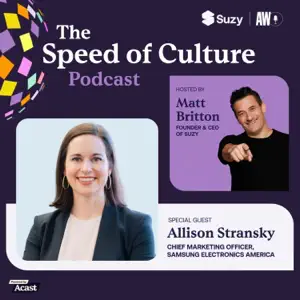
In an increasingly connected world, the convergence of artificial intelligence, data analytics, and consumer electronics is reshaping how brands approach the smart home market. During Episode 159 of The Speed of Culture Podcast, hosted by Matt Britton, founder and CEO of Suzy, the AI-powered consumer intelligence platform, Allison Stransky, Chief Marketing Officer of Samsung Electronics America, sat down to discuss how her organization is positioning itself at the forefront of this transformation.
The conversation, which aired on January 30, 2025, provides critical insights for marketers, executives, and technology leaders seeking to understand how enterprise-scale AI implementation is reshaping consumer expectations and creating new opportunities for differentiation in the highly competitive consumer electronics landscape.
Stransky's vision for Samsung extends far beyond traditional product-focused marketing. Instead, the company has adopted a holistic ecosystem approach that treats the entire home as an interconnected intelligence system—one that learns, adapts, and anticipates user needs before they arise.
By connecting smartwatches, rings, refrigerators, climate systems, and other devices, Samsung is creating a platform for solving “your whole home and your whole life.”
This strategic positioning comes at a critical inflection point in the market. As the global smart home market is projected to grow from $147.52 billion in 2025 to $848.47 billion by 2034—a compound annual growth rate of 21.4%—the companies that can authentically deliver on the promise of personalized, intelligent living will capture disproportionate market share and brand loyalty.
The episode explores Samsung's “Your Home Speaks You” campaign, its sophisticated approach to first-party data utilization, and how voice assistants like Bixby are evolving from novelty features into indispensable daily tools. Most importantly, Stransky articulates the strategic imperative that will define the next decade of consumer technology: AI is no longer optional—it is the foundational enabler of personalization at scale.
The AI-Powered Connected Ecosystem: Samsung's Integrated Platform Strategy
Samsung's approach to the smart home market represents a fundamental departure from how the consumer electronics industry has traditionally operated. Rather than designing and marketing individual products in isolation, Samsung has architected an integrated ecosystem where every device serves a larger purpose: to understand, learn from, and enhance the life of the person or family living in the home.
According to Allison Stransky, this integration is powered by AI at every layer. Through the SmartThings platform, devices actively communicate with one another to deliver contextual, personalized service rather than simply performing isolated functions.
When a user's smartwatch detects that they're falling asleep, the system can automatically adjust bedroom temperature and lighting. When health data from a Samsung Galaxy Ring indicates elevated stress levels, the ecosystem responds with personalized wellness recommendations. This proactive, behavior-driven response marks a significant evolution from earlier rule-based automation systems.
The data advantage underlying this approach is substantial. Samsung has been collecting first-party data across decades of product interactions, creating a rich foundation of behavioral, health, and usage insights that inform its AI models.
Rather than relying on demographic assumptions or browsing history, Samsung’s AI learns from actual patterns inside the home. Each device functions as both a sensor and an actuator—gathering insights while delivering personalized experiences.
The marketing implications are profound. Instead of advertising individual features, Samsung increasingly focuses on outcomes. The message shifts from “our refrigerator has a screen” to “your refrigerator understands your dietary preferences and helps you live healthier.” Outcome-driven positioning resonates more powerfully, particularly among affluent consumers seeking simplicity rather than complexity.
Personalization at Scale: How Data and AI Transform Marketing
For decades, marketers faced a core tension: true personalization requires individual-level insight, but scale demands segmentation. Even with digital marketing advancements, most campaigns still operate at the segment level rather than delivering true one-to-one engagement.
Allison Stransky directly addresses this challenge:
“AI is the enabler that's actually going to make personalization at scale happen.”
By combining deep first-party data with advanced machine learning models, Samsung can deliver personalized marketing messages to billions of individuals simultaneously. This represents a qualitative leap beyond dynamic content or basic targeting.
For example, a health-conscious consumer may receive messaging emphasizing AI-powered meal planning and nutritional analysis. A busy parent may see communications centered on family coordination and smart calendar integration. The system adapts messaging based on real behavioral data, not assumptions.
Delivering this capability requires three key components:
- Robust first-party data collection gathered directly from product and service interactions—not third-party brokers.
- Global scale to train AI models across diverse populations while protecting privacy.
- Technical infrastructure capable of real-time personalization across owned and paid channels.
The results are significant. 81% of consumers ignore irrelevant marketing messages, while 96% are likely to purchase when brands send personalized communications. Companies implementing personalization effectively see consumers spend an average of 38% more following a positive personalized experience.
However, personalization requires responsible data stewardship. Samsung maintains compliance with regulations like GDPR and CCPA, and transparency remains critical. Seventy-nine percent of consumers say they are more likely to trust a company when data usage is clearly explained—making privacy not just a legal requirement but a strategic differentiator.
From Novelty to Necessity: The Evolution of Voice Assistants
Voice assistants have evolved dramatically over the past decade. What began as a novelty feature has become a mainstream interface. Today, 46% of U.S. adults actively use voice assistants, and the voice AI smart home market is growing at a compound annual growth rate of 48.2%, projected to reach $20.09 billion in 2025.
Stransky positions Bixby not as a gimmick but as a foundational interface layer across Samsung’s ecosystem. The innovation lies in cross-device personalization.
Unlike isolated voice tools, Samsung’s system recognizes individual voices and adjusts responses accordingly. A teenager asking for music receives different recommendations than a parent. Accessibility settings may automatically adjust depending on who is speaking.
This solves a core smart home challenge: households are multi-user environments with diverse needs and preferences. Voice becomes the connective tissue that enables seamless personalization across devices.
Market data reinforces this shift. 58.1% of the smart home market is driven by speech recognition technology. 58% of users utilize voice assistants with televisions, 36% for lighting control, and 29% for thermostat regulation.
For marketers, this signals a transformation in how brands engage consumers. Voice search, voice commerce, and conversational AI are becoming primary channels. Brand personality must translate not just visually but audibly.
The Bespoke AI Refrigerator: A Case Study in Intelligent Appliances
The Bespoke AI refrigerator embodies Samsung’s ecosystem strategy in tangible form. Rather than functioning as a passive appliance, it operates as an intelligent system participant.
Using AI-powered computer vision, the refrigerator identifies available ingredients, tracks expiration timelines, and recommends meals accordingly. It integrates dietary preferences, health goals, and even grocery services like Instacart to streamline planning and replenishment.
For a consumer pursuing plant-based eating, the system recommends aligned recipes. For someone managing a specific health condition, it can suggest meals within dietary parameters—assuming permission-based data integration is enabled.
The broader ecosystem multiplies its value. Calendar data, occupancy signals, and weather patterns can influence recipe recommendations or meal timing. The refrigerator becomes context-aware, not just inventory-aware.
This approach reflects three strategic principles:
- Consumer value emerges from ecosystem integration, not isolated features.
- True personalization requires multi-source data inputs, responsibly integrated.
- Outcome-focused marketing outperforms feature-centric messaging.
The market trajectory supports this direction. The global smart home market is projected to reach $848.47 billion by 2034, while AI in smart home technology is forecasted to grow from $15.3 billion in 2024 to $104.1 billion by 2034.
The Broader Implications for Consumer Behavior and Marketing Strategy
Samsung’s strategy reflects broader industry shifts that will define the next decade.
Consumer expectations for personalization are accelerating. AI-powered platforms like Netflix and Amazon have reset the baseline. Consumers increasingly expect products to understand them as individuals.
First-party data is becoming the ultimate competitive advantage. As third-party cookies disappear, direct consumer relationships and permission-based data collection become strategic imperatives.
Product design and marketing strategy are converging. AI-driven personalization requires tight alignment between engineering, product, and marketing teams.
Ecosystem lock-in increases switching costs. A fully integrated smart home ecosystem creates both financial and behavioral barriers to switching brands.
Privacy and trust become differentiators. Transparent data practices are not optional—they are competitive advantages.
Voice is emerging as a central marketing channel. Brands must adapt to conversational interfaces and audio-driven engagement.
Key Takeaways
- AI-powered ecosystems drive competitive advantage. Integration across devices creates defensible differentiation.
- First-party data underpins personalization at scale. Direct consumer relationships are strategic assets.
- Voice assistants are becoming primary interfaces. Marketing strategies must evolve accordingly.
- Outcome-focused positioning outperforms feature selling. Consumers respond to life improvement, not technical specifications.
- Privacy and transparency build durable trust. Responsible data stewardship strengthens brand equity.
Frequently Asked Questions
What is the global market size for smart home technology, and how fast is it growing?
The global smart home market is projected to grow from $147.52 billion in 2025 to $848.47 billion by 2034, representing a compound annual growth rate of 21.4%. AI in smart home technology is projected to expand from $15.3 billion in 2024 to $104.1 billion by 2034.
How does Samsung's approach to personalization differ from other smart home companies?
Samsung leverages decades of first-party data across wearables, appliances, entertainment systems, and security devices to train AI models capable of delivering personalization at scale. Its broad ecosystem and deep integration create advantages over companies with narrower portfolios.
What role does voice play in Samsung's smart home strategy?
Bixby serves as a central interface layer. It recognizes individual voices, personalizes responses, and coordinates across connected devices—addressing the multi-user nature of modern households.
How does the Bespoke AI refrigerator represent the future of smart appliances?
The Bespoke refrigerator uses AI vision to understand ingredients, learns dietary preferences, generates personalized meal plans, integrates grocery services, and adapts recommendations based on household context—transforming appliances into intelligent life assistants.
Looking Ahead
The insights shared by Allison Stransky on Episode 159 of The Speed of Culture Podcast offer essential guidance for executives navigating AI-driven transformation.
For marketing leaders, the episode clarifies how personalization expectations are evolving. For product leaders, it highlights ecosystem thinking as a competitive moat. For organizational leaders, it underscores that authentic AI transformation requires reimagining capabilities—not merely adding features.
To explore more insights on AI, consumer trends, and the future of marketing:


%20(400%20x%20100%20px)%20(300%20x%2050%20px)%20(150%20x%2050%20px).avif)

.jpeg)


.jpeg)
.jpeg)