Opening
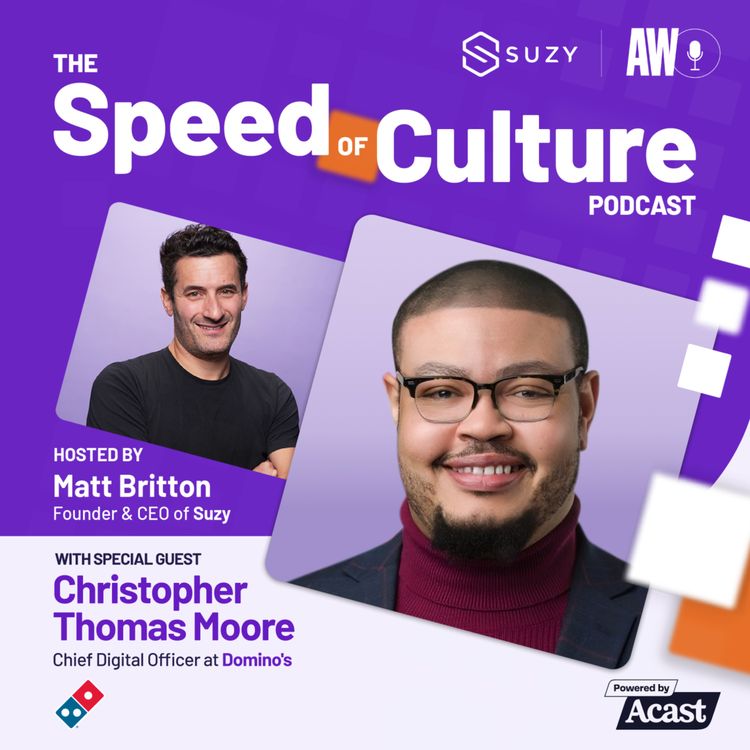
Matt Britton, founder and CEO of Suzy, the AI-powered consumer intelligence platform, recently sat down with Christopher Thomas Moore, Chief Digital Officer at Domino's Pizza, to explore one of the most compelling digital transformation stories in the quick-service restaurant industry. Aired on March 5, 2024, this episode of The Speed of Culture Podcast reveals how a 60-year-old pizza brand has become a beacon of digital innovation, serving as a masterclass in customer-centric technology strategy.
The conversation centers on how Domino's has leveraged digital innovation to redefine customer experience, addressing critical pain points while building competitive advantages that extend far beyond food delivery. With Christopher's over 15 years of expertise in e-commerce, digital marketing, and brand development, Domino's demonstrates that digital transformation is not merely about adopting new technologies—it's about understanding customer tensions and solving them strategically.
Today, Domino's generates more than 65% of its sales through digital channels, a testament to the organization's commitment to making technology serve human needs rather than the reverse. This achievement didn't happen by accident. It resulted from deliberate strategic choices, continuous testing, and an unwavering focus on personalizing every customer interaction.
Christopher Thomas Moore's insights into this journey offer valuable lessons for enterprises across industries seeking to navigate the complex intersection of technology, culture, and customer satisfaction.
Understanding Customer Tensions: The Foundation of Digital Strategy
Christopher Thomas-Moore emphasizes that understanding and alleviating customer tensions is key to achieving significant breakthroughs for brands. Rather than implementing technology for technology's sake, Domino's began its digital transformation by identifying specific customer pain points that traditional ordering methods couldn't adequately address.
The pizza delivery industry historically suffered from friction points: ambiguous order confirmations, uncertainty about delivery timing, difficulty in reordering favorite items, and limited visibility into the preparation process. Domino's recognized these tensions and built its digital strategy around systematically eliminating them through innovative solutions.
This customer-tension-first approach fundamentally shapes how Domino's evaluates new technologies and features. Rather than starting with “What cool tech can we deploy?” the organization asks, “What customer problem are we solving?” This reframing has proven instrumental in creating digital experiences that customers genuinely appreciate rather than merely tolerate.
By mapping the customer journey and identifying friction points across each touchpoint, Domino's has been able to prioritize digital investments that deliver measurable improvements in satisfaction and engagement. This methodology extends beyond the ordering experience into loyalty programs, payment processing, delivery tracking, and post-purchase engagement—creating an integrated ecosystem that simplifies and enhances every interaction.
The Role of Continuous Testing and Personalization
One of the most striking revelations in Christopher's conversation with Matt Britton is Domino's commitment to rigorous, continuous testing. Domino's conducts over 100 UX and UI tests annually, running parallel variations to identify what resonates most effectively with diverse customer segments.
This test-and-learn approach has become the backbone of Domino's digital evolution. Small optimizations—adjusting the placement of menu items, refining payment method options, tweaking confirmation messaging—might seem incremental, but collectively they produce substantial improvements in conversion rates and customer satisfaction.
When multiplied across millions of transactions annually, these micro-improvements translate into significant competitive advantages.
Personalization sits at the heart of this testing strategy. Domino's recognizes that no single user experience satisfies all customers. Some prioritize speed and want to reorder favorite items with minimal friction. Others enjoy exploring new menu options and require robust filtering and recommendation systems, while still others have specific dietary requirements or delivery preferences that demand customization.
Rather than forcing all customers through a one-size-fits-all journey, Domino's has invested heavily in understanding individual preferences and behaviors. The organization leverages first-party data—transaction history, product preferences, delivery addresses, and order frequency patterns—to tailor the experience for each user.
This personalization extends to content, recommendations, pricing incentives, and communication frequency. The business impact is significant:
- Customers who experience personalized recommendations have higher average order values.
- Customers who can quickly reorder favorite items convert at higher rates.
- Customers who receive timely, relevant offers demonstrate improved loyalty and engagement.
By making incremental, data-informed optimizations to address these individual preferences, Domino's has built a digital platform that feels intuitive and responsive to each customer's unique needs.
Digital Marketing Evolution: From Traditional Spend to Platform-Native Strategy
The evolution of digital marketing has been profound over the past decade, and Domino's stands as an exemplary case study of how established brands can successfully transition from broadcast-based media spending to sophisticated, platform-native strategies.
Christopher explains that Domino's evaluates digital media effectiveness through incremental return on advertising spend (iROAS) and lift studies, ensuring that investments in Facebook, Snapchat, and TikTok yield measurable returns. This rigorous measurement discipline separates sophisticated digital operators from those simply chasing engagement metrics.
Domino's success on TikTok particularly illustrates how platform-native thinking drives results. Rather than adapting traditional advertising formats to TikTok, Domino's created authentically scrappy, entertaining content that resonates with the platform's culture and audience.
The brand adapted its voice, storytelling approach, and content style to fit TikTok's expectations, prioritizing platform fit over brand message consistency.
This platform-specific strategy extends across Instagram, Snapchat, and Facebook. Each platform attracts different demographic segments with distinct content consumption patterns, creative preferences, and engagement behaviors.
The shift from traditional spend to platform-native strategy has forced Domino's marketing organization to develop new competencies. Marketing leaders must understand algorithmic recommendation systems, platform monetization models, and creator economics. They must balance data-driven decision-making with creative intuition and move at the velocity of digital platforms rather than the slower cadence of traditional media planning.
Christopher emphasizes that this evolution requires continuous education and intellectual curiosity. What works today on TikTok becomes dated within months. Successful digital marketers must stay perpetually engaged with platform dynamics, audience behavior evolution, and emerging content trends.
Adapting to Rapid Consumer Expectation Shifts and Innovation
The COVID-19 pandemic provided an unexpected catalyst for Domino's digital innovation. As consumers sought contactless delivery options and reduced physical contact, Domino's quickly adapted by offering innovative solutions that met immediate customer needs while positioning the brand as forward-thinking and responsive.
Domino's launched contactless delivery options, enhanced tracking and notification systems, and refined payment processing to minimize contact points. These were significant operational changes implemented on accelerated timelines.
Beyond pandemic-driven adaptations, Domino's recognized that consumer expectations have fundamentally shifted. Customers now expect frictionless digital experiences, real-time order tracking, convenient payment options, and personalized engagement.
Domino's responded by modernizing its digital platform architecture, implementing real-time notification systems, expanding payment options, and building recommendation engines that predict customer preferences. These were not one-time upgrades but ongoing evolutions to ensure the platform remains competitive with customer expectations.
Christopher also notes that Domino's revamped its loyalty program in 2023, introducing Domino's Rewards with significantly enhanced value propositions. By lowering the minimum threshold for earning points and expanding the redemption menu, Domino's made loyalty more immediately rewarding and demonstrably valuable.
This contrasts sharply with many loyalty programs that have progressively reduced benefits, requiring more purchases to unlock increasingly modest rewards.
The Strategic Role of Artificial Intelligence and Emerging Technologies
The conversation ventures into the complex terrain of artificial intelligence, where opportunities and cautionary notes coexist. While AI holds transformative potential for customer service, personalization, and operational efficiency, Christopher advocates for a measured, testing-focused approach rather than blanket enthusiasm.
Generative AI can revolutionize customer interactions—from intelligent chatbots that understand nuanced requests to recommendation systems that learn customer preferences with remarkable accuracy. However, practical challenges and limitations must be navigated, including legislative concerns, appropriate use cases, and the complexity of training models on proprietary data.
Christopher's perspective reflects mature organizational thinking: AI is a powerful tool best deployed where it addresses specific problems, can be thoroughly tested before widespread rollout, and delivers measurable improvements in customer outcomes.
The broader principle is clear: technology adoption should always be measured against customer benefit. The question is not “Is this technology impressive?” but “Does this technology solve a customer problem or enhance their experience in a meaningful way?”
This testing-first, benefit-focused approach has guided Domino's through waves of technological change—from digital ordering platforms to mobile apps to integrations with third-party delivery services to emerging AI-powered features.
The Future of Digital Leadership Roles and Organizational Capabilities
Christopher Thomas-Moore's career trajectory reflects the evolving nature of digital leadership in large organizations. His journey spans e-commerce, digital marketing, product development, and technology strategy—an increasingly common profile for modern Chief Digital Officers.
This evolution reflects a fundamental reality: digital is no longer a separate function within organizations but an integral capability that must permeate every aspect of how businesses operate. Chief Digital Officers must understand technology deeply while remaining grounded in customer psychology, marketing fundamentals, operational realities, and business economics.
The modern CDO role requires comfort with ambiguity, embrace of experimentation, and tolerance for intelligent failure. Leaders must translate technology capabilities into business value, build cross-functional teams that operate at digital velocity, and maintain focus on customer benefit amidst constant technological change.
Christopher emphasizes continuous learning—through conferences like CES, engagement with industry publications, and conversations with peers—as essential to staying ahead in a rapidly shifting landscape.
Looking ahead, the separation between “digital” roles and traditional business functions will continue to dissolve. Digital capabilities will become so fundamental to competitive advantage that the distinction between digital and non-digital strategy will seem quaint.
Key Takeaways
- Customer tensions drive innovation strategy. Domino's begins by identifying specific pain points in the customer experience and building solutions that address those tensions systematically.
- Continuous testing compounds into competitive advantage. Over 100 annual UX/UI tests generate incremental gains that multiply across millions of transactions.
- Personalization at scale requires first-party data. Tailored experiences based on preferences and behaviors increase conversion, loyalty, and average order value.
- Platform-native thinking outperforms one-size-fits-all marketing. Domino's adapts voice, storytelling, and creative style to each platform’s culture.
- Measured adoption of emerging technologies prevents overreach. AI and automation must be tested rigorously and anchored in clear customer value.
Frequently Asked Questions
How does Domino's measure the success of its digital initiatives?
Domino's uses rigorous measurement discipline to evaluate digital investments. The organization tracks incremental return on advertising spend (iROAS), conversion rates across user segments, customer lifetime value by acquisition channel, and overall digital revenue contribution. This ensures digital spending decisions are grounded in data rather than intuition.
What percentage of Domino's revenue now comes from digital channels?
More than 65% of Domino's sales now flow through digital channels. This transformation resulted from sustained investment, continuous optimization, and a focus on delivering digital experiences customers genuinely prefer.
How does Domino's approach artificial intelligence and emerging technologies?
Domino's takes a measured, test-first approach. The organization identifies specific use cases, tests thoroughly, and measures impact against customer satisfaction and business metrics. This avoids both technological complacency and reckless over-investment.
How has Domino's adapted its loyalty program to meet modern customer expectations?
In 2023, Domino's introduced Domino's Rewards with enhanced value propositions. The company lowered earning thresholds, expanded redemption options, and made loyalty more immediately rewarding—demonstrating a commitment to continuously improving customer value.
Looking Ahead
The conversation between Matt Britton and Christopher Thomas Moore offers powerful lessons for enterprises navigating rapid technological change. Domino's success demonstrates that digital transformation is not fundamentally about technology—it's about understanding customer needs, building organizations capable of continuous innovation, and delivering genuine value through every interaction.
For businesses seeking to accelerate their own digital transformations, the implications are clear: start with real customer tensions rather than technological novelty; embrace continuous testing and learning; invest in diverse digital talent; and measure success by customer benefit rather than technological sophistication.
To explore more insights on digital innovation and consumer behavior, visit Suzy to learn how AI-powered consumer intelligence platforms are reshaping enterprise engagement strategies.
For additional thought leadership on AI and the future of consumer culture, explore Generation AI, Matt Britton's latest book on how artificial intelligence is reshaping business and society.
For more episodes exploring culture, technology, and business strategy, tune in to The Speed of Culture Podcast.
If you're interested in keynote presentations on AI and digital transformation, learn more about AI keynote speaker services or explore Speaker HQ for comprehensive speaker development resources.
Episode Details: "Domino's Recipe for Digital Success: A Conversation with Chief Digital Officer, Christopher Thomas Moore" aired March 5, 2024, on The Speed of Culture Podcast, hosted by Matt Britton.
%20(400%20x%20100%20px)%20(300%20x%2050%20px)%20(150%20x%2050%20px).avif)

.jpeg)


.jpeg)
.jpeg)