The Future of AI and Education: Why Generation Alpha Will Never Know a World Without Artificial Intelligence
A keynote reflection from AT&T Stadium, Dallas - October 2025
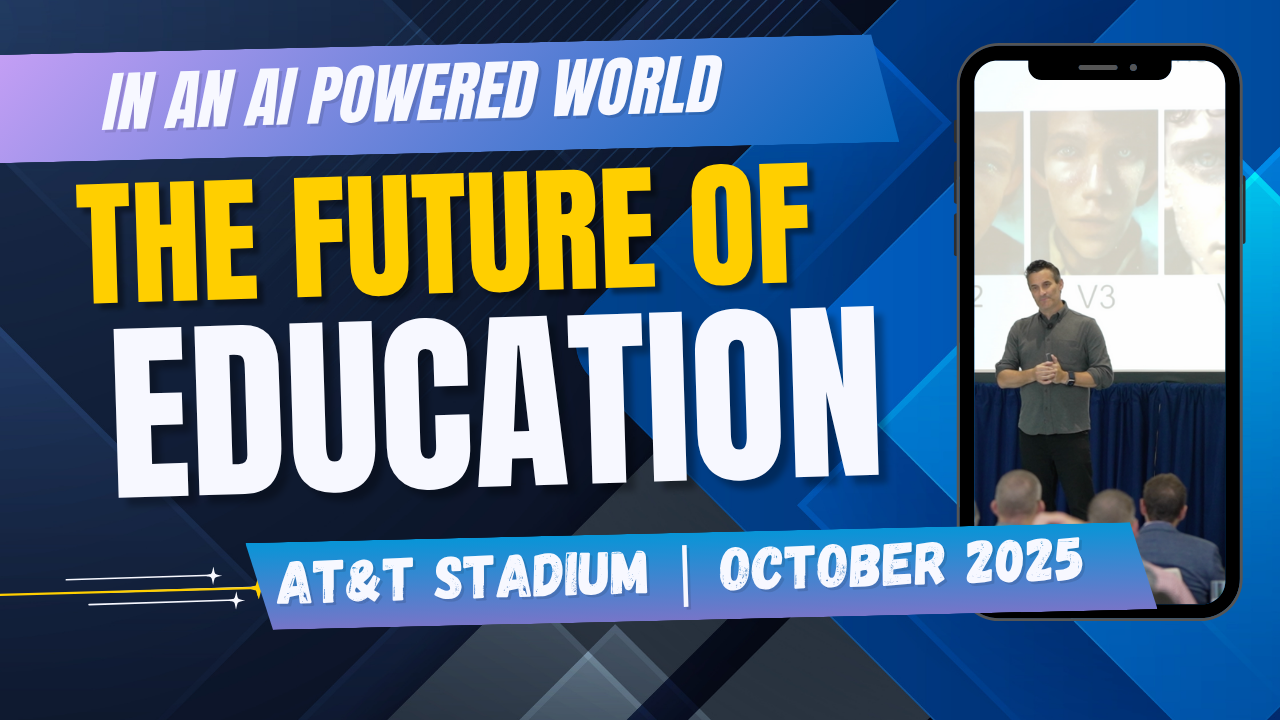
Standing on the stage at AT&T Stadium in Dallas this October, I couldn't help but appreciate the irony. As a lifelong Philadelphia Eagles fan, I'd always dreamed of wowing a Dallas crowd—though I never imagined it would be like this. But just as the Cowboys delivered for their fans that weekend, I was there to deliver a message that every educator, parent, and business leader needs to hear: we are living through the most significant technological transformation since the invention of electricity, and Generation Alpha is at the center of it all.
Understanding Generational Technology Shifts: From Internet to iPhone to AI
I've spent my entire career helping the world's largest brands understand the new consumer. I was fortunate to enter the business world in 2000, right as the Millennial generation was coming of age. Millennials were the first generation to grow up with the internet in their households, and that fundamentally changed everything about how they communicated, gathered information, and set expectations for the world around them.
As a Gen Xer, when I tell my kids there was no internet when I grew up, they look at me the same way I looked at my grandfather when he told me he walked to school with no shoes on in the pouring rain. But that's our reality. Twenty-five years ago, the internet didn't exist in homes. We made phone calls on rotary phones with long, twisty cords, hoping our mothers wouldn't pick up while we were talking to our high school crushes. We went to libraries for research. We actually talked on the phone instead of texting. Our brains were hardwired differently than the generations that followed.
Then came Generation Z, defined not just by the internet, but by the iPhone and social media. For anyone with a Gen Z child, you know the iPhone is practically an appendage to their body. The power of the internet moved into the palm of their hands, fundamentally changing how they shop, communicate, and access information instantaneously. Today, over two-thirds of all e-commerce is actually mobile commerce. Tools like Uber emerged, where you hit a button and a car just appears—all thanks to the power of the iPhone.
Enter Generation Alpha: The AI-Native Generation
Now we have a new generation entering society: Generation Alpha, currently aged 0 to 14 years old. And here's what makes them fundamentally different from every generation that came before: Gen Alpha will never know a world without AI.
They will never know a world where you cannot talk to technology the same way you talk to another human. It's going to seem foreign, even creepy, to have your twelve-year-old developing a close, if not intimate, relationship with an AI chatbot. But for Gen Alpha, they're going to know no other way. They will turn to AI for information, for advice, and in some instances, for emotional support—sometimes more than they will turn to humans.
The Resistance to AI: History Repeating Itself
I hear it at conferences everywhere, all around the world: "This is so bad. AI is so bad for us." But we need perspective here. We were told that rock and roll was bad. We were told that electricity was bad. When humans invented handwriting, Socrates famously said that handwriting was bad for humanity because it would prevent humans from remembering anything.
New technology has always been demonized. And yes, some negative predictions about technology have come true. The internet has created wars and terrible things, but it's also created love, arguably peace, and great prosperity. Social media has done the same. Every technology carries both promise and peril.
But here's the reality: we are not going backwards. AI is here. Whether you believe it takes away the artistry of what it means to be human, whether you think it's terrible for your kids—not one company five years from now is going to be using AI less than they are today. Not one shareholder of a major organization is pushing the company they've invested in to use AI less.
The Education Dilemma: Integration vs. Elimination
When I hear about schools taking AI out of their curricula, I understand the concern. You don't want kids having ChatGPT write their term papers. In fact, my own son did exactly that right when ChatGPT first came out. I was conflicted—here I am getting paid to travel the world talking about AI, and he gets in trouble for using it on a school assignment. (For context, this happened right before the Eagles were heading to the Super Bowl, and I thought it was okay to still take him. His mother? Not so much. We didn't go. Point taken: don't mess with her.)
I completely understand that we want to bring AI into educational curricula without allowing it to completely take away people's ability to think, reason, and do meaningful work. That's going to be the ultimate balancing act for parents and educators moving forward.
But here's what I firmly believe: shutting AI off will do nothing for tomorrow's future leaders besides disable them. We are in an increasingly globalized society, and right now, we're in an AI arms race. Preventing students from learning to work with AI isn't protecting them—it's handicapping them for a future that's already here.
The Great Wealth Transfer: $30 Trillion and Changing Attitudes Toward Money
Gen Alpha and their Gen Z predecessors will be the beneficiaries of the greatest wealth transfer in history. Over $30 trillion will be passed on from Baby Boomers to younger generations in the years ahead.
When my father passed away a couple of years ago, I was put in charge of his estate. Sorting through everything—both emotionally and financially—I was shocked by how much money he'd accumulated versus the way he lived. This was someone who would circle around for an hour to avoid paying seven dollars for a parking space. After understanding his finances, I realized why: my dad was a Baby Boomer, and his relationship with money was one of scarcity. He grew up in the shadows of the Great Depression and World War II. You just don't throw money around when you've experienced that.
Now contrast that with Gen Z's relationship with money during the pandemic stimulus payments. Was their relationship with capital one of scarcity? Hardly. GameStop, "GameStonks," NFTs, cryptocurrency—these young consumers have a fundamentally different relationship with money, risk, and opportunity.
This generational shift in both wealth and attitude will reshape everything from consumer behavior to educational priorities to how we think about work and value creation.
AI's True Power: Beyond What Most People Realize
As someone who spends 99% of my waking hours thinking about and building with AI, I can tell you this technology is far more powerful than most people in any room realize. While the future is already here, it's not evenly distributed. But where it is distributed, people are realizing we are never going to be living in the same world again.
Let me give you concrete examples of what AI can do right now:
Digital Twins and Voice Cloning: I've cloned my voice. I've started creating digital versions of myself for podcast production, readouts, and presentations. It's not hard to do anymore. People are already creating personas of themselves for social media—building digital twins because they want the attention and reach of social media but aren't comfortable on camera. Companies are rolling out tutorials using digital twins. It's starting to happen in education, and we're going to see exponentially more of it. The best use case? Hyper-personalization, where you can have thousands of different videos talking to people based on their individual learning needs.
The Transformation of Coding: For years, if you studied engineering at MIT or Stanford and learned to code, you had a tried-and-true path to a great career. But now there are tools like Cursor and Lovable that allow you to output complete software products with simple prompts. On a plane to a speaking engagement at Nationwide Insurance, I built a competitive price testing tool that would have cost them millions of dollars to develop just a couple of years ago. I built it in an evening.
You need some level of technological knowledge today to do this, but not for long. Which is exactly why software development job postings in the United States have plummeted. This is another "how to solve the problem" type job slowly disappearing.
The Knowledge Economy is Fading
The sooner we all realize that the knowledge economy is fading away, the better positioned we'll be. What matters now is our ability to be creative, to think critically, to analyze complex situations, and to solve novel problems. These are the skills that will differentiate humans in an AI-augmented world.
The Three Stages of AI Adoption
Right now, there's an adoption curve happening in AI, and understanding where you fall on this curve is critical:
Stage 1: AI as a Tool (90% of users) - Most people use AI like a call-and-response tool, almost like they'd use Google. "Give me a recipe." "Write a blog post." "Tell me the best places to visit in Utah." This is using AI as a basic tool for information retrieval.
Stage 2: AI as Automation (9% of users) - Some people are using AI to automate repetitive tasks. For example, I've created a system that takes email addresses from event attendees, figures out who they are, writes personalized emails, pulls the relevant information, and sends everything out automatically. I don't have to do a thing. This is the first place AI will replace jobs—people who go into work every day with a deterministic role, doing the same thing repeatedly, waiting for their boss to tell them what to do.
Stage 3: AI Agents (1% of users) - This is where we're heading, and it's revolutionary. Instead of following steps one, two, three, AI agents have autonomy. They can make decisions. For example, instead of just sending a generic email, an agent might say, "Oh, Matt knows this person. Instead of sending a generic response, I should invite them to lunch the next time Matt's in Dallas in mid-November." These agents will have access to various tools and will operate in both our personal and professional lives—booking appointments, writing curricula, managing communications, and much more.
I might sound crazy standing on stage talking about this, but I'm telling you: I didn't know anything about code a couple of years ago. I've never been an engineer in my life, and yet I've spent most of my waking hours building AI systems. It's hard to sleep when you can actually see the future, and I'm living in it right now. I'm building AI solutions for the world's largest companies. You're going to see agents everywhere. It won't hit everywhere right away, but the world's smartest companies are already figuring out how to adopt this technology.
Four Pillars for Thriving in an AI-Driven World
So what does this mean for everyone? What should students, educators, parents, and professionals be doing? Here are the four main pillars I believe are essential:
1. Learn to Be a Problem Solver - Many people don't know how to use AI effectively because there are so many tools available. It's overwhelming—like turning on Netflix with a million options and feeling like there's nothing to watch. It's a paradox of choice. You have to figure out what problem you want to solve, either personally or professionally. Frame the problem around what can save you the most time or where you can be most productive. That's the promise of AI: allowing us to uplevel how we spend our time by having AI handle tasks we don't need to do anymore, whether that's data entry or extensive research.
2. Practice Perseverance - If you want to become adept at AI, you'll need perseverance. It takes time. If you hear it takes ten or fifteen steps to build your own AI assistant, you can't quit at step six. And here's the beautiful part: with AI, you can say, "Explain this to me like I'm six years old." Sometimes I even ask, "Explain it to me like I'm four years old." Eventually, you'll understand the next step and how to execute it.
3. Understand the Power of Data - Data literacy is becoming as fundamental as reading and writing. Understanding how data works, how it's collected, how it's used, and how to interpret it will be a critical skill for every professional and informed citizen.
4. Be Action-Oriented - Take action, either personally or professionally, to actually understand this technology. It's like we all woke up and suddenly had electricity. I was at Disney with my family recently, and there's a ride called the Carousel of Progress that shows how there was a point where there was no electricity, and then suddenly there was, and it changed everything. That's where we are right now with AI. We have a technology that is just as powerful and will be just as impactful as electricity, the internet, or the Industrial Revolution. It's very new and very powerful, and the sooner we understand it, the sooner it can improve our lives—despite legitimate concerns.
The Path Forward
Standing in AT&T Stadium that October day, looking out at educators, administrators, and thought leaders, I realized we're at an inflection point. The decisions we make now about how we integrate AI into education, how we prepare Gen Alpha for an AI-native world, and how we adapt our own skills and mindsets will determine whether we thrive or struggle in the decades ahead.
The future isn't coming—it's already here. Gen Alpha is growing up right now, developing relationships with AI that will seem as natural to them as the internet seems to Millennials or smartphones seem to Gen Z. Our job isn't to resist this change or pretend it isn't happening. Our job is to thoughtfully, carefully, and proactively prepare ourselves and the next generation for a world where artificial intelligence is as ubiquitous and essential as electricity.
The question isn't whether AI will transform education, work, and society. It already is. The question is: will you be on the right side of this transformation?